Freedom251 › Container Networking Software
Multus CNI
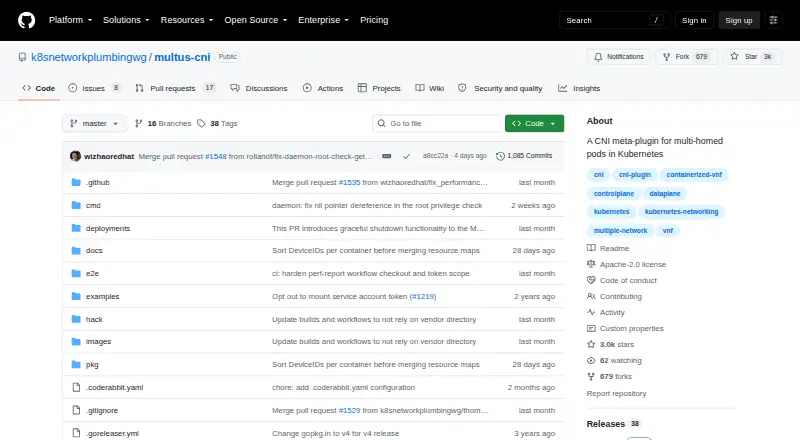
What Multus CNI is
Multus CNI is a Kubernetes CNI meta-plugin that gives pods additional network interfaces by calling other CNI plugins. NetworkAttachmentDefinition custom resources describe the extra interfaces, and the project cites VLAN, VXLAN, and PTP as examples of networks available through other plugins. It requires Kubernetes and an already installed default CNI network before deployment. The project documents thick and thin deployments and recommends thick for most environments, although thick uses more resources; it also supports metrics unavailable with thin deployment. Installation options include a Kubernetes DaemonSet, release binaries, GitHub Container Registry images, or building from source. Multus passes device IDs assigned by kubelet to delegated plugins but does not allocate devices. The maintainers support Kubernetes versions that the Kubernetes community still maintains. The project builds for multiple architectures, but testing and validation are performed against x86; support for other architectures relies on best-effort community contributions. The quickstart notes that installation creates a node directory containing authentication information for Multus to access the Kubernetes API. Multus is open source under Apache-2.0 and is intended for Kubernetes on Linux nodes, including self-hosted clusters.
Who it suits
Multus CNI suits teams running Kubernetes on Linux that need pods to use multiple networks through other CNI plugins. It assumes a cluster and default CNI network are already in place.
What it does well
- Adds interfaces through other CNI plugins
- NetworkAttachmentDefinition resources describe extra interfaces
- Offers DaemonSet, binary, image, and source installation
- Open source under Apache-2.0
What to know first
- Requires Kubernetes and a default CNI network
- Thick deployment consumes more resources than thin
- Testing and validation are performed against x86
- Does not allocate devices itself
Limits
Thick deployment consumes more resources than thin deployment, while thin deployment lacks the metrics supported by thick deployment.
Getting started
- Prepare Kubernetes with an installed default CNI network.
- Choose a documented deployment: DaemonSet, release binary, GitHub Container Registry image, or source build.
- Select thick or thin deployment; the project recommends thick for most environments.
- Configure additional pod interfaces with NetworkAttachmentDefinition custom resources.
Verdict
Multus provides an additional networking layer for Kubernetes pods by delegating configuration to other CNI plugins. The existing cluster and default-network prerequisite, plus thick deployment's higher resource use, matter when choosing how to deploy it.
Questions
What does Multus CNI do?
It calls other CNI plugins to attach additional network interfaces to Kubernetes pods.
What does it cost?
Multus CNI is free and open source under the Apache-2.0 license.
What does installation require?
It requires Kubernetes and an already configured default CNI network. It is intended for Kubernetes on Linux nodes, including self-hosted clusters.
Which deployment should I choose?
The project recommends thick deployment for most environments. It uses more resources than thin deployment and supports metrics that thin deployment lacks.
Does Multus allocate devices?
No. It passes device IDs assigned by kubelet to delegated CNI plugins.
Where can users ask questions?
The project directs users to GitHub issues or the #general channel in Network Plumbing Working Group Slack.
Facts from Multus CNI's own pages
- Architecture support
- The project says it builds for multiple architectures, but testing and validation are performed against x86; other architectures are supported through best-effort community contributions. · github.com, 8 Oct 2026
- CNI integrations
- Multus can invoke other CNI plugins, with the project describing examples including VLAN, VXLAN, and PTP networks. · github.com, 8 Oct 2026
- Compatibility
- The quickstart says Multus supports Kubernetes versions supported by the Kubernetes community. · github.com, 8 Oct 2026
- Deployment options
- The project documents thick and thin plugin deployments, and recommends thick plugin for most environments while noting that it consumes more resources. · github.com, 8 Oct 2026
- Device resources
- Multus passes device IDs assigned by kubelet to delegate CNI plugins and does not allocate devices itself. · github.com, 8 Oct 2026
- Distribution
- The project offers installation by Kubernetes DaemonSet, downloadable release binaries, GitHub Container Registry images, or building from source. · github.com, 8 Oct 2026
- Existing network required
- The quickstart requires Kubernetes and an installed default CNI network before Multus is deployed. · github.com, 8 Oct 2026
- How it works
- Multus calls other CNI plugins to provide additional network interfaces to multi-homed pods. · github.com, 8 Oct 2026
- Integrations
- The project gives VLAN, VXLAN and PTP as examples of networks reached through other CNI plugins. · github.com, 8 Oct 2026
- Kubernetes support
- The maintainers say they support Kubernetes versions that the Kubernetes community maintains. · github.com, 8 Oct 2026
- License
- The repository lists the Apache-2.0 license. · github.com, 8 Oct 2026
- Metrics
- The README says the thick deployment supports metrics that were unavailable with the thin deployment. · github.com, 8 Oct 2026
- Network configuration
- It uses NetworkAttachmentDefinition custom resources to specify configurations for additional pod interfaces. · github.com, 8 Oct 2026
- Prerequisite
- Installation requires Kubernetes and an already configured default CNI network for pod-to-pod connectivity. · github.com, 8 Oct 2026
- Purpose
- Multus CNI is a Kubernetes CNI meta-plugin that attaches multiple network interfaces to pods by calling other CNI plugins. · github.com, 8 Oct 2026
- Resource trade-off
- The README recommends the thick plugin for most environments and says it consumes more resources than the thin plugin. · github.com, 8 Oct 2026
- Security detail
- The quickstart says installation creates a node directory containing authentication information for Multus to access the Kubernetes API. · github.com, 8 Oct 2026
- Support
- The project directs users to open a GitHub issue or ask questions in the Network Plumbing Working Group Slack #general channel. · github.com, 8 Oct 2026
- Support channels
- The project directs questions to GitHub issues or the #general channel in NPWG Slack. · github.com, 8 Oct 2026
Where Multus CNI stands on Freedom251
- Container Networking Software#15 of 28