Freedom251 › Text-to-speech tools
MOSS-TTS
What MOSS-TTS is
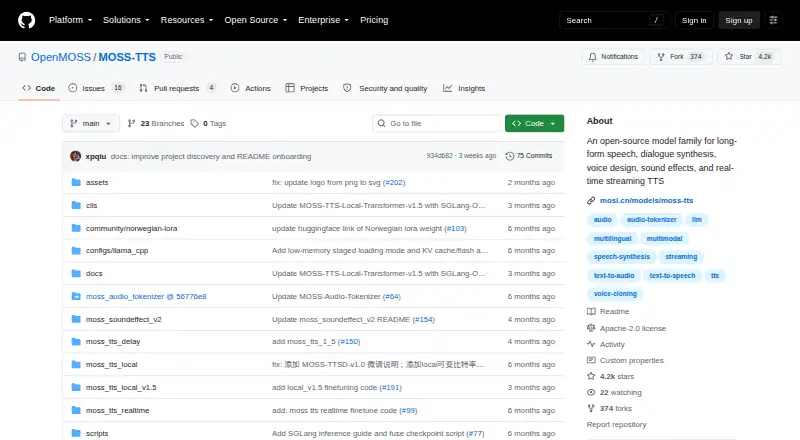
MOSS-TTS is an open-source model family for generating speech and sound, including long-form narration, dialogue, voice design, sound effects, and real-time text-to-speech. Its models cover voice cloning, multi-speaker dialogue, text-prompt voice design, real-time voice agents, and sound-effect generation. MOSS-TTS-v1.5 and MOSS-TTS-Local-Transformer-v1.5 support 31 languages. Version 1.5 includes zero-shot voice cloning, multilingual synthesis, code-switching, duration controls, Pinyin and IPA pronunciation controls, and inline pause markers. The Local-Transformer release supports native 48 kHz stereo input and output, with streaming decode examples. Deployment options include local Python inference, browser demos, a CPU-only llama.cpp configuration, and serving through SGLang-Omni or vLLM-Omni. Model sizes range from about 100 million to 8 billion parameters. The project is Apache-2.0 licensed, permits commercial use, and lists WAV as an export format. Guidance includes quickstarts, model weights, samples, fine-tuning tutorials, serving backends, and model cards.
Who it suits
MOSS-TTS may suit developers and researchers working on narration, voice cloning, dialogue, dubbing, podcasts, voice agents, or sound effects. Its documented local and server deployment options cater to varied technical setups.
What it does well
- Apache-2.0 license permits commercial use
- Two listed models support 31 languages
- Includes zero-shot voice cloning controls
- CPU-only llama.cpp configuration is documented
- WAV export format
What to know first
- Released models range up to 8 billion parameters
- Recommended quickstart uses CUDA 12.8 PyTorch
- Submitted content may be processed for generation and service improvement
Verdict
MOSS-TTS offers a broad set of speech and sound generation models with fine-grained pronunciation and timing controls. Consider the model sizes, deployment path, and stated content-processing policy before selecting it for a project.
Facts from MOSS-TTS's own pages
- API
- MOSI's developer console shows a POST /v1/audio/speech endpoint and an example using the moss-tts-1.5-flash model. · platform.mosi.cn, 13 Oct 2026
- API access
- Yes · github.com, 20 Sept 2026
- Audience
- The maker describes MOSS-TTS as a production-oriented flagship model for long-form and multilingual content, including narration, dubbing, and audiobooks. · mosi.cn, 13 Oct 2026
- Audio output
- The Local-Transformer v1.5 release supports native 48 kHz stereo input and output and includes real-time streaming decode examples. · github.com, 12 Oct 2026
- Commercial use
- Yes · github.com, 20 Sept 2026
- Company
- MOSI says Shanghai Mosi Intelligent Technology Co., Ltd. is headquartered in Shanghai and was incubated by the Shanghai Innovation Institute and Fudan University's OpenMOSS team. · mosi.cn, 13 Oct 2026
- Deployment
- The repository documents local inference and serving backends including llama.cpp, SGLang-Omni, and vLLM-Omni. · github.com, 13 Oct 2026
- Export formats
- WAV · github.com, 20 Sept 2026
- Hardware
- The quickstart recommends Python 3.12 and a CUDA 12.8 PyTorch install, while the documented llama.cpp path also provides a CPU-only configuration. · github.com, 12 Oct 2026
- Integrations
- The repository lists MOSS-TTS API skills for OpenClaw, including a Feishu voice-message skill. · github.com, 13 Oct 2026
- Intended users
- The project describes deployment and research use, and lists narration, voice cloning, dialogue, podcasts, dubbing, voice agents, and media sound effects as target tasks. · github.com, 12 Oct 2026
- Languages
- MOSS-TTS v1.5 supports 31 languages and multilingual or code-switched synthesis. · mosi.cn, 13 Oct 2026
- License
- The MOSS-TTS model page lists the open-source license as Apache 2.0. · mosi.cn, 13 Oct 2026
- Model family
- The family includes models for long-form narration, multi-speaker dialogue, voice design, sound effects, and real-time speech generation. · github.com, 13 Oct 2026
- Models
- The family includes models for voice cloning, multi-speaker dialogue, text-prompt voice design, real-time voice agents, and sound-effect generation. · github.com, 12 Oct 2026
- Platforms
- api,self_hosted · github.com, 20 Sept 2026
- Privacy limits
- The privacy policy says sound-feature analysis may be used to support audio features and is not used to identify a specific natural person. · mosi.cn, 13 Oct 2026
- Product
- MOSS-TTS is an open-source model family for long-form speech, dialogue synthesis, voice design, sound effects, and real-time streaming TTS. · github.com, 13 Oct 2026
- Resource needs
- The released models range from about 100 million parameters for MOSS-TTS-Nano to 8 billion parameters for several flagship models. · github.com, 12 Oct 2026
- Security and privacy
- MOSI's privacy policy says submitted content may be processed for generation, history, troubleshooting, safety review, and service improvement; it also describes possible use of de-identified or anonymized data for model optimization. · mosi.cn, 13 Oct 2026
- Speech controls
- The model supports fine-grained pronunciation, duration, and pause controls. · mosi.cn, 13 Oct 2026
- Support
- The maker lists [email protected] as a contact address for inquiries and feedback. · mosi.cn, 13 Oct 2026
- Voice cloning
- MOSS-TTS v1.5 supports zero-shot voice cloning and audio continuation. · mosi.cn, 13 Oct 2026
- Voice controls
- MOSS-TTS-v1.5 supports zero-shot voice cloning, token-level duration control, Pinyin and IPA pronunciation control, multilingual synthesis, code-switching, and inline pause markers. · github.com, 12 Oct 2026
Where MOSS-TTS stands on Freedom251
- Text-to-speech tools#77 of 232
- Text-to-Speech Software#85 of 223