Freedom251 › Minecraft anti-cheat plugins
Moa
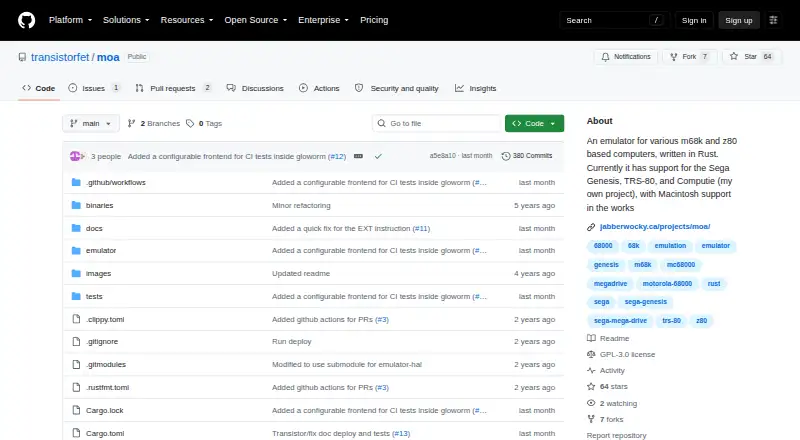
What Moa is
Moa is a free Linux emulator and simulator for computers built around 68000 and Z80 CPUs and their peripherals. The Rust project is public on GitHub and uses the GPL-3.0 license. It can simulate the Sega Genesis, Computie 68000, and TRS-80 Model I. Genesis emulation draws screen layers and supports pixel priority plus shadow and highlight modes, but currently handles NTSC and VDP mode 5, with audio not implemented. Some games fail to display or accept controller input, while games needing extra cartridge memory or NVRAM usually crash. Computie can run its monitor, load the operating-system kernel, and boot from CompactFlash. TRS-80 emulation runs Level I or Level II BASIC with keyboard input through a windowed frontend; cassette and floppy drives are unsupported. Macintosh 512k support is partial and its ROM does not boot. A debugger provides instruction stepping, register views, breakpoints, and memory inspection or editing. GitHub lists no downloadable releases.
Who it suits
Moa suits Linux users exploring retro computer emulation, simulator development, or low-level debugging. It is also relevant to users interested in Genesis, Computie, or TRS-80 systems despite the stated limitations.
What it does well
- Simulates 68000 and Z80 systems
- Includes a built-in debugger
- Runs Computie OS from CompactFlash
- Runs Level I and II BASIC
- GPL-3.0 licensed source
What to know first
- Genesis audio is not implemented
- Some Genesis games fail or crash
- TRS-80 cassette and floppy drives unsupported
- No downloadable releases listed
Verdict
Moa provides several focused retro-system simulations and useful debugging controls in a free Rust project. Compatibility remains incomplete, particularly for Genesis software and unsupported TRS-80 storage devices.
Facts from Moa's own pages
- Audio option
- A command-line option disables audio device creation, while simulated audio devices continue to run in the simulation. · jabberwocky.ca, 9 Oct 2026
- Availability
- The GitHub releases page states that there are no releases to download. · github.com, 9 Oct 2026
- Computie
- The Computie simulation can run the 68k-SMT board monitor, load the Computie OS kernel, and boot it from CompactFlash. · jabberwocky.ca, 9 Oct 2026
- Computie features
- The Computie emulator can run the monitor program and boot the Computie OS kernel from a CompactFlash card. · jabberwocky.ca, 8 Oct 2026
- Debugger
- The built-in debugger can step through ROM instructions, display CPU registers, set breakpoints, inspect memory, and modify memory locations. · jabberwocky.ca, 9 Oct 2026
- Founded
- 2021 · github.com, 28 Sept 2026
- Frontend controls
- The minifb frontend supports window scaling options of 1, 2, or 4 and a speed option that changes the gameplay clock. · jabberwocky.ca, 8 Oct 2026
- Genesis compatibility
- Some Genesis games fail to display or respond to controller input, and games requiring extra cartridge memory or NVRAM usually crash. · jabberwocky.ca, 8 Oct 2026
- Genesis features
- The Genesis emulator draws screen layers and supports pixel priority and shadow and highlight color modes. · jabberwocky.ca, 9 Oct 2026
- Genesis limits
- Genesis emulation currently supports NTSC mode and VDP mode 5, has no audio implementation, and some games have display or controller issues. · jabberwocky.ca, 9 Oct 2026
- Host integration
- The Computie frontend opens PTYs for serial and SLIP, launches pyserial-miniterm and slattach, and configures host routing; its commands may need adjustment for different hosts. · jabberwocky.ca, 9 Oct 2026
- Implementation
- Moa is written in Rust and its repository uses submodules, which the project instructs users to clone recursively. · github.com, 9 Oct 2026
- Language
- Moa is written in Rust. · github.com, 8 Oct 2026
- License
- The repository identifies its license as GPL-3.0. · github.com, 9 Oct 2026
- Macintosh status
- Macintosh 512k support is partially implemented, but its ROM does not boot. · github.com, 8 Oct 2026
- Maker
- The maker’s site identifies Moa as a personal project and lists the contact address [email protected]; it does not state an HQ or founding date. · jabberwocky.ca, 8 Oct 2026
- Project start
- The project page says Moa started September 26, 2021. · github.com, 9 Oct 2026
- Purpose
- Moa is an emulator and simulator for computers using various 68000 and Z80 CPUs and peripherals. · github.com, 9 Oct 2026
- Source and license
- The project source is public on GitHub and the repository identifies its license as GPL-3.0. · github.com, 8 Oct 2026
- Speed controls
- The frontend supports window scaling and a speed option that changes the gameplay clock relative to the frontend update loop. · jabberwocky.ca, 9 Oct 2026
- Supported systems
- It can simulate the Sega Genesis, Computie, and TRS-80 Model I; Macintosh 512k support is partially implemented, but its ROM does not boot. · github.com, 9 Oct 2026
- TRS-80
- The TRS-80 emulator runs Level I or Level II BASIC, but does not yet support cassette or floppy drives. · jabberwocky.ca, 9 Oct 2026
- TRS-80 features
- The TRS-80 emulator can run Level I or Level II BASIC and accepts keyboard input through a windowed frontend. · jabberwocky.ca, 8 Oct 2026
- TRS-80 limits
- Cassette tape and floppy drives are not supported for the TRS-80. · jabberwocky.ca, 8 Oct 2026
Where Moa stands on Freedom251
- Minecraft anti-cheat plugins#24 of 53
- Minecraft Anti-Cheat Plugins#27 of 57
- Sega Genesis Emulators#27 of 29