Freedom251 › File Analysis Software
MIND Data Discovery
What MIND Data Discovery is
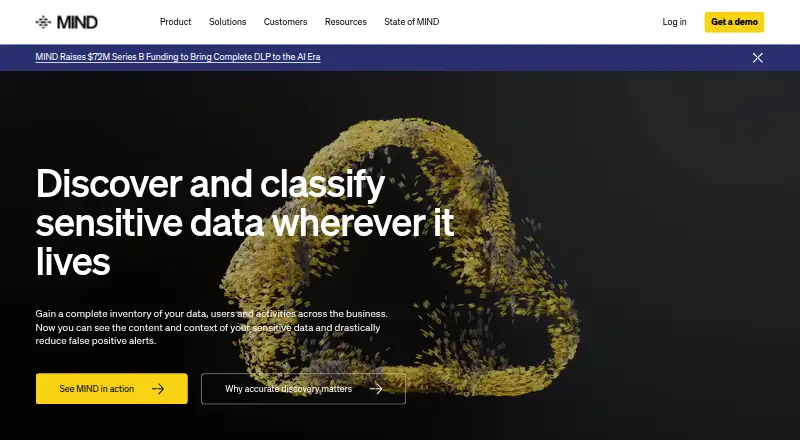
MIND Data Discovery finds and classifies sensitive data across an organization, creating an inventory of data, users and activity. It covers SaaS applications, GenAI applications, endpoints, on-premise file shares and email systems. Its living data catalog brings together resources, users, authorization, file activity and metadata, helping organizations understand where sensitive information is stored and its business significance. MIND AI applies hundreds of tailored algorithms to categorize file types and identify sensitive elements within files. The product handles file types from images to archives, then applies tags and user-based labels automatically. It is cloud-native and connects to existing systems; MIND says connections can be made in minutes. Listed integrations include Google Drive, OneDrive, Box, Microsoft Teams, Slack, GitHub, Salesforce, SharePoint, Dropbox, Jira and Notion. Endpoint coverage includes Windows, Mac, Linux and ChromeOS. MIND presents the product as a way for organizations to protect sensitive data, mitigate risk and preserve brand reputation in the AI era. Its Trust Center lists compliance with CCPA, GDPR, HIPAA, ISO/IEC 27001:2022, ISO/IEC 42001:2023 and SOC 2 Type 2, and provides security materials including a SOC 2 Type 2 report, data flow diagram, data processing agreement and pentest report. Prospective customers can request a live demo or contact MIND.
Who it suits
MIND Data Discovery suits organizations that need an inventory of sensitive information across cloud apps, endpoints, file shares and email. It is aimed at teams seeking data context to support policies, compliance and risk response, including organizations handling GenAI applications.
What it does well
- Discovers data across SaaS, GenAI apps, endpoints, file shares and email.
- Catalogs resources, users, authorization, file activity and metadata.
- Uses tailored algorithms to classify file types and sensitive elements.
- Lists integrations with Google Drive, Slack, Salesforce, Jira and others.
- Trust Center provides security documentation and compliance information.
What to know first
- Pricing is available on request.
- Product information is provided through a live demo or sales contact.
Plans
| Plan | Billed and limits | Price |
|---|---|---|
| Contact sales | Get a live demo or contact MIND for product information | On request |
As mind.io lists them, read 9 Oct 2026. The maker's own page has the final word.
Getting started
- Visit the MIND Data Discovery product page.
- Request a live demo or contact MIND for product information.
- Connect the systems and data sources you want to cover.
- Use the catalog to review resources, users, authorization, file activity and metadata.
MIND Data Discovery finds and classifies sensitive information across cloud apps, endpoints, file shares and email, then puts it in a catalog with user and activity context. It is best suited to organizations that need a broad view of unstructured data and its business significance, rather than a standalone file-labeling tool.
Overview
The product combines discovery, classification and cataloging: it identifies where sensitive information resides, what kind of data it is, and how users and systems interact with it. That context can help teams shape policies, address compliance needs and respond to risk. Its reach across SaaS, GenAI applications, endpoints, on-premise file shares and email systems is a strength for organizations whose data is spread across different environments.
MIND describes the service as cloud-native and says it connects to existing systems in minutes. That deployment approach avoids requiring an on-premises product deployment, but organizations should confirm how the cloud connection fits their architecture and security requirements. The company offers a live demo and direct contact for product information.
Key features
Discovery and classification
MIND AI applies hundreds of tailored algorithms to categorize file types and identify sensitive elements within files. It handles formats from images to archives, and automatically applies tags and user-based labels. This breadth is useful where sensitive information appears in varied file formats; the hybrid classification approach gives organizations a mix of automated categorization and human oversight rather than relying on automation alone.
Catalog and business context
The living data catalog brings together resources, users, authorization, file activity and metadata. Instead of simply flagging a sensitive file, MIND aims to show where it sits and how it relates to organizational activity. That added context can support policy decisions and incident response, though organizations looking only for a narrowly scoped discovery tool may not need the full inventory.
Integrations and trust
Named integrations include Google Drive, OneDrive, Box, Microsoft Teams, Slack, GitHub, Salesforce, SharePoint, Dropbox, Jira and Notion. MIND also lists Windows, Mac, Linux and ChromeOS endpoints. The Trust Center lists CCPA, GDPR, HIPAA, ISO/IEC 27001:2022, ISO/IEC 42001:2023 and SOC 2 Type 2 under compliance, and provides security documentation including a SOC 2 Type 2 report, data flow diagram, data processing agreement and pentest report. Teams with formal vendor reviews can use those materials to assess fit; the certifications and documents do not by themselves establish that a particular deployment meets a customer's requirements.
Pricing
MIND Data Discovery is paid, with custom pricing. The Contact sales plan directs prospective customers to request a live demo or contact MIND for product information. There is no published plan breakdown to compare by seat, data volume or feature tier, so organizations should ask about scope and commercial terms before budgeting. This sales-led approach may suit larger deployments needing a tailored scope, but gives smaller teams no self-serve price point to evaluate.
Platforms
MIND lists Linux, macOS, web and Windows platforms, with cloud deployment. Its endpoint coverage also includes ChromeOS. The mix is relevant to organizations with varied desktop environments, while buyers seeking a self-hosted deployment should look elsewhere.
Who it's for
MIND is a strong fit for organizations that need to locate and classify sensitive data across multiple systems and connect those findings to users, permissions and activity. Compliance, security and data-governance teams can benefit from the catalog and business context, especially where unstructured information spans cloud services and on-premises infrastructure. It is less compelling for buyers who need a transparent, fixed-price plan, a self-hosted product, or only a single-purpose consent-management tool.
Pros and cons
- Pros: Broad coverage across SaaS, GenAI applications, endpoints, file shares and email supports a consolidated view of dispersed data.
- Pros: The catalog links data resources with users, authorization and file activity, making findings more actionable than file-type labels alone.
- Pros: A wide file-type range and automated tags and user-based labels reduce the need to classify every item manually.
- Cons: Custom pricing requires a sales conversation, making early cost comparisons harder.
- Cons: Cloud deployment rules it out for organizations that require a self-hosted installation.
- Cons: The product's broad discovery and catalog focus may exceed the needs of teams seeking a narrowly scoped classification tool.
Alternatives
Thales CipherTrust Data Security Platform is worth considering if a free forever community edition, a free trial, or API and self-hosted platform options matter more than MIND's cloud deployment and catalog context.
Ketch Consent Management is the more relevant choice for a web-focused consent-management need; its free plan covers up to 5,000 unique users per month and two integrations.
Ground Labs Enterprise Recon may suit buyers looking for self-hosted deployment across Linux, macOS and Windows, with a PCI-focused plan that includes remediation and basic reporting.
GEODI DSPM is an alternative for teams prioritizing on-premises deployment and a yearly or three-year subscription sized by features, data and user count.
Strac Data Classification may suit organizations that want a scope-based quote tied to surfaces, integrations, data volume and in-scope employees.
Transcend Data Discovery and Classification is another paid data discovery and classification option, with web, mobile, API and self-hosted platforms.
ActiveNav Discovery Center is another paid option for buyers comparing discovery products.
Lepide Data Classification is worth comparing for teams that want a free trial or self-hosted and Windows options; its Advanced plan is file-server focused and includes permissions and inactive-user remediation.
Browse the Data Discovery and Classification Software category to compare more options.
Verdict
Choose MIND Data Discovery if your organization needs a cross-environment inventory of sensitive information with context about users, permissions and activity. Its combination of varied data-source coverage, automated classification and catalog detail is the central reason to consider it. Look elsewhere if self-hosting or a published price is essential, since MIND is cloud-deployed and custom-priced.
Verdict
Consider MIND Data Discovery if you need to locate and classify sensitive information across varied organizational systems, with catalog context about users and activity. Its cloud deployment and listed integrations cover many data environments. Contact MIND for product information and pricing.
Questions
How much does MIND Data Discovery cost?
It is a paid product with pricing available on request.
How can I learn about the product?
MIND invites prospective customers to request a live demo or contact the company.
Where does MIND Data Discovery run?
Deployment is cloud, and listed platforms are Linux, macOS, web and Windows.
What kinds of data sources does it cover?
It covers SaaS and GenAI applications, endpoints, on-premise file shares and email systems.
Which integrations are listed?
They include Google Drive, OneDrive, Box, Microsoft Teams, Slack, GitHub, Salesforce, SharePoint, Dropbox, Jira and Notion.
What security and compliance information is available?
MIND’s Trust Center lists CCPA, GDPR, HIPAA, ISO/IEC 27001:2022, ISO/IEC 42001:2023 and SOC 2 Type 2. It also features a SOC 2 Type 2 report, data flow diagram, data processing agreement and pentest report.
Facts from MIND Data Discovery's own pages
- AI classification
- MIND AI uses hundreds of tailored algorithms to categorize file types and identify sensitive elements inside files. · mind.io, 9 Oct 2026
- Business context
- MIND provides context about where sensitive data lives and its business significance to support policies, compliance and response. · mind.io, 9 Oct 2026
- Catalog
- MIND’s living data catalog includes resources, users, authorization, file activities and metadata. · mind.io, 9 Oct 2026
- Cloud deployment
- MIND describes itself as cloud-native and says it connects to existing systems in minutes. · mind.io, 9 Oct 2026
- Data sources
- The product covers SaaS apps, on-premise file shares, endpoints and email systems. · mind.io, 9 Oct 2026
- Endpoint platforms
- MIND lists Windows, Mac, Linux and ChromeOS endpoints. · mind.io, 9 Oct 2026
- File types
- MIND supports file types ranging from images to archives and automatically applies tags and user-based labels. · mind.io, 9 Oct 2026
- Headquarters
- Seattle, Washington, United States · mind.io, 28 Sept 2026
- Integrations
- MIND lists integrations including Google Drive, OneDrive, Box, Microsoft Teams, Slack, GitHub, Salesforce, SharePoint, Dropbox, Jira and Notion. · mind.io, 9 Oct 2026
- Purpose
- MIND discovers and classifies sensitive data across an organization to provide an inventory of data, users and activities. · mind.io, 9 Oct 2026
- Security and compliance
- MIND’s Trust Center lists CCPA, GDPR, HIPAA, ISO/IEC 27001:2022, ISO/IEC 42001:2023 and SOC 2 Type 2 under compliance. · trust.mind.io, 9 Oct 2026
- Security documentation
- The Trust Center offers access to security documentation and lists a SOC 2 Type 2 report, data flow diagram, data processing agreement and pentest report as featured documents. · trust.mind.io, 9 Oct 2026
- Support and sales
- MIND invites prospective customers to request a live demo or contact the company. · mind.io, 9 Oct 2026
- Target users
- MIND says it helps organizations protect sensitive data, mitigate risks and preserve brand reputation in the AI era. · mind.io, 9 Oct 2026
Where MIND Data Discovery stands on Freedom251
- File Analysis Software#8 of 23
- Data Discovery and Classification Software#12 of 29