Freedom251 › Blogging Platforms

Meridian
What Meridian is
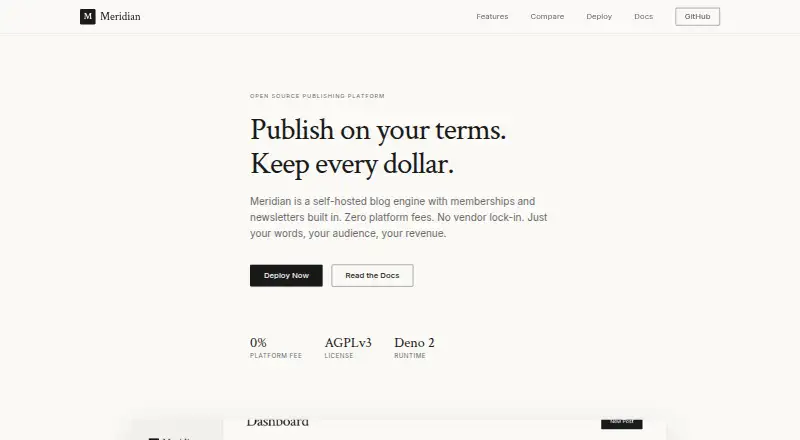
Meridian is an open-source blog engine for publishers who want to run a site with memberships and newsletters. It supports posts and static pages, tags, full-text search, RSS, and a block-based editor that stores content as structured JSON. Publishers can create free, premium, and custom subscription tiers, then set which content each tier can view. Meridian connects those tiers to the publisher’s Stripe account and creates the associated Stripe Products and Prices. Newsletters can be composed in the admin dashboard, with subscriber sign-up through a public form. The product supports multiple email providers and recommends Resend for newsletter delivery. It enforces DKIM, DMARC, and SPF, and includes one-click unsubscribe headers for Gmail and Yahoo compliance. Meridian is available for web, Linux, and self-hosting. It can be deployed with Docker or on Railway, Fly.io, or Render; self-hosting requires PostgreSQL 16, while Redis is optional for caching. It provides a REST API and a GraphQL endpoint, with GraphQL available in development mode. Meridian is licensed under AGPLv3 and says it charges no platform fee. Its Self-Hosted plan is free forever; Managed Cloud is listed at $9 per month and marked “Coming Soon.”
Who it suits
Meridian suits publishers who want to combine blogging, paid memberships, and newsletters, especially those prepared to self-host and manage PostgreSQL. Its tier-based content rules and Stripe connection also suit sites with multiple subscription levels.
What it does well
- Free Self-Hosted plan includes unlimited posts, pages, and members.
- Supports free, premium, and custom membership tiers.
- Connects subscription tiers to the publisher’s Stripe account.
- Newsletter tools include public sign-up and multiple email providers.
- Open source under AGPLv3, with no platform fee.
- Offers REST API and GraphQL endpoint.
What to know first
- Self-hosting requires PostgreSQL 16.
- Managed Cloud is marked “Coming Soon.”
- GraphQL is available only in development mode.
Limits
The free Self-Hosted plan includes unlimited posts, pages, and members, with newsletter sending via Resend and community support. Managed Cloud is listed at $9 per month with managed PostgreSQL and Redis, automatic updates, daily backups, email sending, and priority support, but is marked “Coming Soon.”
Plans
| Plan | Billed and limits | Price |
|---|---|---|
| Self-Hosted | forever · unlimited posts and pages · unlimited members · Resend newsletters · Stripe payments · REST API and GraphQL · community support | Free |
| Managed Cloud | monthly · managed PostgreSQL and Redis · automatic updates · daily backups · custom domain and SSL · email sending · priority support · coming soon | $9 a month |
As meridian.blog lists them, read 15 Oct 2026. The maker's own page has the final word.
Getting started
- Visit https://meridian.blog/.
- Choose the free Self-Hosted plan or review Managed Cloud at $9 per month.
- For self-hosting, deploy with Docker or on Railway, Fly.io, or Render.
- Set up PostgreSQL 16; add Redis if you want caching.
- Connect a supported email provider for newsletter sending; Meridian recommends Resend.
- Connect your Stripe account to use paid membership tiers.
Verdict
Choose Meridian if you want an open-source publishing engine with memberships, newsletters, and Stripe integration, and can handle self-hosting. The listed Managed Cloud plan adds managed databases, updates, backups, and priority support, but it is marked “Coming Soon.”
Questions
Is Meridian free?
Yes. The Self-Hosted plan is $0 forever. Managed Cloud is listed at $9 per month and marked “Coming Soon.”
What platforms does Meridian support?
Meridian lists Linux, self-hosted, and web platforms.
Is Meridian open source?
Yes. It is licensed under AGPLv3 and says it charges no platform fee.
Does Meridian support paid memberships?
Yes. It supports free, premium, and custom tiers with content visibility rules, and connects them to the publisher’s Stripe account.
What does self-hosting require?
Meridian requires PostgreSQL 16. Redis is optional for caching, and deployment options include Docker, Railway, Fly.io, and Render.
Who created Meridian?
The Meridian site credits Ali Raza as its creator.
Facts from Meridian's own pages
- API
- Meridian exposes a REST API and a GraphQL endpoint, with GraphQL available in development mode. · meridian.blog, 8 Oct 2026
- API extensibility
- Stripe-specific endpoints support tiers, checkout sessions, billing portals and webhooks. · meridian.blog, 15 Oct 2026
- Billing portal
- Members receive a customer portal for self-service billing. · meridian.blog, 15 Oct 2026
- Blog analytics
- Yes · meridian.blog, 22 Sept 2026
- Built-in memberships
- Yes · meridian.blog, 22 Sept 2026
- Content types
- Users can create posts and static pages, organize tags, search all content and provide an RSS feed. · meridian.blog, 15 Oct 2026
- Custom domain
- Yes · meridian.blog, 22 Sept 2026
- Database requirement
- Meridian requires PostgreSQL 16 and can optionally use Redis for caching. · meridian.blog, 15 Oct 2026
- Deployment
- The product can be deployed with Docker or on Railway, Fly.io, or Render, and requires PostgreSQL 16 with Redis optional for caching. · meridian.blog, 8 Oct 2026
- Deployment options
- The project documents Docker deployment and one-click or guided deployment on Railway, Fly.io and Render. · meridian.blog, 15 Oct 2026
- Editor blocks
- Documented blocks include text, headings, quotes, code and dividers. · meridian.blog, 15 Oct 2026
- Email compliance
- The documentation says Meridian enforces DKIM, DMARC and SPF and adds one-click unsubscribe headers for Gmail and Yahoo. · meridian.blog, 15 Oct 2026
- Email deliverability
- Meridian enforces DKIM, DMARC, and SPF and includes one-click unsubscribe headers for Gmail and Yahoo compliance. · meridian.blog, 8 Oct 2026
- Email integration
- Meridian supports multiple email providers and recommends Resend for sending newsletters. · meridian.blog, 8 Oct 2026
- Free plan
- Yes · meridian.blog, 22 Sept 2026
- GraphQL
- A GraphQL endpoint is available at /graphql in development mode for content queries with personalization and member context. · meridian.blog, 15 Oct 2026
- Import tool
- The repository includes a Jekyll importer that parses Atom or RSS, converts HTML into content blocks and preserves tags and cover images. · github.com, 15 Oct 2026
- License
- Meridian is released under the GNU Affero General Public License version 3. · github.com, 15 Oct 2026
- License and fees
- Meridian is open source under AGPLv3 and says it charges no platform fee. · meridian.blog, 8 Oct 2026
- Limit: email configuration
- Without email configuration, newsletters only log to the console, which is intended for development. · meridian.blog, 15 Oct 2026
- Limit: managed hosting availability
- The $9 Managed Cloud plan is marked Coming Soon. · meridian.blog, 15 Oct 2026
- Limit: Render database
- The documentation says Render's free PostgreSQL tier expires after 90 days and must be upgraded for production use. · meridian.blog, 15 Oct 2026
- Local development
- Local setup uses Deno 2.x, PostgreSQL 16, environment variables and migration commands. · meridian.blog, 15 Oct 2026
- Maker
- The Meridian site credits Ali Raza as its creator. · meridian.blog, 8 Oct 2026
Where Meridian stands on Freedom251
- Blogging Platforms#2 of 125