Freedom251 › Online Marketplace Software

Mercur
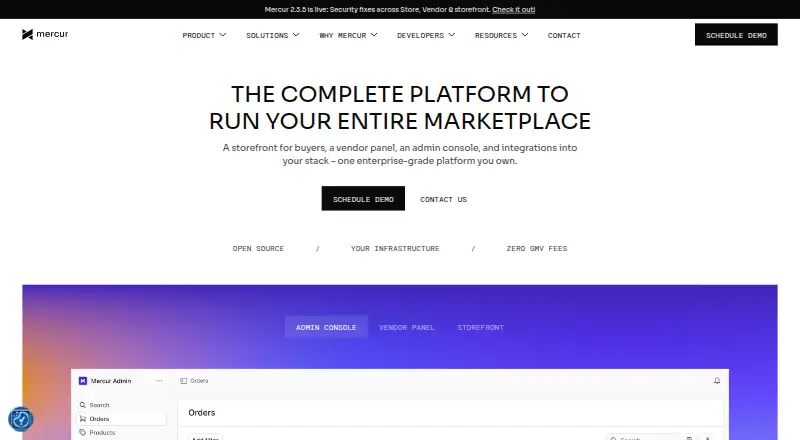
What Mercur is
Mercur is an open-source, headless platform for building multi-vendor marketplaces, built on Medusa v2. Its marketplace engine includes vendor management, catalogs, offers, split orders, commissions, and payouts; vendor payouts can use Stripe Connect. A typed REST API covers admin, vendor, and storefront scopes. Teams can run Mercur in their own cloud, on-premise, or in an air-gapped environment. The MIT-licensed Open Source plan costs nothing, but the team handles implementation, deployment, and maintenance. Managed hosting through Mercur Cloud is purchased separately. The Open Source edition lists HTTP-only session authentication, per-vendor data isolation, and TLS in transit at the deployment layer. Enterprise adds financial settlement, BuyBox, vendor integrations, and access controls. It includes supported Shopify and Magento / Adobe Commerce connectors, while connections to an organization's own ERP, PIM, OMS, or custom feeds are scoped separately. Enterprise licensing is quoted for each marketplace, and implementation is scoped separately. Enterprise support includes a Platform Specialist, dedicated Slack and email, architectural guidance, and an SLA for defects and incidents in code Mercur maintains.
Who it suits
Mercur Open Source suits teams able to implement, deploy, and maintain a marketplace themselves. Enterprise is aimed at businesses seeking added capabilities and platform maintenance.
What it does well
- MIT-licensed marketplace core costs nothing.
- Supports self-hosted and air-gapped deployment.
- Includes vendor management, split orders, commissions, and payouts.
- Typed REST API spans admin, vendor, and storefront scopes.
- Enterprise includes a designated Platform Specialist.
What to know first
- Open Source teams handle implementation, deployment, and maintenance.
- Managed Mercur Cloud hosting is purchased separately.
- Enterprise license price is quoted, not listed.
- Connecting an organization's own systems requires separate implementation work.
Limits
The free Open Source edition is self-hosted, and the team using it handles implementation, deployment, and maintenance. Enterprise licensing is quoted for each marketplace, while implementation and connections to an organization's own ERP, PIM, OMS, or custom feeds are scoped separately. Managed hosting through Mercur Cloud is purchased separately.
Plans
| Plan | Billed and limits | Price |
|---|---|---|
| Mercur Open Source | MIT-licensed marketplace core · self-hosted · team handles implementation, deployment, and maintenance | Free |
| Mercur Enterprise | Complete Enterprise suite · license quoted for your marketplace · implementation scoped separately · zero GMV fees | On request |
As mercurjs.com lists them, read 30 Sept 2026. The maker's own page has the final word.
Getting started
- Visit the Mercur website.
- Choose the MIT-licensed Open Source edition or request an Enterprise license quote.
- For Open Source, arrange to implement, deploy, and maintain the self-hosted platform.
- Select a deployment environment: your cloud, on-premise, or air-gapped.
- Use the API across admin, vendor, and storefront scopes.
- For Enterprise, scope implementation and any ERP, PIM, OMS, or custom-feed connections separately.
Mercur is an open-source, headless multi-vendor marketplace engine built on Medusa v2. It is best suited to engineering-led teams that can deploy and maintain their own commerce stack. The free core is capable and flexible, but choosing it means taking responsibility for implementation rather than buying a turnkey marketplace.
Overview
Mercur provides the underlying machinery for a marketplace in which multiple sellers offer products through a shared storefront. Vendor management, catalogs, offers, split orders, commissions and payouts are part of the open-source engine, so it can support a genuinely multi-seller operation rather than a single-store catalog with add-ons. Seller onboarding, mixed product types, multi-currency handling and shipping workflows broaden its usefulness for varied commerce models.
This is a headless product, not a finished business site. Building the marketplace around an organization's processes and connecting its ERP, PIM, OMS or custom feeds are separate implementation work. Teams without the engineering capacity to do that should prefer a more packaged service.
Key features
A typed REST API covers admin, vendor and storefront scopes. That gives developers defined interfaces for custom applications and integrations, while keeping the presentation layer independent of the marketplace core. Open Source supports vendor payouts through Stripe Connect, which is a practical route for distributing seller funds.
Enterprise adds financial settlement, BuyBox, vendor integrations and enterprise access controls. It also includes supported connectors for Shopify and Magento / Adobe Commerce. Integrations with an operator's other systems are scoped separately, so these connectors reduce some work but do not eliminate integration planning.
Deployment can run in a customer's cloud, on-premise or an air-gapped environment. That is a meaningful advantage for organizations with infrastructure-control or isolation requirements, although the same flexibility leaves deployment, upgrades and maintenance with the customer unless Mercur Cloud is purchased separately. The open-source edition lists HTTP-only session authentication, per-vendor data isolation and TLS in transit at the deployment layer. Its compliance position includes GDPR, a data processing agreement and ISO 27001 controls built by design; Enterprise adds GDPR tooling and audit evidence for those ISO controls.
Pricing
Mercur Open Source
free. This MIT-licensed marketplace core is self-hosted, with the customer responsible for implementation, deployment and maintenance. There is no free trial because the plan itself is free. It fits teams that have the developers and operations staff to build the marketplace and run its infrastructure. The trade-off is support: users receive documentation and community channels, including a public issue tracker and Discord, rather than a designated support team.
Mercur Enterprise
Custom pricing, with a license quoted for your marketplace. It includes the complete Enterprise suite, zero GMV fees, the additional settlement, BuyBox, integration and access-control modules, and the supported Shopify and Magento / Adobe Commerce connectors. Implementation is scoped separately, so the license is not an all-in delivery commitment. Enterprise support includes a designated Platform Specialist, dedicated Slack and email access, architectural guidance and an SLA for defects and incidents in code Mercur maintains.
Managed hosting through Mercur Cloud is a separate purchase for either route. The free core therefore minimizes licensing cost, not the total cost of creating and operating a marketplace.
Platforms
Mercur is offered as an API, a self-hosted deployment and a web-facing marketplace stack. Customer-cloud, on-premise and air-gapped deployment options make it suitable for infrastructure policies that rule out a conventional hosted-only service.
Who it's for
Choose Mercur Open Source if your team can implement, deploy and maintain a Medusa-based marketplace and wants control over code, hosting and integrations. Enterprise is the better fit for businesses that need platform maintenance, formal support, additional controls or the supplied commerce connectors. It is a poor fit for a buyer seeking a ready-to-launch marketplace with its business-system integrations already completed.
Pros and cons
- Pro: A free, MIT-licensed core avoids marketplace license fees and permits self-hosting.
- Pro: Vendor, order-splitting, commission, payout and multi-currency foundations cover essential multi-vendor operations.
- Pro: API, on-premise and air-gapped options give technical teams substantial architectural control.
- Con: Marketplace construction and ERP, PIM, OMS or custom-feed connections require separate implementation work.
- Con: Open Source relies on documentation and community channels, so organizations needing guaranteed response should budget for Enterprise.
- Con: Managed hosting is not included in the free core.
Alternatives
For a broader comparison, see Online Marketplace Software.
EcommerceSoftwarePro is a paid Android, iOS and web option; pick it when those client platforms and its add-ons matter more than Mercur's self-hosted API architecture.
Litekart offers a free, source-available, self-hosted build across Android, iOS, API and web, making it an alternative for teams wanting all features included in a downloadable package.
MarketplaceKit has a free self-hosted Community Edition and paid hosted tiers; choose it when a lighter free edition or a monthly hosted plan is preferable.
Websta is a freemium Android, iOS and web product centered on AI-built profile pages rather than a marketplace engine.
Dokan Multivendor Marketplace is a freemium self-hosted and web solution for WordPress users who want a Lite plan and conventional site licensing.
Marketbridge by Hykmah provides API and web plans with tightly defined product, record, transaction and storage quotas.
Yourstore is a paid web storefront with fixed Essential and Professional plans, suited to buyers prioritizing packaged store features.
Yclas Neo offers a freemium web marketplace with a free member and listing allowance, useful when those published caps fit your launch.
Verdict
Mercur is a strong choice for capable engineering teams that want an open marketplace core, deployment control and a typed API without license fees. Its main reason to look elsewhere is the implementation burden: if you need hosting, integrations and ongoing operations delivered as a finished service, a more managed alternative will be the safer choice.
Verdict
Mercur provides a self-managed marketplace core and an Enterprise route with additional modules, integrations, and support. Teams should account for separate implementation work and, for managed hosting, a separate purchase.
Questions
Is Mercur free?
Mercur Open Source is free and MIT-licensed. It is self-hosted, and the team handles implementation, deployment, and maintenance.
Is Mercur open source?
Yes. The marketplace core is MIT-licensed.
Which platforms does Mercur support?
Mercur lists API, self-hosted, and web platforms.
What does Enterprise add?
Enterprise adds financial settlement, BuyBox, vendor integrations, and enterprise access controls. It also includes supported Shopify and Magento / Adobe Commerce connectors.
What does Enterprise cost?
The Enterprise license is quoted for each marketplace. The plan lists zero GMV fees, and implementation is scoped separately.
What support is available?
Open Source users receive documentation and community channels, including a public issue tracker and Discord. Enterprise includes a designated Platform Specialist, dedicated Slack and email channel, architectural guidance, and an SLA for defects and incidents in code Mercur maintains.
Facts from Mercur's own pages
- API
- Mercur provides a typed REST API across admin, vendor, and storefront scopes. · mercurjs.com, 30 Sept 2026
- Compliance
- The security page lists GDPR and a data processing agreement and says ISO 27001 controls are built by design for Open Source; Enterprise adds GDPR tooling and audit evidence for ISO 27001 controls. · mercurjs.com, 30 Sept 2026
- Core capabilities
- The open-source engine includes vendor management, catalogs, offers, split orders, commissions, and payouts. · mercurjs.com, 30 Sept 2026
- Deployment
- Mercur can run on a customer's cloud, on-premise, or in an air-gapped environment; managed hosting through Mercur Cloud is purchased separately. · mercurjs.com, 30 Sept 2026
- Enterprise modules
- Enterprise adds financial settlement, BuyBox, vendor integrations, and enterprise access controls. · mercurjs.com, 30 Sept 2026
- Enterprise support
- Enterprise includes a designated Platform Specialist, dedicated Slack and email channel, architectural guidance, and an SLA for defects and incidents in code Mercur maintains. · mercurjs.com, 30 Sept 2026
- Headquarters
- Rzeszow, Poland · mercurjs.com, 23 Sept 2026
- Integrations
- Enterprise includes supported Shopify and Magento / Adobe Commerce connectors; integrations to an operator's ERP, PIM, OMS, or custom feeds are scoped separately. · mercurjs.com, 30 Sept 2026
- Intended users
- Mercur describes Open Source as suited to teams that can implement, deploy, and maintain the marketplace themselves, and Enterprise for businesses needing added capabilities and platform maintenance. · mercurjs.com, 30 Sept 2026
- Limit
- Building the marketplace and connecting an organization's own ERP, PIM, OMS, or custom feeds are separate implementation work. · mercurjs.com, 30 Sept 2026
- Open-source support
- Open Source users receive documentation and community channels, including a public issue tracker and Discord. · mercurjs.com, 30 Sept 2026
- Payments
- Open Source supports vendor payouts via Stripe Connect. · mercurjs.com, 30 Sept 2026
- Product
- Mercur is an open-source, headless multi-vendor marketplace platform built on Medusa v2. · mercurjs.com, 30 Sept 2026
- Security
- The open-source edition lists HTTP-only session authentication, per-vendor data isolation, and TLS in transit at the deployment layer. · mercurjs.com, 30 Sept 2026
Where Mercur stands on Freedom251
- Online Marketplace Software#5 of 34