Freedom251 › Malware Analysis Sandboxes
Malwagon
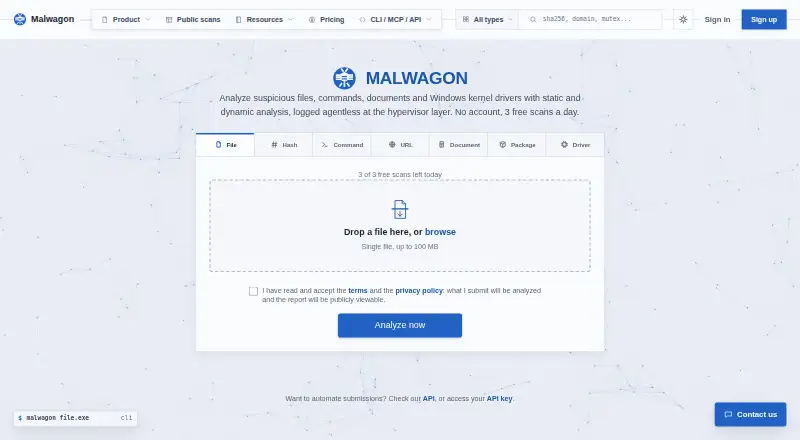
What Malwagon is
Malwagon is a cloud malware-analysis sandbox that examines files, URLs, commands, documents, packages and Windows kernel drivers in isolated virtual machines. It returns scored verdicts with evidence for security investigation. Static analysis includes YARA checks, capability identification, obfuscated-string recovery, packer and entropy checks, signature scanning, disassembly, secrets scanning and configuration extraction. Dynamic analysis records kernel telemetry, memory forensics, hypervisor introspection, network traffic and JA3/JA4 fingerprints. Reports can include MITRE ATT&CK mappings and generated YARA, Sigma and Suricata rules, with exports such as ATT&CK Navigator, STIX 2.1, MISP, PDF and DOCX. Each run gets its own full virtual machine, which is discarded afterward. Submitted samples stay on Malwagon-operated infrastructure; third parties receive hashes and derived indicators for reputation checks, and the AI layer receives locally derived summaries rather than sample bytes. Free-tier reports are public, while paid plans can keep scans private. The service has a REST API, an MCP server and a Python CLI. Pro starts at $79 a month.
Who it suits
It is designed for incident responders, detection engineers, SOC analysts and threat researchers. Unauthenticated users can also submit untrusted attachments and read reports.
What it does well
- Analyzes files, URLs, commands and packages.
- Each run uses a separate virtual machine.
- Reports can include ATT&CK mappings and detection rules.
- Offers REST API, MCP server and Python CLI.
- Paid plans can keep scan reports private.
What to know first
- Free-tier reports are publicly viewable.
- Free scan plan allows three scans per source address daily.
- Free scan plan has no internet egress.
- Accepted executables and archives are limited to 128 MB.
Limits
Free scan allows three scans per source address per day, uses Windows 10 22H2, has no internet egress and makes reports public. Community includes 20 scan credits per month, 120-second runs, one concurrent scan and public reports. Pro starts at $79 a month, billed yearly at $790/yr, and adds private reports, 200 scan credits per month and three concurrent scans.
Plans
| Plan | Billed and limits | Price |
|---|---|---|
| Community | 20 scan credits/month · 120-second runs · Windows 10 and Ubuntu 24.04 · 1 concurrent scan · public reports | Free |
| Free scan | 3 scans per source address per day · Windows 10 22H2 · network isolated · public report · no account | Free |
| Business | $199/mo; $1,990/yr billed yearly · 500 credits/month · 600-second runs · 7 sandboxes · 5 concurrent scans · private reports · API and MCP | $199 a month |
| Pro | $79/mo; $790/yr billed yearly · 200 credits/month · 300-second runs · 7 sandboxes · 3 concurrent scans · private reports · API and MCP | $79 a month |
| Team / Enterprise | 5,000 credits/month · 600-second runs · 7 sandboxes · 10 concurrent scans · 10 seats · shared pool · role management | On request |
As malwagon.com lists them, read 15 Oct 2026. The maker's own page has the final word.
Getting started
- Open https://malwagon.com/ to submit a supported file, URL, command, document, package, driver or hash.
- Choose an available scan plan; unauthenticated users can submit untrusted attachments and read reports.
- For API use, obtain a bearer token and use the REST API; Pro and Business include REST API and MCP access.
- For MCP integration, connect to https://malwagon.com/mcp.
- Install the Python CLI with pip; it runs on Linux, macOS and Windows.
Malwagon is a cloud malware-analysis sandbox for people investigating suspicious files, links, commands and packages. It is best suited to incident responders, detection engineers and SOC teams that need behavioral evidence as well as outputs they can carry into security workflows. The free tiers offer a route to public triage, but private reports and meaningful scan capacity start with a paid plan.
Overview
Malwagon returns scored verdicts with evidence after examining submissions in isolated virtual machines. It accepts executables and archives up to 128 MB, URLs, PowerShell, CMD and bash commands, office and PDF documents, Windows kernel drivers, pip packages, and MD5, SHA-1 or SHA-256 hashes. That range is useful when an investigation begins with a link, script or package rather than a conventional executable.
Each analysis runs in its own full virtual machine under a kernel-level hypervisor, and that machine is discarded after the run. Samples stay on Malwagon-operated infrastructure. Third parties receive hashes and derived indicators for reputation lookups, while the AI layer receives locally derived summaries rather than sample bytes. These handling measures do not make the free tiers appropriate for confidential samples: their reports are public. Paid plans allow private reports, and Ultra Privacy deletes stored scan data after analysis.
Key features
Static analysis combines YARA checks, capability identification, recovery of obfuscated strings, packer and entropy checks, signature scanning, disassembly, secrets scanning and configuration extraction. Dynamic analysis adds ETW kernel telemetry, memory forensics, hypervisor introspection, network capture and JA3/JA4 fingerprints. Together, these methods give analysts both indicators from the sample itself and observations of its behavior, rather than relying on a verdict alone.
Reports can map activity to MITRE ATT&CK and generate YARA, Sigma and Suricata rules. Exports include ATT&CK Navigator, STIX 2.1, MISP, defanged IOC lists, PDF and DOCX, giving detection and response teams several ways to pass findings onward. A bearer-token REST API, an MCP server and a Python CLI provide workflow access; the CLI has no dependencies and runs on Linux, macOS and Windows.
Unauthenticated users can submit untrusted attachments and read reports, which lowers the barrier for basic triage. That convenience should be weighed against public report visibility on free tiers, particularly before submitting material that should not be exposed.
Pricing
The Free scan option costs nothing and allows three scans per source address per day, with Windows 10 22H2, no internet egress and public reports. It is suited to occasional basic checks, but the daily address-based cap and lack of network egress constrain repeated or network-dependent investigations.
Community is also free, billed Free, and provides 20 scan credits per month, 120-second runs, Windows 10 and Ubuntu 24.04, one concurrent scan and public reports. It gives regular users more monthly capacity and a Linux environment, but its short runs, single scan slot and public results make it a limited choice for team operations or sensitive samples.
Pro costs $79 a month, billed $790/yr billed yearly. It includes 200 scan credits per month, 300-second runs, all seven sandboxes, three concurrent scans, private reports, and REST API and MCP access. This is the sensible step up for individual analysts or small teams that need privacy and integrations. Business costs $199 a month, billed $1,990/yr billed yearly, and raises the allowance to 500 credits, run time to 600 seconds and concurrency to five; it retains all seven sandboxes, private reports and API/MCP access. The higher tier fits teams with more frequent or parallel investigations.
Team / Enterprise has custom pricing and includes 5,000 scan credits per month, 600-second runs, all seven sandboxes, ten concurrent scans, ten seats, a shared credit pool and organization reports. Its seat and shared-credit structure suits larger groups coordinating work across analysts. Pro and Business prices are stated monthly but billed yearly, so the annual billing terms matter when comparing them with the free tiers.
Platforms
Malwagon is a cloud service with API, Linux, macOS, web and Windows platforms. The CLI runs on Linux, macOS and Windows, and the REST API and MCP interface support programmatic access on paid Pro and Business plans. Windows and Ubuntu are also available analysis environments on the free Community tier; paid plans open all seven sandboxes.
Who it's for
Incident responders, detection engineers, SOC analysts and threat researchers are the clearest fit, especially when they need to analyze mixed submission types and convert findings into rules, indicators or structured exports. The REST API, MCP access and CLI are useful for teams incorporating analysis into existing processes. It is a weaker fit for anyone who needs private analysis without a paid plan, or whose free-tier work depends on internet egress, long runs or concurrent scans.
Pros and cons
- Broad submission support: Files, URLs, commands, documents, drivers, packages and hashes cover more than executable-only triage.
- Layered evidence: Static checks and detailed runtime telemetry give analysts multiple kinds of evidence behind a scored verdict.
- Actionable outputs: ATT&CK mappings, generated detection rules and several export formats help move analysis into response and detection work.
- Free analysis is public: Both free options expose reports publicly, making them unsuitable for sensitive submissions.
- Free limits are restrictive: Community caps users at 20 credits a month, 120-second runs and one concurrent scan, while Free scan is limited to three daily scans per source address and has no internet egress.
- Paid plans bill yearly: The monthly prices for Pro and Business come with annual billing, a material commitment for teams evaluating capacity.
Alternatives
Malware Analysis Sandboxes is a useful starting point for comparing this category. Choose ANY.RUN if its free Community plan's stated Windows, Android and Ubuntu environments or its free trial better match the evaluation need. Retrace may suit readers seeking a free community feed, standard execution queue, web interface, basic report export and unlimited public analyses.
CAPE Sandbox is the alternative to consider when open-source software and a self-hosted setup are the priority. Hybrid Analysis offers a free community service with 30 uploads per month and a 100 MB maximum upload size, for readers whose needs fit that quota and cap. Bitdefender Total Security is a different kind of choice: its listed Total Security Individual plan covers five devices under one account for $59.99 a year, billed at a first-year price plus applicable sales tax.
Hatching Triage is worth considering for organizations whose required analysis volume fits its volume-based packages, which start at 500 analyses per day and scale toward 50,000 per day. ReversingLabs Cloud Sandbox offers a feature preview limited to five samples per day, with full access at additional cost. SorbSecurity Cloud Sandbox is another alternative to compare.
Verdict
Malwagon is a strong choice for security teams that need varied submissions analyzed with both static and behavioral evidence, then exported or routed into detection workflows. Its clearest advantage is the combination of broad input support, detailed analysis and integrations. The main reason to look elsewhere is the boundary between free and paid use: free reports are public and tightly limited, while private analysis and higher capacity require paid plans billed yearly.
Verdict
Malwagon combines static and dynamic analysis with evidence-rich reports and several export formats. Review report visibility, scan allowances and plan limits before submitting sensitive samples.
Questions
Is Malwagon free?
Yes. Free scan allows three scans per source address per day. Community is also free and includes 20 scan credits per month.
How much does Pro cost?
Pro is $79 a month, billed yearly at $790/yr. Business is $199 a month, billed yearly at $1,990/yr.
Which operating systems does Malwagon support?
The platform list includes Linux, macOS, web and Windows. The Python CLI runs on Linux, macOS and Windows.
Can I keep scan reports private?
Free scan and Community reports are public. Pro and Business include private reports; Ultra Privacy deletes stored scan data after analysis.
Does Malwagon provide API access?
Yes. It provides a bearer-token REST API and an MCP server. Pro and Business include REST API and MCP access.
What can I submit for analysis?
Submissions include executables and archives up to 128 MB, URLs, shell commands, office and PDF documents, Windows kernel drivers, pip packages and MD5, SHA-1 or SHA-256 hashes.
Facts from Malwagon's own pages
- Account security
- The service documents 12-character minimum passwords, TOTP two-factor authentication, sign-in rate limiting and revocable API tokens. · malwagon.com, 15 Oct 2026
- AI data boundary
- The AI narrative receives locally derived summaries, API-call sequences, indicators and extracted strings rather than sample bytes. · malwagon.com, 15 Oct 2026
- Analysis layers
- Static analysis includes YARA, capability identification, obfuscated-string recovery, packer and entropy checks, signature scanning, disassembly, secrets scanning and configuration extraction. · malwagon.com, 30 Sept 2026
- API upload limit
- The API has a file-upload route, but the documentation says the MCP server cannot upload bytes and other API submissions name targets as text. · malwagon.com, 15 Oct 2026
- CLI
- The Python CLI installs with pip, has no dependencies, runs on Linux, macOS and Windows, and returns exit codes for clean, malicious, suspicious and error results. · pypi.org, 15 Oct 2026
- CLI licence
- The PyPI package identifies itself as MIT licensed and OSI-approved. · pypi.org, 15 Oct 2026
- CLI maintainer
- PyPI lists one maintainer, zecrain, and credits Malwagon as the author. · pypi.org, 15 Oct 2026
- CLI platforms
- The Malwagon CLI has no dependencies and runs on Linux, macOS and Windows. · malwagon.com, 30 Sept 2026
- CLI release
- PyPI lists version 0.1.3 uploaded on September 7, 2026, with a 0.1.2 release also dated September 7, 2026. · pypi.org, 15 Oct 2026
- CLI runtime
- The PyPI package requires Python 3.8 or newer and is classified for Windows, macOS, Linux/POSIX and Python 3. · pypi.org, 15 Oct 2026
- Command analysis
- Command analysis executes PowerShell, CMD and bash text after local decoding of common obfuscation forms. · malwagon.com, 15 Oct 2026
- Company founding
- No founding year is stated on the reviewed official pages or the PyPI project page. · malwagon.com, 15 Oct 2026
- Company headquarters
- No headquarters location is stated on the reviewed official pages or the PyPI project page. · malwagon.com, 15 Oct 2026
- Data handling
- Malwagon says submitted samples stay on its infrastructure; external reputation services receive only hashes and derived indicators. · malwagon.com, 15 Oct 2026
- Detection outputs
- Reports can export ATT&CK Navigator, STIX 2.1, MISP, defanged IOC, PDF and DOCX formats, plus generated YARA, Sigma and Suricata rules. · malwagon.com, 15 Oct 2026
- Document analysis
- Document analysis opens Office, PDF, RTF, OneNote, CHM and web-container formats in the application that owns the format. · malwagon.com, 15 Oct 2026
- Documentation depth
- The documentation covers submission modules, analysis options, report interpretation, exports, visibility, retention, REST endpoints, MCP methods, errors and rate limits. · malwagon.com, 15 Oct 2026
- Dynamic analysis
- Dynamic analysis records ETW kernel telemetry, memory forensics, hypervisor introspection, network capture and JA3/JA4 fingerprints. · malwagon.com, 30 Sept 2026
- File analysis
- File analysis supports PE, DLL, .NET, ELF, Go, scripts and archives up to 128 MB, with static and dynamic analysis. · malwagon.com, 15 Oct 2026
- Hypervisor isolation
- Each analysis runs in its own full virtual machine under a kernel-level hypervisor, and the machine is discarded after the run. · malwagon.com, 30 Sept 2026
- Integrations
- The service provides a bearer-token REST API, an MCP server at https://malwagon.com/mcp, and a Python CLI installable with pip. · malwagon.com, 30 Sept 2026
- Internet egress
- Internet-connected detonation is a paid-plan, per-scan option; anonymous and Community runs remain network isolated. · malwagon.com, 15 Oct 2026
- Isolation
- Each analysis runs in its own virtual machine under a kernel-level hypervisor and the machine is discarded after the run. · malwagon.com, 15 Oct 2026
- Kernel-driver analysis
- Windows kernel drivers receive static BYOVD analysis covering their control interface, signing and known-abuse status; they are not kernel-detonated. · malwagon.com, 15 Oct 2026
Where Malwagon stands on Freedom251
- Malware Analysis Sandboxes#5 of 27