Freedom251 › Email Testing Software
MailCatcher
What MailCatcher is
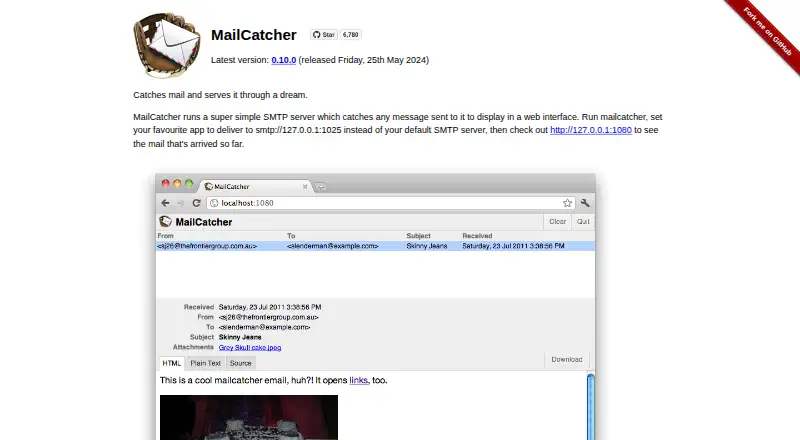
MailCatcher is a free, open-source tool for inspecting application email during development. It runs a local SMTP server, captures messages, and displays them in a web interface, where developers can review mail sent to a local endpoint. Captured messages can be viewed as HTML, plain text, or source when available. For HTML messages, MailCatcher adjusts the content so embedded images display and links open in a new window. It lists attachments, supports downloading individual message parts, and can provide the original email. New messages appear instantly in browsers with WebSockets support; otherwise, the interface refreshes every thirty seconds. The URL API provides message lists and metadata in JSON, along with message HTML, plain text, attachments, and full source. The maker documents setup examples for Rails, PHP, and Django, plus installation as a Ruby gem or via a Docker image. MailCatcher requires Ruby 3.3 or newer, and dependencies may require build tools. The project uses the MIT License. Its mail processing is basic, and UTF-8 is not completely supported directly over the wire; the maker advises using a mail library that encodes according to SMTP server capabilities.
Who it suits
MailCatcher suits developers who want to capture and inspect application email at a local SMTP endpoint during development. It is available for self-hosted use and supports an API for message access.
What it does well
- Captures application messages for local inspection.
- Displays HTML, plain text, and source when available.
- Offers an API for message content and metadata.
- Setup examples cover Rails, PHP, and Django.
- Released under the MIT License.
What to know first
- Requires Ruby 3.3 or newer.
- Dependencies may require build tools.
- Mail processing is basic.
- UTF-8 sent directly over the wire is not fully supported.
Limits
Mail processing is basic, and UTF-8 sent directly over the wire is not completely supported. The maker advises using a mail library that encodes according to SMTP server capabilities.
Getting started
- Open the MailCatcher website for installation instructions
- Install MailCatcher as a Ruby gem or use the Docker image
- Check that Ruby 3.3 or newer is available if using the Ruby installation
- Configure the application to send mail to a local SMTP endpoint
- Use the web interface or URL API to inspect captured messages
Verdict
MailCatcher provides a local way to inspect development email, with message views, attachment downloads, and API access. Check its Ruby requirement and UTF-8 limitation before relying on it for a workflow.
Questions
Is MailCatcher free?
Yes. MailCatcher is free and open source under the MIT License.
Which platforms does MailCatcher support?
Its listed platforms are API, Linux, macOS, self-hosted, and web.
How can I install MailCatcher?
The maker documents installation as a Ruby gem and provides a Docker image. The repository README requires Ruby 3.3 or newer, and dependencies may need build tools.
What can I inspect with MailCatcher?
It can display captured messages as HTML, plain text, or source when available, and lists attachments for separate downloads. Its URL API provides message lists and metadata, content, attachment parts, and full source.
Does MailCatcher integrate with Rails, PHP, or Django?
The maker documents setup examples for Rails, PHP, and Django.
Facts from MailCatcher's own pages
- API
- Its REST-style endpoints provide message lists and metadata in JSON, message content, attachments, and full source. · mailcatcher.me, 10 Oct 2026
- Attachments
- It lists attachments and allows individual parts to be downloaded. · mailcatcher.me, 10 Oct 2026
- HTML preview
- It rewrites HTML to display embedded images and opens links in a new window. · mailcatcher.me, 10 Oct 2026
- Images and links
- It rewrites HTML to display embedded images and open links in a new window. · mailcatcher.me, 4 Oct 2026
- Installation
- The site instructs users to install MailCatcher with `gem install mailcatcher` and run it locally. · mailcatcher.me, 10 Oct 2026
- Integrations
- The site gives setup instructions for Rails, PHP, and Django applications. · mailcatcher.me, 10 Oct 2026
- Intended use
- The setup instructions direct applications to send mail to a local SMTP endpoint for inspection in development. · mailcatcher.me, 4 Oct 2026
- License
- The project is released under the MIT License. · mailcatcher.me, 10 Oct 2026
- Limitation
- MailCatcher does not completely support UTF-8 sent directly over the wire and advises using a mail library that encodes according to SMTP server capabilities. · mailcatcher.me, 10 Oct 2026
- Limits
- The maker says mail processing is basic and that UTF-8 is not completely supported directly over the wire. · mailcatcher.me, 4 Oct 2026
- Live updates
- Messages appear instantly in browsers supporting WebSockets; otherwise, the interface updates every thirty seconds. · mailcatcher.me, 10 Oct 2026
- Message views
- It shows HTML, plain text, and source versions of messages when available. · mailcatcher.me, 10 Oct 2026
- Purpose
- MailCatcher runs an SMTP server that catches messages and displays them in a web interface. · mailcatcher.me, 10 Oct 2026
- Requirements
- The repository README says MailCatcher requires Ruby 3.3 or newer and notes build tools may be needed for dependencies. · github.com, 4 Oct 2026
- Support
- The maker asks users to file an issue and include the complete message when reporting processing problems. · mailcatcher.me, 10 Oct 2026
Where MailCatcher stands on Freedom251
- Email Testing Software#11 of 28