Freedom251 › Personal Email Services

mail.de
by mail.de
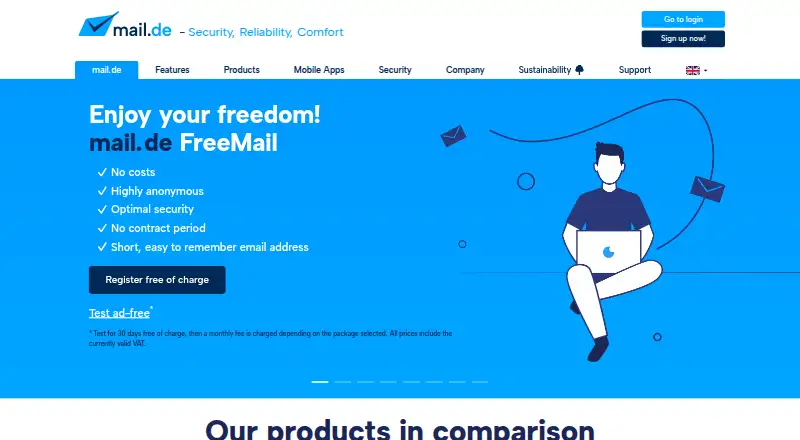
What mail.de is
mail.de is an email service available on the web, iOS, and Android, with IMAP/SMTP support and end-to-end encryption. It offers two free plans. FreeMail Zero includes 500 MB of storage, up to 25 emails per day, and a 60 MB attachment size; FreeMail provides 1 GB, one alias, and up to 50 emails per day. Paid plans start with PureMail at €0.99 per month, billed on a 12-month contract with the total due at the beginning of the term. PureMail includes 2.5 GB of storage, one alias, and a 100-email daily limit. PlusMail is €2.49 per month with 5 GB and 10 aliases; ProMail is €3.99 per month with 20 GB and 20 aliases. PowerMail costs €6.49 per month and includes unlimited storage and 30 aliases. The paid plans' daily sending limits rise to 5,000 emails with PowerMail. A 30-day trial is listed. mail.de was founded in 2009 and is based in Gütersloh, Germany.
Who it suits
mail.de suits people looking for web or mobile email with IMAP/SMTP support and end-to-end encryption. Its plans offer different storage, alias, and daily sending limits.
What it does well
- FreeMail Zero and FreeMail are free
- Supports IMAP/SMTP
- End-to-end encryption is listed
- Web, iOS, and Android access
What to know first
- Paid plans use 12-month contracts
- Paid plan totals are due at the beginning of the term
Limits
FreeMail Zero includes 500 MB of storage and up to 25 emails per day; FreeMail includes 1 GB and up to 50 emails per day. Paid plans require a 12-month contract, with the total amount due at the beginning of the term.
Plans
| Plan | Billed and limits | Price |
|---|---|---|
| FreeMail Zero | No contract period · 500 MB storage · 25 emails/day · 60 MB attachment size | Free |
| FreeMail | No contract period · 1 GB storage · 1 email alias · 50 emails/day | Free |
| PureMail | 12-month contract; total amount due at beginning of term · 2.5 GB storage · 1 email alias · 100 emails/day | €0.99 a month |
| PlusMail | 12-month contract; total amount due at beginning of term · 5 GB storage · 10 email aliases · 500 emails/day | €2.49 a month |
| ProMail | 12-month contract; total amount due at beginning of term · 20 GB storage · 20 email aliases · 2,500 emails/day | €3.99 a month |
| PowerMail | 12-month contract; total amount due at beginning of term · Unlimited storage · 30 email aliases · 5,000 emails/day | €6.49 a month |
As mail.de lists them, read 21 Sept 2026. The maker's own page has the final word.
Getting started
- Open the mail.de website
- Choose FreeMail Zero or FreeMail, or review the paid plans
- For a paid plan, select the tier that fits your storage, alias and daily email needs
- Use the service on the web, iOS or Android
- Connect through IMAP/SMTP if needed
Overview
mail.de is an email service from mail.de, a provider founded in 2009 and headquartered in Gütersloh, Germany. It is best suited to individuals who want browser and mobile access, encrypted mail, and a choice between a genuinely free mailbox and capacity-based paid tiers. The strongest reason to choose it is the unusually broad progression from a small free account to unlimited storage; the main drawback is the commitment attached to every paid tier.
Key features
Storage starts at 500 MB and reaches unlimited, while daily sending allowances run from 25 emails to 5,000. That range makes the service workable for occasional correspondence as well as high-volume personal sending, although the entry plans can become restrictive if you keep a large archive or send frequently.
Alias allowances are equally tiered. FreeMail and PureMail provide one alias, PlusMail provides 10, ProMail 20, and PowerMail 30. Multiple aliases are useful for separating shopping, registrations, work and personal mail without maintaining separate accounts; users who need only one address gain little from paying specifically for this feature.
End-to-end encryption is supported, which gives privacy-conscious users a clear reason to consider mail.de. IMAP and SMTP support also allows use with compatible third-party email clients rather than requiring the web interface. Access is provided through the web, iOS and Android. The stated platform coverage is therefore solid for browser and mobile users, but does not include dedicated desktop applications.
Pricing
FreeMail Zero costs nothing with no contract period. Its 500 MB mailbox, 25-email daily limit and 60 MB attachment limit make it appropriate for a lightly used secondary address or minimal correspondence. The storage and sending ceiling will be noticeable for anyone who keeps years of mail or sends messages in batches.
FreeMail is also free with no contract period, but doubles storage to 1 GB, raises the daily allowance to 50 emails and includes one alias. It is the sensible free choice for routine personal use, though still modest for an active mailbox.
PureMail costs €0.99 a month on a 12-month contract, with the full term amount due at the beginning. It provides 2.5 GB, one alias and 100 emails per day. This is the low-cost upgrade for users who have outgrown FreeMail’s storage or sending cap but do not need multiple identities.
PlusMail costs €2.49 a month on the same 12-month, upfront-billed basis. Its 5 GB, 10 aliases and 500 emails per day make it the first tier that materially supports several separate addresses and heavier correspondence. ProMail costs €3.99 a month and expands those figures to 20 GB, 20 aliases and 2,500 emails per day, a better fit for substantial archives or frequent sending.
PowerMail costs €6.49 a month, again billed for a 12-month term upfront. Unlimited storage, 30 aliases and 5,000 emails per day remove the principal capacity constraints, making it the appropriate choice for the heaviest personal workload. Paid plans have a 30-day trial, but their annual commitment should be weighed before starting one.
Platforms
mail.de runs on the web and has apps for iOS and Android. IMAP and SMTP support broadens client compatibility, while the listed platform range does not extend to native desktop software.
Who it's for
Choose mail.de if you want end-to-end encryption, standard mail-protocol support and a clear upgrade path based on storage, aliases and sending volume. FreeMail suits ordinary personal correspondence, while PlusMail and above are more appropriate when alias separation or higher daily limits matter. It is less suitable if you require a paid plan without an annual upfront commitment or a dedicated desktop app.
Pros and cons
Pros
- Broad capacity ladder: plans scale from 500 MB to unlimited storage and from 25 to 5,000 emails per day.
- Useful alias expansion: paid tiers reach 30 aliases, enabling distinct addresses for different purposes.
- Privacy and client flexibility: end-to-end encryption plus IMAP/SMTP support covers privacy-focused and third-party-client users.
- Free entry: two no-contract plans let users choose between lower cost and modestly higher limits.
Cons
- Upfront annual billing: every paid tier uses a 12-month contract and charges the term at the start.
- Restrictive free caps: 500 MB or 1 GB storage and 25 or 50 daily emails may not suit active inboxes.
- Limited platform range: access is web, iOS and Android rather than a listed native desktop app.
Alternatives
Compare Email providers for a wider provider shortlist, or Secure Email Providers when encrypted mail is your primary criterion. The Personal Email Services list is useful when you want to compare consumer-focused options.
Aster Mail is a better choice if open-source software, broad desktop coverage and 10 GB of encrypted free storage matter more than mail.de’s tiered daily limits. Pick Proton Mail for a security-focused service with a 1 GB free plan and apps across desktop and mobile platforms. Tuta Mail suits readers wanting end-to-end encryption and a free plan that also includes a calendar. eclipso Mail Europe offers 4 GB on its free tier with no minimum contract period, making it preferable when free storage and cancellation freedom are priorities.
Mailfence is an alternative with web, iOS and Android access and a 1 GB free tier split between email and documents. Mailo combines 1 GB email storage with document/photo storage, five aliases and IMAP4/EAS access on its free plan. SecureMyEmail is worth considering when a free trial and paid support for up to eight addresses are more important than published storage tiers. NevTan Mail is another freemium option with 5 GB per mailbox and support for up to 10 mailboxes.
Verdict
mail.de is a strong fit for individuals who want encrypted email, IMAP/SMTP compatibility and a scalable plan ladder, especially when aliases or high sending limits are important. Start with FreeMail for normal personal use and move to PlusMail or higher when capacity and address separation justify the cost. Look elsewhere if annual upfront billing is unacceptable or if you need a native desktop application.
Verdict
mail.de offers free and paid plans with differing storage, alias, and sending limits. Compare those limits and the paid plans' upfront term billing before choosing.
Questions
Does mail.de have a free plan?
Yes. FreeMail Zero and FreeMail are listed at no charge. FreeMail Zero has 500 MB of storage and a 25-email daily limit; FreeMail has 1 GB, one alias and a 50-email daily limit.
How much do the paid plans cost?
PureMail is €0.99 per month, PlusMail €2.49 per month, ProMail €3.99 per month and PowerMail €6.49 per month. Each has a 12-month contract billed in full at the beginning of the term.
Which platforms does mail.de support?
It is available on the web, iOS and Android. It also supports IMAP/SMTP.
Does mail.de list end-to-end encryption?
Yes, end-to-end encryption is listed.
Who makes mail.de?
The maker is mail.de, based in Gütersloh, Germany. It was founded in 2009.
Is there a trial?
A 30-day trial is listed.
Facts from mail.de's own pages
- Email aliases
- 1 · mail.de, 15 Sept 2026
- End-to-end encryption
- Yes · mail.de, 15 Sept 2026
- Founded
- 2009 · mail.de, 28 Sept 2026
- Free plan
- Yes · mail.de, 21 Sept 2026
- Headquarters
- Gütersloh, Germany · mail.de, 28 Sept 2026
- Mailbox storage
- 2.5 · mail.de, 21 Sept 2026
- Mail protocol support
- imap_smtp · mail.de, 15 Sept 2026
Where mail.de stands on Freedom251
- Personal Email Services#25 of 115
- Secure Email Providers#8 of 28
- Email providers#10 of 28