Freedom251 › Physics Simulation Software
LISE++
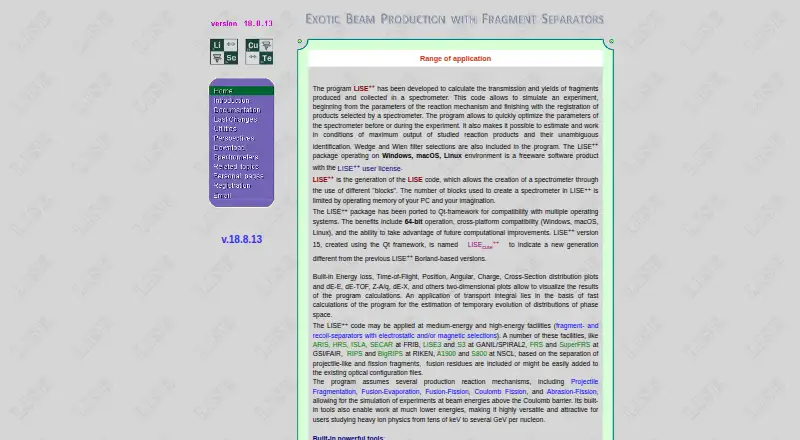
What LISE++ is
LISE++ is free desktop software for calculating the transmission and yields of fragments produced and collected in a spectrometer, and for simulating experiments from reaction parameters through registration of spectrometer-selected products. It runs on Linux, macOS, and Windows and includes 3D visuals. Users can assemble a spectrometer from configurable blocks such as dipoles, materials, and beam pipe; the number of blocks depends on the computer’s available operating memory. LISE++ can optimize spectrometer parameters before or during an experiment, with wedge and Wien filter selections. Its plots cover energy loss, time-of-flight, position, angular, charge, and cross-section distributions, as well as two-dimensional views such as dE-ToF and Z-A/q. Supported production mechanisms include projectile fragmentation, fusion-evaporation, fusion-fission, Coulomb fission, and abrasion-fission. The package includes physical, relativistic kinematics, evaporation, radiation residue, ion mass, and matrix calculators, along with PACE4, GEMINI++, MOTER, ETACHA4, GLOBAL, and Charge codes. Facility configurations include ARIS, HRS, SECAR, LISE3, S3, FRS, SuperFRS, RIPS, BigRIPS, A1900, and S800, with more possible through optical configuration files. The site also offers tutorials and user guides, including a 2026 practical guide, plus a video tutorial.
Who it suits
LISE++ suits researchers and users modeling fragment production, transmission, and yields in spectrometers. It is relevant to people who need configurable spectrometer designs, reaction calculations, optimization, and plots across supported production mechanisms.
What it does well
- Free desktop software for Linux, macOS, and Windows.
- Includes 3D visuals and configurable spectrometer blocks.
- Optimizes parameters before or during an experiment.
- Provides one- and two-dimensional plot types.
- Supports five listed production mechanisms.
- Includes facility configurations and optical configuration files.
What to know first
- The number of configurable blocks depends on available operating memory.
- Published results using LISE++ calculations must cite the software.
- The license disclaims warranty and liability for losses.
Limits
The free LISE++ license requires citation in published results based on or including its calculations. The number of spectrometer blocks is limited by available operating memory.
Plans
| Plan | Billed and limits | Price |
|---|---|---|
| LISE++ | Freeware; publication of results based on or including LISE++ calculations must cite LISE++ | Free |
As lise.frib.msu.edu lists them, read 11 Oct 2026. The maker's own page has the final word.
Getting started
- Visit the LISE++ website.
- Download the package for Windows, Linux, or macOS.
- Install and run the desktop software on a supported operating system.
- Use the tutorials, user guides, or video tutorial to learn the program.
Verdict
LISE++ is a strong fit for users who need free spectrometer and reaction modeling tools across its supported operating systems. Its extensive calculators, mechanisms, and plots are useful strengths; users must check result correctness themselves and cite LISE++ when publishing results based on its calculations.
Questions
Is LISE++ free?
Yes. The LISE++ plan is freeware, listed as free.
Which operating systems are supported?
LISE++ packages are listed for Windows, Linux, and macOS.
What does LISE++ calculate?
It calculates transmission and yields of fragments produced and collected in a spectrometer, and simulates experiments from reaction parameters through registration of selected products.
Does LISE++ include spectrometer configurations?
Yes. Configurations for facilities including ARIS, HRS, SECAR, LISE3, S3, FRS, SuperFRS, RIPS, BigRIPS, A1900, and S800 are included or can be added through optical configuration files.
Is LISE++ open source?
The license permits copying and distribution but prohibits selling, modifying, decompiling, or disassembling the software.
What does the license require for published results?
Published results using LISE++ calculations must cite LISE++.
Facts from LISE++'s own pages
- Accuracy and warranty
- The license provides no warranty, disclaims liability for losses, and makes users responsible for confirming the correctness of results. · lise.frib.msu.edu, 11 Oct 2026
- Android utility
- The download page lists Charge for Android, described as calculating charge-state distributions on Android. · lise.frib.msu.edu, 11 Oct 2026
- Calculators and codes
- The package lists physical, relativistic kinematics, evaporation, radiation residue, ion mass, and matrix calculators, and includes PACE4, GEMINI++, MOTER, ETACHA4, GLOBAL, and Charge codes. · lise.frib.msu.edu, 11 Oct 2026
- Current downloads
- The download page lists LISE++ packages for Windows, Linux, and macOS, including Windows v.18.8.13, Linux v.18.2.11, and macOS v.18.7.5. · lise.frib.msu.edu, 11 Oct 2026
- Delivery mode
- desktop · lise.frib.msu.edu, 24 Sept 2026
- Facilities
- The site says configurations for facilities including ARIS, HRS, SECAR, LISE3, S3, FRS, SuperFRS, RIPS, BigRIPS, A1900, and S800 are included or can be added through optical configuration files. · lise.frib.msu.edu, 11 Oct 2026
- Free plan
- Yes · lise.frib.msu.edu, 24 Sept 2026
- Guides
- The site provides tutorials and user guides, including a 2026 practical guide to production, separator tuning, and identification, plus a video tutorial. · lise.frib.msu.edu, 11 Oct 2026
- Integrations
- The home page lists LISE for Excel (64-bit) as a built-in tool, and the download page lists LISE RayReader, which plots LISE++ Monte Carlo data using Matplotlib in Python. · lise.frib.msu.edu, 11 Oct 2026
- License limits
- Users may copy and distribute the software, but may not sell, modify, decompile, or disassemble it; published results using its calculations must cite LISE++. · lise.frib.msu.edu, 11 Oct 2026
- Optimization
- The program can optimize spectrometer parameters before or during an experiment and includes wedge and Wien filter selections. · lise.frib.msu.edu, 11 Oct 2026
- Plots
- Built-in plots include energy loss, time-of-flight, position, angular, charge, and cross-section distributions, along with two-dimensional plots such as dE-ToF and Z-A/q. · lise.frib.msu.edu, 11 Oct 2026
- Purpose
- LISE++ calculates transmission and yields of fragments produced and collected in a spectrometer and simulates experiments from reaction parameters through registration of spectrometer-selected products. · lise.frib.msu.edu, 11 Oct 2026
- Reaction mechanisms
- Supported production mechanisms include projectile fragmentation, fusion-evaporation, fusion-fission, Coulomb fission, and abrasion-fission. · lise.frib.msu.edu, 11 Oct 2026
- Spectrometer design
- Users can create a spectrometer from configurable blocks such as dipoles, materials, and beam pipe, with the number of blocks limited by the computer’s operating memory. · lise.frib.msu.edu, 11 Oct 2026
- Support and updates
- The license says registered users automatically receive information about new versions, features, and documentation, and asks users to report errors and suggestions. · lise.frib.msu.edu, 11 Oct 2026
- 3D visuals
- Yes · lise.frib.msu.edu, 24 Sept 2026
- Website privacy
- The privacy policy says submitted name, institution, and email information may be used for registration and communications, and that Google Analytics collects aggregated website-usage information. · lise.frib.msu.edu, 11 Oct 2026
Where LISE++ stands on Freedom251
- Physics Simulation Software#15 of 89