Freedom251 › Storage Management Software
LINBIT SDS
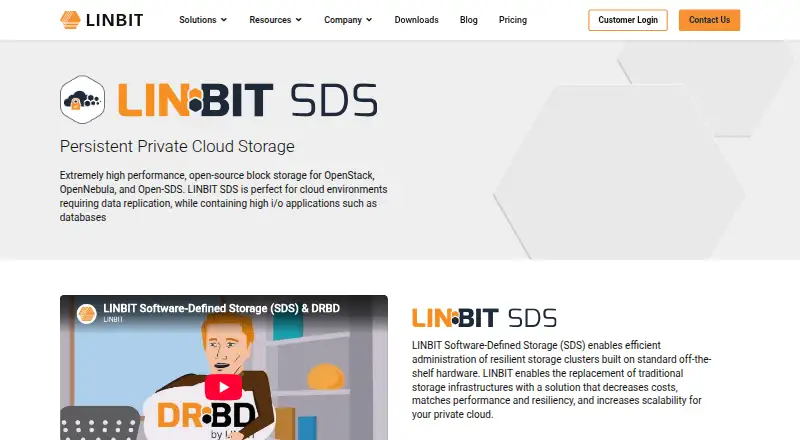
What LINBIT SDS is
LINBIT SDS is paid, open-source block storage for private-cloud infrastructure. It combines DRBD replication with LINSTOR orchestration to build resilient clusters on standard hardware, targeting private clouds and high-I/O workloads such as databases. DRBD supports synchronous, asynchronous, and semi-synchronous replication for up to 32 replicated persistent volumes. Storage features include multi-tiering, geo-clustering, thin provisioning, snapshots, clones, automatic recovery, and data-integrity synchronization. Volumes can be accessed through DRBD Diskless, iSCSI, NFS, NVMe-oF, or a Fibre Channel gateway. The product provides a REST API and can ship encrypted snapshots to remote locations. Integrations include Kubernetes, OpenShift, Rancher, OpenStack, Proxmox, and other listed platforms. Supported Linux systems include Red Hat Enterprise Linux, SUSE Linux Enterprise Server, Oracle Linux 6.3+, and Ubuntu Server Edition. Starter begins at $1,000 a year for two nodes.
Who it suits
LINBIT SDS suits private-cloud operators and teams running storage-intensive workloads such as databases. It is intended for Linux-based, self-hosted or hybrid environments.
What it does well
- Open-source storage for private clouds
- Supports synchronous and asynchronous replication
- Offers thin provisioning, snapshots, and clones
- Integrates with Kubernetes and OpenStack
- Encryption at rest with LUKS keys
What to know first
- No free plan
- Starter starts at $1,000 a year
- Replicated volumes are read-write-once
Limits
The Starter subscription is $1,000 a year for two nodes and includes repository access, updates and community non-SLA support. Replicated volumes are read-write-once, with quorum and internal protocols controlling promotion to read-write.
Plans
| Plan | Billed and limits | Price |
|---|---|---|
| LINBIT Starter | Starting from $1,000 /2 nodes/year · 2 nodes · repository access · updates · community non-SLA support | $1,000 a year |
| LINBIT Plus | Priced per cluster per year + terabyte fee · Unlimited support tickets · remote installation · 8-hour initial response · 4-hour emergency response | On request |
| LINBIT Enterprise | Priced per cluster per year + terabyte fee · 24×7 support · 4-hour initial response · 1-hour emergency response · dedicated account manager | On request |
As linbit.com lists them, read 4 Oct 2026. The maker's own page has the final word.
Getting started
- Open the LINBIT SDS private-cloud website
- Choose the Starter, Plus or Enterprise subscription
- Prepare supported Linux servers and standard hardware
- Deploy LINSTOR with DRBD replication in a self-hosted or hybrid environment
- Connect storage through DRBD Diskless, iSCSI, NFS or NVMe-oF
- Integrate with a listed platform such as Kubernetes, OpenStack or Proxmox
Verdict
LINBIT SDS provides a broad storage toolkit for organizations building private-cloud clusters on standard hardware. Its replication model and platform integrations make deployment design an important consideration.
Questions
How much does LINBIT SDS cost?
LINBIT Starter starts at $1,000 a year for two nodes. Plus and Enterprise are priced per cluster per year plus a terabyte fee.
Is LINBIT SDS open source?
Yes. LINBIT describes it as open-source block storage for private-cloud infrastructure.
Which operating systems are supported?
Listed platforms include Red Hat Enterprise Linux, SUSE Linux Enterprise Server, Oracle Linux 6.3+ and Ubuntu Server Edition.
What platforms integrate with LINBIT SDS?
Integrations include Kubernetes, OpenShift, Rancher, MicroK8s, Nomad, OpenStack, OpenNebula, Proxmox, oVirt, XCP-ng and Apache CloudStack.
What support does Enterprise provide?
Enterprise includes 24×7 mail and phone support, a dedicated account manager, a four-hour initial response and a one-hour emergency response.
Facts from LINBIT SDS's own pages
- API and backups
- LINBIT SDS provides a REST API and supports asynchronous shipping of encrypted snapshots to remote locations. · linbit.com, 4 Oct 2026
- Audience
- LINBIT describes SDS as suited to private-cloud environments and high-I/O workloads such as databases. · linbit.com, 4 Oct 2026
- Founded
- 2001 · linbit.com, 28 Sept 2026
- Hardware
- It builds resilient storage clusters on standard off-the-shelf hardware and is designed to replace traditional storage infrastructure in private clouds. · linbit.com, 4 Oct 2026
- Headquarters
- Vienna, Austria · linbit.com, 28 Sept 2026
- Integrations
- LINBIT SDS lists integrations and use cases for Kubernetes, OpenShift, Rancher, MicroK8s, Nomad, OpenStack, OpenNebula, Proxmox, oVirt, XCP-ng, and Apache CloudStack. · linbit.com, 4 Oct 2026
- Notable limit
- The product FAQ describes replicated volumes as read-write-once (RWO), with quorum and internal protocols controlling whether a replica may be promoted to read-write. · linbit.com, 4 Oct 2026
- Purpose
- LINBIT SDS is open-source block storage for private cloud infrastructure, combining DRBD replication with LINSTOR storage orchestration. · linbit.com, 4 Oct 2026
- Replication
- DRBD supports synchronous, asynchronous, and semi-synchronous replication, with up to 32 replicated persistent volumes. · linbit.com, 4 Oct 2026
- Security
- LINBIT SDS supports encryption at rest using LUKS keys, and its documentation says it supports encryption available in the Linux kernel across all nodes. · linbit.com, 4 Oct 2026
- Storage access
- Volumes can be accessed locally or remotely through DRBD Diskless, iSCSI, NFS, and NVMe-oF; the product also lists Fibre Channel as a storage gateway. · linbit.com, 4 Oct 2026
- Storage features
- Features include multi-tier storage, geo-clustering, thin provisioning, snapshots and clones, automatic recovery, and data integrity synchronization methods. · linbit.com, 4 Oct 2026
- Support
- LINBIT offers Starter, Plus, and Enterprise subscriptions, with Enterprise including 24×7 mail and phone support and a maximum one-hour emergency initial response time. · linbit.com, 4 Oct 2026
- Supported Linux platforms
- The product page lists Red Hat Enterprise Linux, SUSE Linux Enterprise Server, Oracle Linux 6.3+ (RHEL Compatible or UEK), and Ubuntu Server Edition. · linbit.com, 4 Oct 2026
Where LINBIT SDS stands on Freedom251
- Storage Management Software#18 of 28
- Storage Replication Software#17 of 24