Freedom251 › API Monetization Software
Layer7 API Management
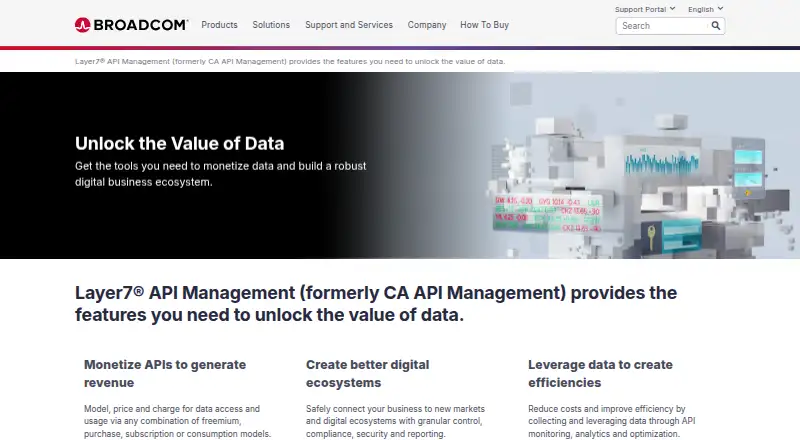
What Layer7 API Management is
Layer7 API Management gives publishers a portal to publish, document, and manage APIs across their lifecycle. Consumers can browse available APIs, register for access, receive an API key and shared secret, and view consumption metrics. Teams can set organization-specific rules for authentication and threat protection, then group APIs into products with usage limits, documentation, and interactive tests. Portal actions are also available through an API for programmatic workflows. Access controls include single sign-on, multifactor authentication such as biometrics, and fine-grained API authorization. Lifecycle tools include health metrics, CI/CD integration, GraphQL management interfaces, and support for popular API tools. It supports REST, SOAP, GraphQL, OAuth 2.0, LDAP, SAML, MQTT, RabbitMQ, Kafka, JMS, WebSockets, HTTP(S), and FTP(S). Deployment options include on-premises, SaaS, and hybrid, in hardware, software, virtual, and container forms. It is available for Android, iOS, web, API, and self-hosted use. Pricing is on request.
Who it suits
Layer7 suits organizations that publish and govern APIs and need consumer onboarding, lifecycle tooling, or API product packaging. It also fits teams choosing among on-premises, SaaS, and hybrid deployment.
What it does well
- Portal supports API publishing and lifecycle management.
- Consumers can obtain credentials and view usage metrics.
- Policies can specify authentication and threat protection.
- Supports CI/CD integration and GraphQL management interfaces.
- Offers on-premises, SaaS, and hybrid deployment.
What to know first
- Pricing is available only on request.
- One Docker Gateway instance is limited to six cores and eight gigabytes of memory.
- Additional portal instances cost extra on the SaaS plan.
- Additional SaaS environments must be purchased.
Limits
The SaaS plan includes one production environment; additional environments must be purchased, and extra portal instances cost extra. A single Docker Gateway instance can be configured with up to six cores and eight gigabytes of memory.
Plans
| Plan | Billed and limits | Price |
|---|---|---|
| Layer7 API Management SaaS | Contact Broadcom · one production environment included · additional portal instances cost extra · additional environments must be purchased | On request |
As broadcom.com lists them, read 30 Sept 2026. The maker's own page has the final word.
Getting started
- Visit the Broadcom API Management website.
- Choose an on-premises, SaaS, or hybrid deployment model.
- Contact Broadcom for pricing and SaaS plan details.
- Select a suitable hardware, software, virtual, or container form factor.
Layer7 API Management is Broadcom’s platform for publishing, securing, governing, and operating APIs across on-premises, SaaS, and hybrid environments. It is best suited to organizations that need formal consumer onboarding, policy control, and lifecycle automation rather than a simple gateway. The main trade-off is commercial and deployment complexity: SaaS usage is metered, pricing is by request, and extra environments or portal instances cost more.
Overview
Layer7 brings the API portal, governance controls, security, and operational tooling into one management offering. Publishers can document APIs and manage their lifecycle, while consumers discover products, obtain credentials, and monitor consumption. That unified model fits enterprises running many APIs or serving external developers, especially when deployment requirements span data-center infrastructure and managed cloud services.
It is less compelling for a small team that only needs a lightweight reverse proxy or a narrowly focused developer portal. The product’s broad deployment and protocol coverage are valuable, but they also imply more architecture and purchasing decisions than a single-purpose API tool.
Key features
Portal and products
The portal supports publishing, documentation, and lifecycle management. Consumers can browse available APIs, receive an API key and shared secret, and view API-consumption metrics. API Products package collections of APIs into usage-limitation tiers with centralized documentation and interactive testing. This gives organizations a practical way to present APIs as governed offerings instead of disconnected endpoints.
Governance and automation
Organizations can define policies such as approved authentication methods and required threat protection. Actions exposed in the portal interface are also available programmatically through the Portal API, which supports repeatable workflows and automation in addition to manual administration.
Security and operations
Access controls include single sign-on, multifactor authentication with biometric options, and fine-grained API authorization. Security provisions cited for the product include defense aligned with the OWASP API Security Top 10, Common Criteria Certification, FIPS 140-2 compliance, and STIG hardening. Lifecycle tooling adds health-tracking metrics, support for popular API tools, CI/CD pipeline integration, and GraphQL management interfaces.
Protocol and integration coverage is unusually broad: REST, SOAP, GraphQL, OAuth 2.0, LDAP, SAML, MQTT, RabbitMQ, Kafka, JMS, WebSockets, HTTP(S), and FTP(S) are supported. That range helps organizations modernize mixed estates, although teams using only modern REST APIs may not need all of it.
Pricing
Layer7 is paid software with pricing on request. The Layer7 API Management SaaS plan is billed through Broadcom’s sales process and includes one production environment. Additional portal instances cost extra, and additional environments must be purchased. Usage metering and subscription billing apply, with supported billing models including freemium, purchase, subscription, and consumption; the SaaS offer itself is not presented as a free plan.
These terms make the plan a better fit for a defined production deployment than for experimentation across numerous isolated environments. Buyers should budget for expansion when they need separate development, test, or additional portal instances, and should clarify request-volume economics before committing.
Platforms
Layer7 supports Android, iOS, web, API, and self-hosted use. Deployment models include on-premises, SaaS, and hybrid, with hardware, software, virtual-environment, and container form factors. A single Docker Gateway instance can be configured with up to six cores and eight gigabytes of memory, a concrete capacity ceiling that matters when sizing containerized gateways.
The SaaS service commits to 99.8% availability for a minor-default threshold and 98.5% for a major-default threshold. Customer data is backed up daily, replicated within the same geographic location, and retained for seven days. Those terms provide a defined baseline, but organizations with stricter recovery or geographic-redundancy requirements should account for their own controls.
Who it's for
Layer7 is a strong match for enterprises, regulated teams, and API programs that need enforceable governance, multiple authentication choices, detailed authorization, and support for both legacy and modern protocols. It also suits organizations that want to combine a developer-facing portal with CI/CD and programmatic administration.
It is a weaker fit for buyers seeking transparent self-service pricing, a no-cost starter tier, or a small, single-environment installation. The request-based commercial process and paid expansion of environments make total cost more important to model up front.
Pros and cons
Pros
- End-to-end API management: Publishing, consumer onboarding, product packaging, governance, and lifecycle metrics are covered in one platform.
- Strong access and compliance controls: SSO, biometric-capable multifactor authentication, fine-grained authorization, FIPS 140-2, Common Criteria, and STIG hardening support demanding security programs.
- Broad integration surface: REST, SOAP, GraphQL, messaging systems, identity standards, and web protocols accommodate mixed API estates.
- Deployment flexibility: On-premises, SaaS, and hybrid options avoid forcing every organization into one operating model.
Cons
- Opaque pricing: Buyers must request a quote, and usage metering makes request volume part of cost planning.
- SaaS expansion charges: Only one production environment is included; extra environments and portal instances cost more.
- Container sizing limit: A Docker Gateway instance is capped at six cores and eight gigabytes of memory, which may require additional sizing or instances for larger workloads.
- Short backup retention: SaaS backups are retained for seven days and replicated within the same geographic location.
Alternatives
For mobile threat protection rather than API governance, ESET Mobile Security for Android offers a free lifetime basic plan and a paid Premium tier on Android. Bitdefender Total Security is the better alternative when one subscription must cover Android, iOS, macOS, and Windows; its Individual plan costs $59.99 a year for the first year and five devices.
Ivanti Mobile Threat Defense and Cybereason Mobile Threat Defense are paid mobile-focused options. Choose Lookout Mobile Endpoint Security when a 12-month contract for up to 100 devices fits, at $7,200 a year for Essentials or $8,400 a year for Advanced. Pradeo Mobile Threat Defense is another paid enterprise mobile option.
For broader data-loss controls, Trellix Data Loss Prevention covers endpoints, email, web, networks, and storage with on-premises or SaaS management. Check Point Harmony SASE is worth considering for cross-platform secure access after its 30-day trial, with a license required afterward. The API Monetization Software directory is a useful starting point when monetization, rather than full API lifecycle management, is the priority.
Verdict
Choose Layer7 API Management if your organization needs governed API products, structured consumer access, strong security controls, and deployment across self-hosted and cloud environments. Its main reason to buy is the breadth of management and integration in one platform. Look elsewhere if you need simple, transparent pricing, unrestricted environment growth, or a tool focused only on mobile security or a smaller API footprint.
Verdict
Layer7 combines API publishing, consumer access, governance, and lifecycle tooling in one management offering. Buyers should account for its request-based pricing and the listed SaaS and container limits.
Questions
How much does Layer7 API Management cost?
Pricing is available on request. The SaaS plan is billed through Contact Broadcom; additional portal instances cost extra.
What does the SaaS plan include?
It includes one production environment. Additional environments must be purchased.
Which deployment options does Layer7 support?
Deployment models include on-premises, SaaS, and hybrid, with hardware, software, virtual-environment, and container form factors.
Which platforms are listed?
Layer7 is listed for Android, API, iOS, self-hosted, and web.
What security capabilities are included?
Access security includes single sign-on, multifactor authentication including biometrics, and fine-grained API authorization. The product brief also lists OWASP API Security Top 10 defense, Common Criteria Certification, FIPS 140-2 compliance, and STIG hardening.
Facts from Layer7 API Management's own pages
- Access security
- Layer7 supports single sign-on, multifactor authentication including biometrics, and fine-grained API authorization. · docs.broadcom.com, 30 Sept 2026
- API-first automation
- Actions available in the portal user interface can also be performed programmatically through the Portal API. · broadcom.com, 30 Sept 2026
- API governance
- The API Portal supports organization-defined policies such as approved authentication methods and required threat protection. · broadcom.com, 30 Sept 2026
- API portal
- The portal lets publishers publish, document, and manage the full lifecycle of APIs. · docs.broadcom.com, 30 Sept 2026
- API products
- API Products package collections of APIs and usage-limitation tiers with centralized documentation and interactive testing. · broadcom.com, 30 Sept 2026
- Consumer onboarding
- API consumers can onboard, view available APIs, obtain an API key and shared secret, and access API-consumption metrics. · docs.broadcom.com, 30 Sept 2026
- Container limit
- A single Docker Gateway instance may be configured with up to six cores and eight gigabytes of memory. · docs.broadcom.com, 30 Sept 2026
- Deployment options
- Deployment models include on-premises, SaaS, and hybrid, with hardware, software, virtual-environment, and container form factors. · docs.broadcom.com, 30 Sept 2026
- Headquarters
- Palo Alto, California, United States · broadcom.com, 28 Sept 2026
- Lifecycle tooling
- Layer7 provides health-tracking metrics, support for popular API tools, CI/CD pipeline integration, and GraphQL management interfaces. · docs.broadcom.com, 30 Sept 2026
- Protocol integrations
- Supported standards and transports include REST, SOAP, GraphQL, OAuth 2.0, LDAP, SAML, MQTT, RabbitMQ, Kafka, JMS, WebSockets, HTTP(S), and FTP(S). · docs.broadcom.com, 30 Sept 2026
- SaaS availability
- The SaaS listing commits to 99.8% availability for a minor-default threshold and 98.5% for a major-default threshold. · docs.broadcom.com, 30 Sept 2026
- SaaS backup
- SaaS customer data is backed up daily, replicated within the same geographic location, and retained for seven days. · docs.broadcom.com, 30 Sept 2026
- Security certifications
- The product brief lists OWASP API Security Top 10 defense, Common Criteria Certification, FIPS 140-2 compliance, and STIG hardening. · docs.broadcom.com, 30 Sept 2026
Where Layer7 API Management stands on Freedom251
- API Monetization Software#17 of 41