Freedom251 › AI Music Generators
LatentScore Live
What LatentScore Live is
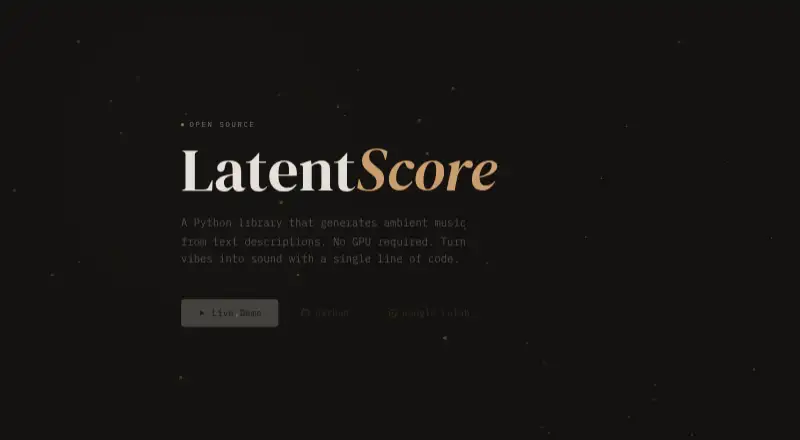
LatentScore Live is an open-source Python library that turns text descriptions into procedural ambient and electronic music. You can describe a vibe in natural language without musical training, then adjust tempo, mode, texture, and other settings in real time. The live interface exposes 18 or more musical parameters, shows generated titles and color palettes, and uses playback-responsive particle effects. Playlists can combine different vibes and cross-fade between tracks for live sets. The SDK continuously emits audio, allows synthesis changes during playback, and saves rendered output as WAV. NumPy-based CPU synthesis requires no GPU; the maker reports rendering two seconds of audio in 23 ms. Access includes a browser demo, Google Colab, Docker demo, GitHub source, documentation, and a PyPI package. Local pip installation supports macOS and Linux with Python 3.11 or 3.12. Native Windows pip is unsupported, though Docker Desktop with WSL2 is supported for the demo. Optional LiteLLM connectivity accepts a user-provided hosted LLM, including Anthropic, Gemini, and OpenAI. The project uses the Apache License 2.0 and cannot generate vocals.
Who it suits
LatentScore Live suits developers, researchers, and performers exploring text-driven ambient or electronic music. It is also useful for Python users who want live parameter control and WAV output.
What it does well
- Generates ambient music from text descriptions
- Real-time control of 18 or more parameters
- CPU synthesis needs no GPU
- Exports rendered audio as WAV
- Browser, Colab, Docker, and PyPI access
What to know first
- Native Windows pip installation is unsupported
- Cannot generate vocals
- Experimental optional local-LLM extra
Verdict
LatentScore Live combines text prompting, procedural synthesis, and live controls in an open-source Python project. Check the operating-system requirements and vocal limitation before adopting it.
Facts from LatentScore Live's own pages
- Access
- The maker links to a browser demo, GitHub source and documentation, Google Colab, and a PyPI installation. · latentscore.com, 5 Oct 2026
- Access options
- The maker links to a browser demo, a Colab notebook, Docker-based local demo, and a pip-installable Python library. · github.com, 12 Oct 2026
- Audio export formats
- wav · latentscore.com, 21 Sept 2026
- CPU synthesis
- The synthesizer is CPU-based, and the maker says the default retrieval backend runs in under a second without network access or inference. · prabal.ca, 12 Oct 2026
- Integrations
- The optional external install connects to hosted LLMs through LiteLLM, including Anthropic, Gemini, and OpenAI. · github.com, 12 Oct 2026
- Intended users
- The maker presents it as a Python library for generating ambient music from text descriptions and demonstrates it for research use. · github.com, 12 Oct 2026
- License
- The project is released under the Apache License 2.0. · github.com, 12 Oct 2026
- Live control
- The SDK can continuously emit audio and crossfade to new configurations while playback continues. · prabal.ca, 12 Oct 2026
- Live controls
- The demo offers real-time adjustment of 18 or more musical parameters, including tempo, mode, and texture. · latentscore.com, 5 Oct 2026
- Manual parameters
- Users can manually change synthesis parameters and re-render with updates. · prabal.ca, 12 Oct 2026
- Music focus
- The maker says it handles ambient and electronic music, but cannot generate vocals. · prabal.ca, 12 Oct 2026
- Optional models
- The heavy extra adds CLAP audio-based retrieval, while the expressive extra for local LLM inference is described as extremely experimental and under testing. · github.com, 5 Oct 2026
- Output
- The README shows saving generated audio to a WAV file. · github.com, 12 Oct 2026
- Output controls
- The Python library supports configuring musical parameters directly and saving rendered audio as WAV. · github.com, 5 Oct 2026
- Playlists
- The maker says users can build playlists of different vibes and cross-fade between tracks for live performance sets. · latentscore.com, 5 Oct 2026
- Product
- LatentScore is an open-source Python library that generates ambient music from text descriptions. · latentscore.com, 5 Oct 2026
- Supported SDK platforms
- Local pip installation is supported on macOS and Linux with Python 3.11 or 3.12; native Windows pip is unsupported. · github.com, 5 Oct 2026
- Supported setup
- The local SDK install supports macOS and Linux with Python 3.11 or 3.12; the demo can run through Docker Desktop on Windows using WSL2. · github.com, 12 Oct 2026
- Text to music
- Users can describe a vibe in natural language to generate ambient music without musical training. · latentscore.com, 5 Oct 2026
- Visual interface
- The web interface displays generated titles, color palettes, and a parameter editor, with particle effects that respond to playback. · prabal.ca, 12 Oct 2026
- Visuals
- The maker says particle effects are driven by the generated color palette. · latentscore.com, 5 Oct 2026
- What it does
- LatentScore is an open-source Python library that turns text prompts into procedural music in real time. · prabal.ca, 12 Oct 2026
- Windows demo
- The maker says the local Docker demo has been tested on Windows with Docker Desktop using the WSL2 backend. · github.com, 5 Oct 2026
Where LatentScore Live stands on Freedom251
- AI Music Generators#93 of 123