Freedom251 › Kubernetes Ingress Controllers
Kusk Gateway
What Kusk Gateway is
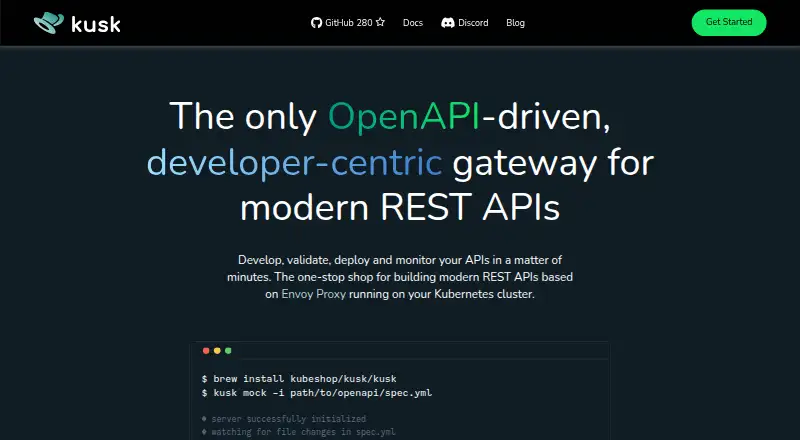
Kusk Gateway is a Kubernetes API gateway powered by Envoy and built for native OpenAPI support. It uses OpenAPI definitions to configure a cluster's Ingress Controller, fitting teams that follow an OpenAPI-first workflow for REST APIs. Kusk can mock responses for prototyping and automatically validate requests and responses. It also lets teams set request timeouts and CORS without coding, and control headers, CORS, limits, and quality of service globally or for particular paths. An open-source dashboard supports deploying and managing APIs, editing and validating specifications, and testing APIs. The maker says APIs can be published by adding an annotation to a service deployment without additional configuration or DevOps support. Kusk Gateway is self-hosted and available to install on Mac, Linux, or Windows. It is 100% open source under the MIT License. The maker presents it for teams building modern REST APIs on Kubernetes; the project documentation links to a Discord community and GitHub project.
Who it suits
It suits teams building REST APIs on Kubernetes with an OpenAPI-first workflow. It is also relevant to teams seeking a self-hosted gateway with API controls and a management dashboard.
What it does well
- Uses OpenAPI definitions to configure Kubernetes Ingress.
- Can mock API responses for prototyping.
- Automatically validates requests and responses.
- Offers path-level headers, limits, and QoS controls.
- Free and licensed under MIT.
What to know first
- Deployment model is self-hosted.
- Focused on Kubernetes API gateway workflows.
- No pricing tiers beyond the free gateway are listed.
Limits
The listed Kusk Gateway plan is free. Kusk is self-hosted and uses Kubernetes clusters for its gateway workflow.
Plans
| Plan | Billed and limits | Price |
|---|---|---|
| Kusk Gateway | 100% open source · MIT License | Free |
| Free | MIT-licensed open-source gateway; self-hosted Kubernetes deployment | Free |
As kusk.io lists them, read 5 Oct 2026. The maker's own page has the final word.
Getting started
- Visit the Kusk website and review its documentation.
- Choose an installation for Mac, Linux, or Windows from the download options.
- Deploy Kusk in a Kubernetes environment using its OpenAPI-based Ingress Controller workflow.
- Use the dashboard to deploy APIs, edit and validate specifications, and test APIs.
- For community and project resources, follow the Discord and GitHub links in the documentation.
Overview
Kusk Gateway is an open-source Kubernetes API gateway built on Envoy that uses OpenAPI definitions to configure cluster ingress. It is best suited to teams building REST APIs on Kubernetes with an OpenAPI-first workflow. Its appeal is the combination of specification-based setup, request controls and API management in a self-hosted package; teams outside Kubernetes will find its focus a poor fit.
Key features
OpenAPI sits at the center of Kusk’s workflow: definitions configure the Kubernetes Ingress Controller, and the dashboard supports editing and validating specifications as well as testing APIs. That alignment can keep an API-first process close to deployment, but it makes Kusk most relevant to teams already working in that model.
Mock responses let teams prototype before an API is built. Automatic request and response validation adds a way to protect endpoints, while configurable timeouts and CORS avoid coding those policies directly. Kusk can also inspect requests and adjust headers, CORS, limits and QoS globally or on individual paths, with rate limiting and authentication policies supported. These controls offer useful scope for shaping traffic, though the product remains a Kubernetes gateway rather than a general-purpose API service.
An open-source dashboard centralizes API deployment and management. Kusk says an API can be published by adding an annotation to a service deployment, without extra configuration or DevOps support. That could simplify publishing for teams using its workflow; the product’s self-hosted Kubernetes model still requires an environment suited to that deployment.
Pricing
Kusk Gateway costs free. The plan is 100% open source under the MIT License, and Kusk is self-hosted. There is no paid tier to compare: teams get an open-source gateway and dashboard, but should choose Kusk only if they can operate a self-hosted Kubernetes-based service.
Platforms
Kusk’s download page supports installation for Mac, Linux or Windows. The product is also categorized for API, web and self-hosted use, but its core role is configuring Kubernetes ingress; desktop installation support does not make it a substitute for a hosted gateway.
Who it's for
Kusk is a strong candidate for teams building modern REST APIs on Kubernetes and following an OpenAPI-first APIOps workflow. It suits developers who want validation, mocking and traffic policies alongside specification editing and deployment. Teams that do not use Kubernetes, or want a managed service instead of self-hosting, should look elsewhere.
Pros and cons
- Pro: OpenAPI definitions configure Kubernetes ingress, linking API specifications to the gateway workflow.
- Pro: Mocking, request and response validation, and path-level traffic controls support both prototyping and endpoint management.
- Pro: The MIT-licensed open-source plan costs nothing.
- Con: The self-hosted Kubernetes focus narrows its fit for teams seeking a managed or platform-neutral gateway.
- Con: Its workflow centers on OpenAPI and Kubernetes ingress, so teams outside that setup may not benefit from its main strengths.
Alternatives
Explore Kubernetes Ingress Controllers if you want to compare the broader category. Choose ngrok instead for a freemium option with a free plan, trial and online endpoints. Traefik Proxy is another free, open-source ingress controller, reverse proxy and load balancer with service auto-discovery.
agentgateway is a free open-source gateway that can be deployed as a binary, Docker image or Kubernetes workload. Airlock Microgateway offers a free Community Edition for small environments or local development, with enforced throughput and six-month license validity. Contour is a free open-source Kubernetes ingress controller with community support.
Envoy Gateway is a free open-source project for teams considering another Envoy-based option. HAProxy Ingress requires a Kubernetes cluster; version 0.16 requires Kubernetes 1.21 or newer. NGINX Gateway Fabric is a free open-source Kubernetes deployment whose Gateway API support varies by resource.
Verdict
Choose Kusk Gateway if your team runs Kubernetes, treats OpenAPI as the source of truth and wants validation, request controls and dashboard-based API management without a license fee. Its clearest advantage is bringing those capabilities into an OpenAPI-driven ingress workflow. Look elsewhere if you need a managed service or do not want to operate a Kubernetes-focused gateway yourself.
Verdict
Kusk Gateway combines OpenAPI-driven Kubernetes configuration with validation, request controls, and an open-source dashboard. Its self-hosted model and Kubernetes focus are central considerations.
Questions
How much does Kusk Gateway cost?
The Kusk Gateway plan is listed as free. The product is open source under the MIT License.
What does Kusk Gateway do?
It is a Kubernetes API gateway powered by Envoy with native OpenAPI support. It uses OpenAPI definitions to configure a cluster's Ingress Controller.
Which platforms can I install it on?
The download page lists installation options for Mac, Linux, and Windows.
Can Kusk mock or validate APIs?
It can mock API responses for prototyping and automatically validate requests and responses.
What can I manage through the dashboard?
The dashboard supports deploying and managing APIs, editing and validating specifications, and testing APIs.
Who is Kusk Gateway intended for?
The maker presents it for teams building modern REST APIs on Kubernetes and following an OpenAPI-first APIOps workflow.
Facts from Kusk Gateway's own pages
- API management
- The Kusk site describes a dashboard for deploying and managing APIs, editing and validating specifications, and testing APIs. · kusk.io, 5 Oct 2026
- API workflow
- Kusk uses OpenAPI definitions to configure the Ingress Controller of Kubernetes clusters. · docs.kusk.io, 5 Oct 2026
- Authentication
- Documented authentication modes include JWT, OAuth2/OIDC, custom authorization and Cloudentity. · docs.kusk.io, 15 Oct 2026
- CLI installation methods
- Installation options include Homebrew, a shell script, Debian/Ubuntu APT, Windows Chocolatey, release binaries and go install. · docs.kusk.io, 15 Oct 2026
- CLI platforms
- The Kusk CLI is distributed for macOS, Linux and Windows. · docs.kusk.io, 15 Oct 2026
- Community
- Kusk's documentation links to a Discord community and GitHub project. · docs.kusk.io, 5 Oct 2026
- Community support
- The project directs users to GitHub contribution workflows and a Discord community for feedback. · github.com, 15 Oct 2026
- Company ownership event
- InfraCloud reported on July 7, 2022 that Kubeshop acquired a majority stake in BotKube and was backed by Insight Partners and Ratmir Timashev. · infracloud.io, 15 Oct 2026
- Company profile
- Crunchbase describes Kubeshop as a private Wilmington, Delaware company with 11–50 employees and Dmitry Fonarev as CEO and co-founder. · crunchbase.com, 15 Oct 2026
- CORS and timeouts
- CORS, request timeouts, retries and idle timeouts can be configured through the x-kusk OpenAPI extension. · docs.kusk.io, 15 Oct 2026
- Dashboard
- The browser dashboard inspects APIs, Envoy Fleets and Static Routes and embeds Swagger UI for ad-hoc API requests. · docs.kusk.io, 15 Oct 2026
- Deployment
- Kusk says APIs can be published by adding an annotation to a service deployment, without additional configuration or DevOps support. · kusk.io, 5 Oct 2026
- Development status
- The repository README says Kubeshop has paused active development and support, while still considering incoming pull requests. · github.com, 15 Oct 2026
- Documentation depth
- Documentation includes getting-started tutorials, CLI reference, dashboard reference, Kubernetes resources, guides and a detailed OpenAPI extension reference. · docs.kusk.io, 15 Oct 2026
- Gateway components
- The installation can include Gateway Manager, Envoy Fleets, a REST API server and a dashboard. · docs.kusk.io, 15 Oct 2026
- Independent project feedback
- The GitHub issue tracker records an unassigned request for API logs and analytics, indicating a documented observability gap at that time. · github.com, 15 Oct 2026
- Installation model
- Kusk installs into Kubernetes with Helm through the kusk cluster install command. · docs.kusk.io, 15 Oct 2026
- Intended users
- The maker presents Kusk for teams building modern REST APIs on Kubernetes and following an OpenAPI-first APIOps workflow. · kusk.io, 5 Oct 2026
- Licence
- Kusk is presented as 100% open source under the MIT License. · kusk.io, 15 Oct 2026
- License
- Kusk is 100% open source under the MIT License. · kusk.io, 5 Oct 2026
- Limit: analytics
- A GitHub feature request asks for an API endpoint providing API logs and analytics; the issue remains open and marked for investigation. · github.com, 15 Oct 2026
- Maker headquarters
- The privacy policy gives the company address as 20 Brynwood Ln, Greenwich, Connecticut, United States. · kubeshop.io, 15 Oct 2026
- Maker leadership
- Kubeshop lists Dmitry Fonarev as CEO, Ole Lensmar as CTO and Joon Park as CFO/CMO. · kubeshop.io, 15 Oct 2026
- Maker legal identity
- Kubeshop operates as Kubernetes Innovation Labs LLC according to its privacy policy. · kubeshop.io, 15 Oct 2026
Where Kusk Gateway stands on Freedom251
- Kubernetes Ingress Controllers#4 of 28