Freedom251 › Data Virtualization Software
Kubling
What Kubling is
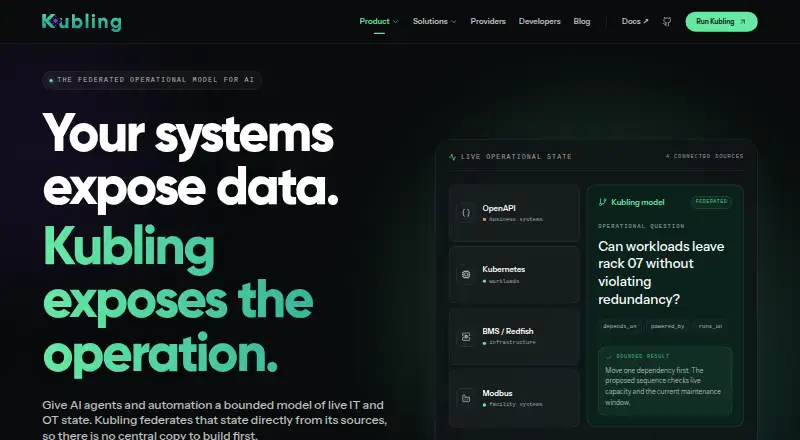
Kubling gives AI agents and automation a bounded model of live IT and OT state drawn from the systems that hold it. It makes shared entities, relationships, source ownership and valid actions explicit, so queries and mutations can reach across databases, APIs and infrastructure. Providers translate those operations into each source’s native protocol and keep their own credentials, source logic and release cycle; Kubling coordinates federation, planning and policy. Its OpenAPI provider turns API operations into relational entities and maps changes back to HTTP operations.
An instance can use local providers, connect with other Kubling instances, or combine both; the deployment does not require a central instance. Providers are independent services that follow a public gRPC contract and can be built in any language supporting gRPC. The catalog includes Cassandra, Kubernetes, OpenAPI and Redis, along with an in-memory reference provider. The provider protocol, Go SDK and official providers are open source, while the engine is not. Kubling is presented for data center, IT and platform, and industrial operations. Its Docker Compose quickstart runs Kubling, Kubling Studio and the in-memory provider as a disposable project.
Who it suits
Kubling suits teams working in data center, IT and platform, or industrial operations that need agents to query or change state across multiple sources. It is also a fit for teams that want to build independent providers against its gRPC contract.
What it does well
- Federates queries and mutations across databases, APIs and infrastructure.
- Providers translate operations into each source’s native protocol.
- Supports local providers and connections between Kubling instances.
- OpenAPI operations can be exposed as relational entities.
- Offers SQL, gRPC, native protocol and PostgreSQL wire access.
- Catalog includes Cassandra, Kubernetes, OpenAPI and Redis providers.
What to know first
- The engine is not open source.
- Provider APIs and releases are pre-1.0.
- Quickstart requires Git, Docker Engine and Docker Compose v2.
- Authentication and authorization rely on external systems.
Getting started
- Visit https://kubling.com/.
- Install Git, Docker Engine and Docker Compose v2.
- Follow the documented quickstart to run Kubling, Kubling Studio and the in-memory provider in Docker Compose.
- Pin exact Kubling and provider versions for production deployments.
Verdict
Choose Kubling when agents need a shared model for operating across IT or OT sources, while each provider retains its source credentials and logic. Teams seeking an entirely open-source engine should look elsewhere, since the engine itself is not open source.
Questions
Is Kubling free?
Its pricing model is free, and the provider protocol, Go SDK and official providers are open source. The engine is not open source.
Which integrations are listed?
The provider catalog lists Cassandra, Kubernetes, OpenAPI and Redis, plus an in-memory reference provider. Provider APIs and releases are pre-1.0; the catalog recommends pinning exact image versions and reviewing compatibility notes before upgrades.
How does authentication work?
Kubling relies on external systems for authentication and authorization and has no internal IAM mechanism. Runtime connection credentials authenticate the Kubling-to-runtime channel and do not grant VDB or source access.
How can Kubling be deployed?
Instances can use local providers, federate other Kubling instances, or do both. The deployment model is hybrid, with no central instance required.
What access protocols are supported?
Listed access protocols are SQL, gRPC, native protocol and PostgreSQL wire protocol. REST API access is also available.
What does the quickstart require?
It requires Git, Docker Engine and Docker Compose v2, and runs Kubling, Kubling Studio and the official in-memory provider as a disposable Docker Compose project.
Facts from Kubling's own pages
- Authentication
- Kubling does not have an internal IAM mechanism and relies on external systems for authentication, authorization, and role reading. · docs.kubling.com, 3 Oct 2026
- Cross-source operations
- Queries and mutations can cross databases, APIs and infrastructure, with providers translating operations into each source’s native protocol. · kubling.com, 2 Oct 2026
- Deployment
- Instances can use local providers, federate other Kubling instances, or both; the site says no central instance is required. · kubling.com, 3 Oct 2026
- Federated queries
- Queries and mutations can cross databases, APIs, and infrastructure, with providers translating operations to each source's native protocol. · kubling.com, 3 Oct 2026
- Integration maturity
- The provider catalog says provider APIs and releases are pre-1.0 and recommends pinning exact image versions and reviewing compatibility notes before upgrades. · docs.kubling.com, 3 Oct 2026
- Integrations
- The provider catalog lists Cassandra, Kubernetes, OpenAPI, and Redis integrations, plus an in-memory reference provider. · docs.kubling.com, 3 Oct 2026
- Intended users
- The site describes use for data center, IT and platform, and industrial operations teams. · kubling.com, 3 Oct 2026
- OpenAPI integration
- The OpenAPI provider exposes API operations as relational entities and maps mutations back to the API’s HTTP operations. · kubling.com, 2 Oct 2026
- Open source boundary
- The provider protocol, Go SDK, and official providers are open source, while the engine is not. · kubling.com, 3 Oct 2026
- Operational model
- The model makes entities, relationships, source ownership, policies, capabilities, and valid actions explicit. · kubling.com, 3 Oct 2026
- Production versioning
- The quickstart recommends pinning exact Kubling and provider versions in production deployments. · docs.kubling.com, 3 Oct 2026
- Provider architecture
- Providers are independent services behind a public gRPC contract and can use any language that supports gRPC. · kubling.com, 3 Oct 2026
- Provider development
- Providers are independent services behind a public gRPC contract, and teams can implement them in any language that supports gRPC. · kubling.com, 2 Oct 2026
- Purpose
- Kubling provides AI agents and automation with a bounded model of live IT and OT state, federated directly from source systems. · kubling.com, 3 Oct 2026
- Quickstart
- The documented quickstart runs Kubling, Kubling Studio, and an in-memory provider in Docker Compose and requires Git, Docker Engine, and Docker Compose v2. · docs.kubling.com, 3 Oct 2026
- Quickstart requirements
- The documented quickstart requires Git, Docker Engine and Docker Compose v2. · docs.kubling.com, 2 Oct 2026
- Quickstart scope
- The quickstart runs Kubling, Kubling Studio and the official In-memory provider as a disposable Docker Compose project. · docs.kubling.com, 2 Oct 2026
- Security boundary
- Kubling’s agent security documentation says runtime connection credentials authenticate the Kubling-to-runtime channel and do not grant VDB or source access. · docs.kubling.com, 2 Oct 2026
- Source ownership
- Providers retain their credentials, source logic and release cycle while Kubling handles federation, planning and policy. · kubling.com, 2 Oct 2026
- Transport security
- Kubling's HTTP endpoints can be secured with TLS by configuring a certificate at the application level. · docs.kubling.com, 3 Oct 2026
Where Kubling stands on Freedom251
- Data Virtualization Software#20 of 25