Freedom251 › Infrastructure Testing Tools
Kubetest2
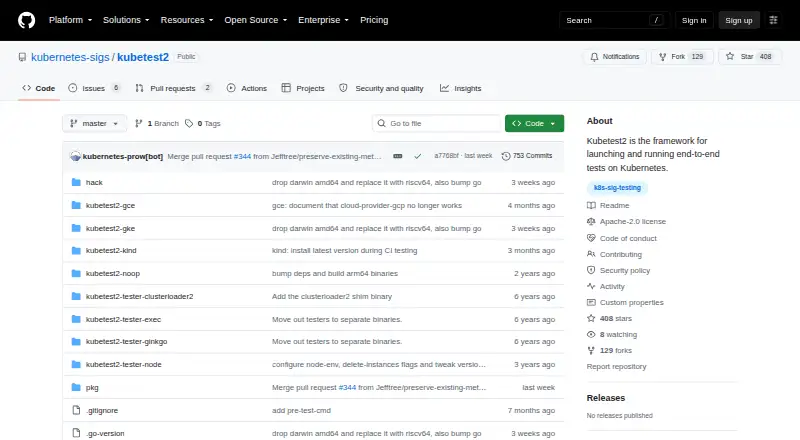
What Kubetest2 is
Kubetest2 is a free, open-source framework for deploying Kubernetes clusters and running end-to-end tests against them. It uses separate executables for deployers, cluster lifecycle management and test runners. The design aims to keep deployers and testers loosely coupled and to support implementations maintained outside the project.
Reference deployers include GCE, GKE, kind and noop, which can use an existing cluster. Reference testers include clusterloader2, exec, Ginkgo and node e2e runners. The README also lists external deployers for AKS, kOps, Terraform and EC2, plus an external kOps tester. Go installation commands are provided for Kubetest2 and its reference deployers and testers. The project runs locally and lists support for Terraform, provisioning tests, deployed checks, and deployments involving Google Cloud, AWS and Azure. It describes itself as unversioned and unreleased, and makes a best-effort attempt to work with Kubernetes releases in development and supported releases. Maintainer contact options include Kubernetes community Slack and a mailing list. The repository includes the Apache License 2.0.
Who it suits
It suits teams that need a framework to deploy Kubernetes clusters and run end-to-end tests with reference or external implementations. It may also fit teams using Terraform or deployments involving Google Cloud, AWS or Azure.
What it does well
- Provides reference deployers and multiple test runners.
- Can use an existing cluster with the noop deployer.
- Lists external deployers for AKS, kOps, Terraform and EC2.
- Apache License 2.0 grants no-charge, royalty-free rights under its terms.
What to know first
- The project is currently unversioned and unreleased.
- Compatibility is described as best-effort.
- Installation uses Go commands for the framework and reference components.
Plans
| Plan | Billed and limits | Price |
|---|---|---|
| Apache License 2.0 | No charge under the license | Free |
As github.com lists them, read 8 Oct 2026. The maker's own page has the final word.
Getting started
- Open the Kubetest2 GitHub repository.
- Install Kubetest2 using the Go commands in its README.
- Install a reference deployer and tester using their Go commands.
- Choose a deployer such as GCE, GKE, kind, or noop.
- Use Kubernetes community Slack or the mailing list to contact maintainers.
Verdict
Kubetest2 brings cluster deployment and end-to-end testing into one extensible framework, with reference and external implementations listed. Its unreleased status and best-effort compatibility approach are important considerations.
Questions
Is Kubetest2 free?
Yes. It is free and open source, with the Apache License 2.0.
How is Kubetest2 installed?
Its README provides Go installation commands for Kubetest2, reference deployers, and testers.
Which deployers are included as references?
The reference deployers are GCE, GKE, kind, and noop. Noop can use an existing cluster.
Which cloud environments are supported?
The listed cloud support covers Google Cloud through GCE and GKE, AWS through EC2, and Azure through AKS.
Is Kubetest2 a released, versioned project?
The project states that it is currently unversioned and unreleased.
How can users contact maintainers?
The README points users to Kubernetes community Slack and a mailing list.
Facts from Kubetest2's own pages
- Architecture
- The system consists of a discovery and orchestration binary, deployer binaries that manage cluster lifecycles, and tester binaries that execute tests. · github.com, 14 Oct 2026
- Artifact handling
- The ARTIFACTS environment variable identifies where logs and other test outputs should be stored. · deepwiki.com, 14 Oct 2026
- Cloud and local workflows
- The e2e-framework documentation demonstrates both noop execution against an existing cluster and KinD cluster creation and teardown. · pkg.go.dev, 14 Oct 2026
- Command syntax
- The documented command form places deployer flags before a double dash and tester arguments after it. · github.com, 14 Oct 2026
- Community ownership
- The CNCF conformance working group says SIG Testing handles the mechanics of Kubernetes conformance tests while SIG Architecture owns the conformance definition. · github.com, 14 Oct 2026
- Community support
- The README directs users to Kubernetes community Slack and a mailing list to contact maintainers. · github.com, 8 Oct 2026
- Compatibility policy
- Maintainers aim to keep the tool and reference implementations working with the in-development Kubernetes version and currently supported releases. · github.com, 14 Oct 2026
- Custom testers
- Custom testers must follow the naming convention, accept configuration arguments, use supplied environment variables, and return meaningful exit codes. · deepwiki.com, 14 Oct 2026
- Deployers
- Reference deployers include GCE, GKE, kind, and noop, which can use an existing cluster. · github.com, 8 Oct 2026
- Design goal
- Its separation of deployers and testers is intended to reduce coupling, keep the core small, and enable out-of-tree implementations. · github.com, 14 Oct 2026
- Documentation depth
- pkg.go.dev exposes documented packages for application logic, deployers, testers, artifacts, build helpers, metadata, process execution, and shared types. · pkg.go.dev, 14 Oct 2026
- E2E framework controls
- That tester supports package selection, feature and assessment filters, dry runs, parallel execution, fail-fast behavior, kubeconfig selection, and Go test flags. · pkg.go.dev, 14 Oct 2026
- E2E framework integration
- The Kubernetes e2e-framework publishes a kubetest2 tester that can be installed with Go and placed on PATH. · pkg.go.dev, 14 Oct 2026
- Extensibility
- Its design aims to minimize coupling between deployers and testers and encourage out-of-tree implementations. · github.com, 8 Oct 2026
- External implementations
- The README lists external deployers for AKS, kOps, Terraform, and EC2, plus a kOps tester. · github.com, 8 Oct 2026
- External integrations
- The project lists external implementations for AKS, kOps, Terraform, EC2, and a kOps tester. · github.com, 14 Oct 2026
- Go API
- The public Go types package defines deployer interfaces for build, up, down, status, log dumping, kubeconfig, initialization, finalization, post-test handling, provider identification, and version reporting. · pkg.go.dev, 14 Oct 2026
- Independent architecture description
- A Kubernetes Day India presentation describes Kubetest2 as orchestrating cluster creation, Kubernetes builds, test execution, log collection, and cluster deletion. · static.sched.com, 14 Oct 2026
- Independent kOps guidance
- The kOps documentation recommends Kubetest2 as the preferred framework for Kubernetes end-to-end testing and says it downloads artifacts into ./_artifacts. · kops.sigs.k8s.io, 14 Oct 2026
- Independent training coverage
- Class Central lists a free, 40-minute Linux Foundation video covering cloud testing, architecture, log collection, disposal, and custom deployer development. · classcentral.com, 14 Oct 2026
- Install
- The README provides Go install commands for Kubetest2, reference deployers, and testers. · github.com, 8 Oct 2026
- Installation
- The project documents installing the core, reference deployers, and testers with Go's go install command. · github.com, 14 Oct 2026
- Known compatibility gap
- The Kubernetes CI migration proposal says some tests need client-server version-skew checking that Kubetest2 did not yet support. · kubernetes.dev, 14 Oct 2026
- Known migration gap
- The same proposal says substantial kOps cluster setup functionality still needed to be ported into a Kubetest2 kOps deployer. · kubernetes.dev, 14 Oct 2026
Where Kubetest2 stands on Freedom251
- Infrastructure Testing Tools#2 of 28