Freedom251 › BDD Testing Tools
Kiwi
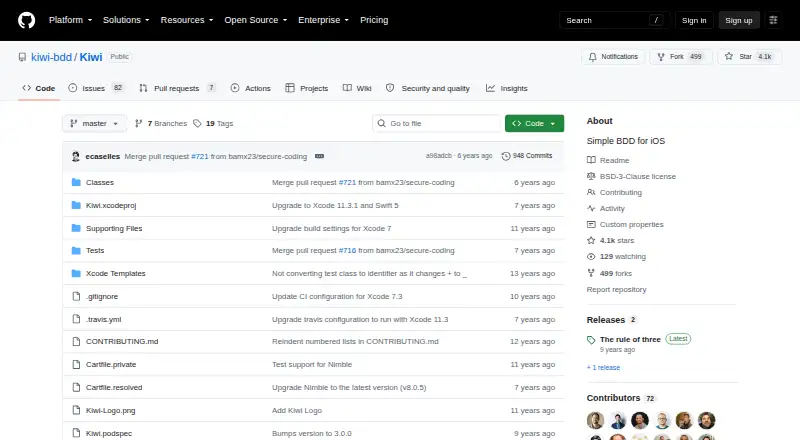
What Kiwi is
Kiwi is a free Behavior Driven Development library for iOS development. Developers write specifications in Objective-C and run them within Xcode, organizing examples with describe, context and it blocks. The project aims to make tests more readable than those produced with the bundled test framework. Its official GitHub wiki documents expectations, mocks and stubs, and asynchronous testing. The README includes CocoaPods and Carthage installation instructions, while the wiki is the stated documentation source. Kiwi 2.0 is identified as the most recent version and in active development; Kiwi 1.0 is legacy and no longer updated. The podspec declares XCTest as a dependency and sets deployment targets of iOS 8.0 and OS X 10.8. Kiwi supports Gherkin and local execution, but not browser testing or API access. The repository uses a BSD 3-Clause license. Questions go to a Google Group, while bug reports and feature requests use GitHub issues.
Who it suits
Kiwi suits iOS developers who want Objective-C BDD specifications integrated with Xcode. It is intended for local testing workflows.
What it does well
- Free BSD 3-Clause licensed library
- Readable describe, context and it structure
- Documentation covers expectations and mocks
- CocoaPods and Carthage instructions provided
- Kiwi 2.0 is in active development
What to know first
- No browser testing
- No API access
- Kiwi 1.0 is legacy and unmaintained
- Requires Objective-C and Xcode
Getting started
- Visit the Kiwi GitHub repository.
- Read the GitHub wiki, identified as the official documentation.
- Install using the CocoaPods or Carthage instructions in the README.
- Write Objective-C specifications and run them within Xcode.
Verdict
Kiwi provides a focused BDD style for Objective-C tests in Xcode, with documentation for common test components. Developers should use the actively developed 2.0 line and note its local, non-browser scope.
Questions
Does Kiwi cost anything?
Kiwi is listed as free, with a free plan.
Which platforms does Kiwi target?
It is listed for iOS and macOS. The podspec sets deployment targets of iOS 8.0 and OS X 10.8.
Which version is current?
The wiki says Kiwi 2.0 is the most recent version and in active development. Kiwi 1.0 is legacy and no longer updated.
How is Kiwi installed?
The README gives installation instructions for CocoaPods and Carthage.
What license does Kiwi use?
The repository provides a BSD 3-Clause license that permits redistribution and use subject to its stated conditions.
Does Kiwi support browser testing or API access?
No. Browser testing and API access are listed as unavailable; Kiwi runs locally.
Facts from Kiwi's own pages
- Asynchronous testing
- The official wiki lists asynchronous testing among its reference topics. · github.com, 7 Oct 2026
- Documentation
- The project identifies its GitHub wiki as the official documentation source. · github.com, 7 Oct 2026
- Documentation status
- The wiki identifies itself as the official documentation and says Kiwi 1.0 is legacy and no longer updated. · github.com, 8 Oct 2026
- Expectations
- The official wiki includes reference material for expectations. · github.com, 7 Oct 2026
- Framework
- The podspec declares XCTest as a framework dependency. · github.com, 8 Oct 2026
- Installation
- The README documents installation through CocoaPods or Carthage. · github.com, 8 Oct 2026
- Intended users
- Kiwi is intended for iOS developers seeking a BDD library that integrates with Xcode. · github.com, 7 Oct 2026
- Language and environment
- Specs are written in Objective-C and run within Xcode. · github.com, 7 Oct 2026
- Language and IDE
- Specs are written in Objective-C and run within Xcode. · github.com, 8 Oct 2026
- License
- The repository includes a BSD 3-Clause license. · github.com, 8 Oct 2026
- Mocks and stubs
- The official wiki includes reference material for mocks and stubs. · github.com, 7 Oct 2026
- Platform targets
- The podspec sets deployment targets of iOS 8.0 and OS X 10.8. · github.com, 8 Oct 2026
- Purpose
- Kiwi is a Behavior Driven Development library for iOS development. · github.com, 8 Oct 2026
- Readable specs
- The project says Kiwi aims to make tests more readable than those possible with the bundled test framework. · github.com, 8 Oct 2026
- Spec structure
- The README shows specs organized with describe, context, and it blocks. · github.com, 7 Oct 2026
- Support
- The README directs questions and suggestions other than bug reports to the Google Group, while the wiki directs bug reports and feature requests to GitHub issues. · github.com, 8 Oct 2026
- Test capabilities
- The official documentation lists specs, expectations, mocks and stubs, and asynchronous testing as reference topics. · github.com, 8 Oct 2026
- Version status
- The wiki says Kiwi 2.0 is the most recent version and in active development, while Kiwi 1.0 is legacy and no longer updated. · github.com, 7 Oct 2026
- Warranty
- The license provides the software “AS IS” and disclaims express and implied warranties. · github.com, 8 Oct 2026
Where Kiwi stands on Freedom251
- BDD Testing Tools#22 of 30