
KeystoneJS
by KeystoneJS
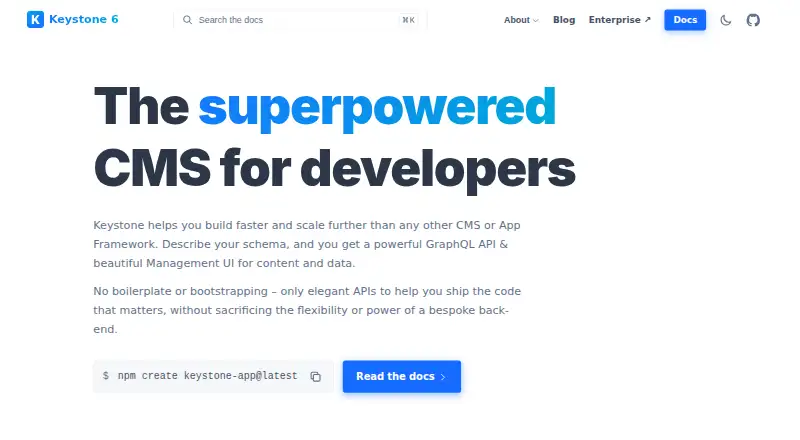
What KeystoneJS is
KeystoneJS is a free, open-source CMS and backend framework for building applications, websites, eCommerce services, and multichannel content experiences. It creates a GraphQL API and management interface from a schema, then supplies automated create, read, update, and delete operations, filtering, relationships, session management, and event hooks. Its configurable rich-text editor accepts custom React components and outputs structured JSON. Developers can define role-based permissions for lists, operations, and fields. Keystone connects with third-party systems, microservices, and external APIs. Deployment can use managed services or custom infrastructure, with databases and assets hosted in the cloud or self-hosted. It supports API, self-hosted, and web platforms. The named stack includes Prisma, Apollo Server, Next.js, PostgreSQL, and SQLite. Keystone 8 requires Node.js 20.19 or newer. Production migration files are handled through Prisma CLI; Keystone does not create or apply migrations.
Who it suits
KeystoneJS suits developers building schema-driven apps, websites, commerce projects, or multichannel content systems who want GraphQL and configurable access controls. It fits teams comfortable managing hosting and Prisma migrations themselves.
What it does well
- Free forever and open source
- Generates GraphQL API and management UI
- Custom role permissions for fields and operations
- Supports cloud or self-hosted deployment
- Integrates with external APIs and microservices
What to know first
- No content localization
- No built-in content preview
- No database-level security policies
- Requires Node.js 20.19 or newer
Limits
Keystone 8 requires Node.js 20.19 or newer. Production migrations must be managed through the Prisma CLI because Keystone does not create or apply them.
Plans
| Plan | Billed and limits | Price |
|---|---|---|
| Free | Free forever · Open source · no lock-in | Free |
As keystonejs.com lists them, read 11 Oct 2026. The maker's own page has the final word.
Getting started
- Visit the KeystoneJS website
- Use the free, open-source plan
- Prepare Node.js 20.19 or newer for Keystone 8
- Define your schema and configure lists, operations, and fields
- Choose managed, custom, cloud-hosted, or self-hosted deployment
- Manage production migration files with the Prisma CLI
Verdict
KeystoneJS combines a schema-driven CMS with backend capabilities, GraphQL, rich-text editing, and configurable permissions. Its free plan and flexible hosting suit developers, but migration management and database security policies remain outside Keystone.
Questions
How much does KeystoneJS cost?
Keystone has a free plan costing free, billed free forever.
Is KeystoneJS open source?
Yes. The free plan is open source and states no lock-in.
Which platforms are supported?
Keystone is available for API, self-hosted, and web use.
What API type does it generate?
Keystone generates a GraphQL API from a schema.
Does Keystone provide role permissions?
Yes. Developers can configure role-based access for lists, operations, and fields.
What support is available?
Community Slack offers help and personalized support, and the makers offer enterprise support.
Facts from KeystoneJS's own pages
- Access control
- Developers can configure role-based access with controls for lists, operations, and fields. · keystonejs.com, 11 Oct 2026
- API types
- graphql · keystonejs.com, 20 Sept 2026
- Compatibility requirement
- Keystone 8 requires Node.js 20.19 or newer. · keystonejs.com, 11 Oct 2026
- Content editing
- Its configurable rich-text editor supports custom React components and structured JSON output. · keystonejs.com, 11 Oct 2026
- Data migrations
- For production, migration files are managed with the Prisma CLI; Keystone does not create or apply migrations. · keystonejs.com, 11 Oct 2026
- Data operations
- It provides automated CRUD operations, filtering, relationships, session management, and event hooks. · keystonejs.com, 11 Oct 2026
- Developer stack
- The developer page names Prisma, Apollo Server, Next.js, PostgreSQL, and SQLite as components of its stack. · keystonejs.com, 11 Oct 2026
- Founded
- 2013 · keystonejs.com, 28 Sept 2026
- Free plan
- Yes · keystonejs.com, 20 Sept 2026
- Hosting
- Keystone can be deployed to managed services or custom infrastructure, and its database and assets can be cloud-hosted or self-hosted. · keystonejs.com, 11 Oct 2026
- Integrations
- Keystone can integrate with third-party systems, microservices, and external APIs. · keystonejs.com, 11 Oct 2026
- Content localization
- No · keystonejs.com, 20 Sept 2026
- Content preview
- No · keystonejs.com, 20 Sept 2026
- Product
- Keystone is an open-source CMS and backend framework that generates a GraphQL API and management UI from a schema. · keystonejs.com, 11 Oct 2026
- Role permissions
- custom · keystonejs.com, 20 Sept 2026
- Security limitation
- Keystone does not implement database-level security policies such as PostgreSQL row-level security. · keystonejs.com, 11 Oct 2026
- Support
- The Keystone community Slack offers help and personalized support, and enterprise support is available from the makers. · keystonejs.com, 11 Oct 2026
- Use cases
- The maker describes Keystone for apps, websites, eCommerce, and multichannel content experiences. · keystonejs.com, 11 Oct 2026
Where KeystoneJS stands on Freedom251
- Headless CMS#20 of 34