Freedom251 › BDD Testing Tools
JBehave
What JBehave is
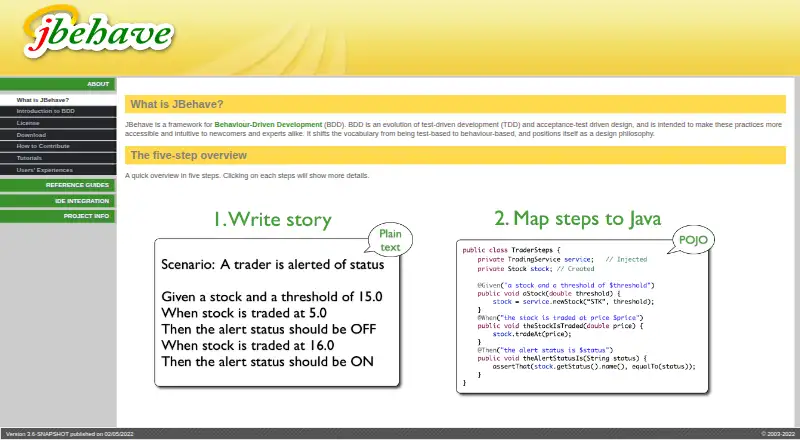
JBehave is a Java-based framework for Behaviour-Driven Development. It lets teams express user stories in its own syntax or Gherkin, then run stories concurrently using a chosen number of threads. Annotations connect textual steps to Java methods, and custom parameter converters can map string arguments to other parameter types. Dependency injection support includes Guice, Needle, PicoContainer, Spring, and Weld. Story reports can be produced in HTML, TXT, and XML, with JSON and XML cross-reference reports for external applications. Stories can be localised and written in any language. The project documents Maven integration and dependency retrieval through Gradle, Grape, Ivy, and sbt. Its REST module supports Redmine and XWiki; Confluence supports resource indexing and loading, but not uploading. Eclipse and IDEA plugins are documented, with the Eclipse plugin providing story syntax highlighting, step links, autocompletion, and validation. JBehave is self-hosted and BSD-style licensed. Downloads include Core and Web distributions in stable and preview categories, as well as source and binary downloads. The free plan is listed at 0.00 USD, with no paid plans or product limits stated.
Who it suits
JBehave suits Java teams using Behaviour-Driven Development who want to write executable stories in JBehave syntax or Gherkin. It can also suit teams that need localised stories, concurrent execution, dependency injection, and reports in several formats.
What it does well
- Accepts stories in JBehave syntax or Gherkin.
- Runs stories concurrently with a specified thread count.
- Supports five dependency injection frameworks.
- Generates HTML, TXT, XML, and cross-reference reports.
- Localised stories can be written in any language.
- BSD-style licensed and free.
What to know first
- Self-hosted deployment is the listed platform.
- Confluence support covers resource indexing and loading, not uploading.
Plans
| Plan | Billed and limits | Price |
|---|---|---|
| JBehave (BSD-licensed open-source software) | No paid plans or product limits stated | Free |
As jbehave.org lists them, read 5 Oct 2026. The maker's own page has the final word.
Getting started
- Visit the JBehave website.
- Choose a Core or Web distribution, stable or preview.
- Retrieve dependencies through Maven, Gradle, Grape, Ivy, or sbt.
- Run JBehave as self-hosted software.
Verdict
Choose JBehave if your Java team wants a free, BSD-style licensed framework for Behaviour-Driven Development, with Gherkin support and configurable concurrent story runs. Its reports and dependency injection options cover a range of workflows. Teams that need Confluence uploads should look elsewhere for that capability.
Questions
Is JBehave free?
Yes. The listed plan costs nothing, and no paid plans or product limits are stated.
What license does JBehave use?
JBehave is released under a BSD-style license.
Can JBehave use Gherkin?
Yes. User stories can be written in JBehave syntax or Gherkin syntax.
What reports can it generate?
Story reports are available in HTML, TXT, and XML. JSON and XML cross-reference reports are available for external applications.
Which integrations are documented?
The REST module supports Redmine and XWiki. Confluence supports resource indexing and loading, but not uploading.
How can I get JBehave?
Downloads include Core and Web distributions in stable and preview categories, plus source and binary downloads. The project documents Maven integration and dependency retrieval through Gradle, Grape, Ivy, and sbt.
Facts from JBehave's own pages
- Build tools
- The maker documents Maven integration and dependency retrieval through tools including Gradle, Grape, Ivy, and sbt. · jbehave.org, 5 Oct 2026
- Dependency injection
- Dependency injection support includes Guice, Needle, PicoContainer, Spring, and Weld. · jbehave.org, 5 Oct 2026
- Downloads
- The download page lists Core and Web distributions in stable and preview categories, plus source and binary downloads. · jbehave.org, 5 Oct 2026
- IDE integrations
- The site documents Eclipse and IDEA plugins; the Eclipse plugin includes story syntax highlighting, step links, autocompletion, and validation. · jbehave.org, 5 Oct 2026
- Languages
- JBehave supports localised user stories that can be written in any language. · jbehave.org, 5 Oct 2026
- License
- JBehave is released under a BSD-style license. · jbehave.org, 5 Oct 2026
- Purpose
- JBehave is a Java-based framework for Behaviour-Driven Development (BDD). · jbehave.org, 5 Oct 2026
- Reports
- Story reports can be generated in HTML, TXT, and XML, with JSON and XML cross-reference reports for external applications. · jbehave.org, 5 Oct 2026
- REST integrations
- The REST module supports Redmine and XWiki; Confluence is supported for resource indexing and loading, but not uploading. · jbehave.org, 5 Oct 2026
- Security
- The maker pages opened describe licensing and product features but do not state security certifications or compliance claims. · jbehave.org, 5 Oct 2026
- Step binding
- Annotations bind textual steps to Java methods, and custom parameter converters can convert string arguments to parameter types. · jbehave.org, 5 Oct 2026
- Story execution
- Stories can be executed concurrently with a specified number of threads. · jbehave.org, 5 Oct 2026
- Story formats
- User stories can be written in JBehave syntax or Gherkin syntax. · jbehave.org, 5 Oct 2026
- Support
- The site lists project mailing lists and issue tracking as project information resources. · jbehave.org, 5 Oct 2026
Where JBehave stands on Freedom251
- BDD Testing Tools#17 of 30