Freedom251 › Statistical Analysis Software
IDCeMPy
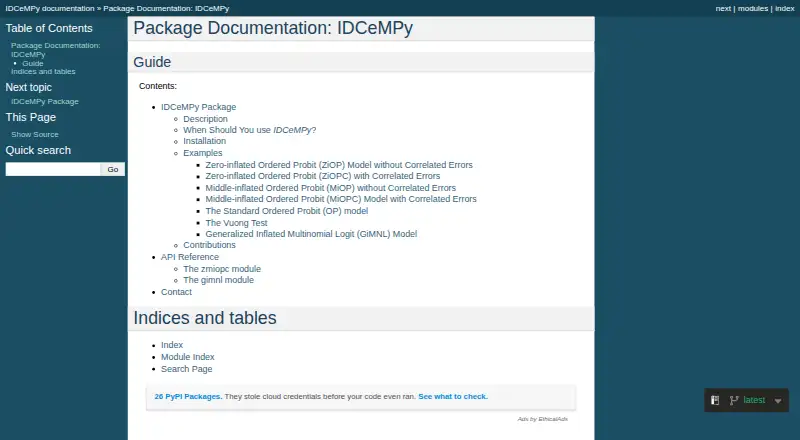
What IDCeMPy is
IDCeMPy is a free Python package for fitting and assessing inflated discrete choice models on desktop environments. It is intended for ordered or unordered polytomous outcomes where an outcome category contains an excessive share of observations from distinct data-generating processes. The package fits zero-inflated and middle-inflated ordered probit models, with or without correlated errors. It also handles generalized inflated multinomial logit models for three-outcome dependent variables, allowing the baseline, second, or third category to be inflated. Standard ordered probit and three-category multinomial logit models are included. Estimation uses maximum likelihood with Newton numerical optimization. IDCeMPy calculates AIC, log-likelihood, and Vuong test statistics, and produces fitted probabilities and marginal effects for split-stage and outcome-stage covariates. Data can be supplied as CSV, Stata files, or pandas DataFrames. Documentation covers pip and GitHub installation, with examples using pandas, urllib, and matplotlib.
Who it suits
It suits researchers analyzing inflated categories in ordered or unordered polytomous outcomes, including smoking, immigration-attitude, or vote-choice studies. Python users can work through scripting and DataFrame-based workflows.
What it does well
- Free Python package
- Several inflated model families
- AIC, likelihood, and Vuong diagnostics
- CSV, Stata, and DataFrame inputs
- Predictions and marginal effects
What to know first
- Correlated-error models run substantially longer
- Runtime depends on observations and covariates
- Examples use additional Python packages
Verdict
IDCeMPy offers specialized inflated-choice models alongside standard alternatives and model diagnostics. Correlated-error specifications may require considerably more runtime, so model choice should account for that cost.
Facts from IDCeMPy's own pages
- Contributions
- The authors welcome contributors to help test IDCeMPy and add functionality. · idcempy.readthedocs.io, 11 Oct 2026
- Data import formats
- CSV, Stata (.dta), pandas DataFrame · idcempy.readthedocs.io, 24 Sept 2026
- Dependencies in examples
- The documentation examples use pandas, urllib, and matplotlib for importing and visualizing data. · idcempy.readthedocs.io, 11 Oct 2026
- Deployment
- desktop · idcempy.readthedocs.io, 24 Sept 2026
- Diagnostics
- It computes AIC, log-likelihood, and Vuong test statistics to assess model performance. · idcempy.readthedocs.io, 11 Oct 2026
- Estimation
- The package estimates models by maximum likelihood using Newton numerical optimization methods. · idcempy.readthedocs.io, 11 Oct 2026
- Free plan
- Yes · idcempy.readthedocs.io, 24 Sept 2026
- Inflated category options
- For GiMNL, users can choose the baseline, second, or third outcome category as the inflated category. · idcempy.readthedocs.io, 11 Oct 2026
- Input workflow
- The examples use pandas DataFrames and show CSV and Stata data imports. · idcempy.readthedocs.io, 11 Oct 2026
- Installation
- The documentation gives installation instructions through pip and from the project's GitHub repository. · idcempy.readthedocs.io, 11 Oct 2026
- Intended use
- The documentation describes using IDCeMPy when an outcome category has an excessive share of observations arising from distinct data-generating processes. · idcempy.readthedocs.io, 11 Oct 2026
- Middle-inflated models
- It fits middle-inflated ordered probit models with or without correlated errors. · idcempy.readthedocs.io, 11 Oct 2026
- Model diagnostics
- It computes AIC, log-likelihood, and Vuong test statistics to assess model performance. · idcempy.readthedocs.io, 11 Oct 2026
- Multinomial models
- It fits generalized inflated multinomial logit models for three-outcome dependent variables. · idcempy.readthedocs.io, 11 Oct 2026
- Notable runtime limit
- The documentation says correlated-error models run substantially longer than their counterparts without correlated errors, and runtime also depends on observation and covariate counts. · idcempy.readthedocs.io, 11 Oct 2026
- Performance limit
- The documentation says models with correlated errors take substantially longer to run than their counterparts without correlated errors. · idcempy.readthedocs.io, 11 Oct 2026
- Predictions and effects
- Its functions calculate fitted probabilities and marginal effects for split-stage and outcome-stage covariates. · idcempy.readthedocs.io, 11 Oct 2026
- Purpose
- IDCeMPy is a Python package for fitting and assessing inflated discrete choice models. · idcempy.readthedocs.io, 11 Oct 2026
- Regression models
- Yes · idcempy.readthedocs.io, 24 Sept 2026
- Scripting support
- Yes · idcempy.readthedocs.io, 24 Sept 2026
- Standard models
- The package also includes standard ordered probit and three-category multinomial logit models. · idcempy.readthedocs.io, 11 Oct 2026
- Statistical tests
- Yes · idcempy.readthedocs.io, 24 Sept 2026
- Who it is for
- The documentation presents it for researchers analyzing inflated categories in ordered or unordered polytomous outcomes, including smoking, immigration-attitude, and vote-choice examples. · idcempy.readthedocs.io, 11 Oct 2026
- Zero-inflated models
- It fits zero-inflated ordered probit models with or without correlated errors. · idcempy.readthedocs.io, 11 Oct 2026
Where IDCeMPy stands on Freedom251
- Statistical Analysis Software#78 of 106