Freedom251 › Social Media Management Tools
Hollo
What Hollo is
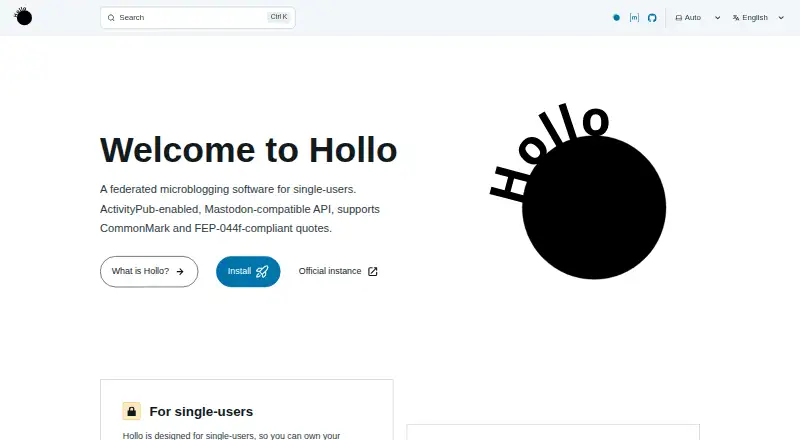
Hollo is a free, open-source, self-hosted server for single-user federated microblogging. It is intended for personal posts, notes, and journals, and one instance can hold multiple accounts. ActivityPub connects it with Mastodon, Misskey, Akkoma, WordPress, Threads, and other compatible services. Hollo is headless: it provides a Mastodon-compatible API and has no built-in web interface, so users connect through compatible clients. Posts use CommonMark formatting and can contain up to 10,000 characters, hashtags, mentions, media, polls, shares, favorites, emoji reactions, and FEP-044f quotes. Deployment options include Railway, Docker, or manual server installation. Manual setup requires Node.js 24 or later, pnpm, ffmpeg, PostgreSQL 17 or later, a load balancer, and a domain; Railway deployment requires S3-compatible media storage. Hollo is licensed under GNU AGPL version 3 or later and supports passkeys, TOTP two-factor authentication, OAuth 2.0 with PKCE, and CSRF protection.
Who it suits
Hollo suits individuals running personal fediverse servers and people comfortable deploying self-hosted software. It is not designed around moderation tools for shared instances.
What it does well
- Free and open source
- ActivityPub federation with multiple networks
- Posts up to 10,000 characters
- Passkeys and TOTP two-factor authentication
- Railway, Docker, or manual deployment
What to know first
- No built-in web interface
- Manual setup has several server requirements
- Designed for single-user instances
- Some client features may not work as expected
Plans
| Plan | Billed and limits | Price |
|---|---|---|
| Free, open source, and self-hosted | Self-hosted · single-user focused | Free |
As docs.hollo.social lists them, read 12 Oct 2026. The maker's own page has the final word.
Verdict
Hollo provides a focused, self-hosted microblogging server with broad federation and Mastodon-compatible client access. Its single-user design and deployment requirements make it more appropriate for personal infrastructure than shared community hosting.
Facts from Hollo's own pages
- Accounts
- One instance can host multiple accounts, which users can switch between. · docs.hollo.social, 12 Oct 2026
- Audience
- Hollo is designed for individual users and personal microblogs, notes, and journals; it can host multiple accounts on one instance. · docs.hollo.social, 5 Oct 2026
- Client access
- Hollo has no web app of its own and provides a Mastodon-compatible API for use with Mastodon clients. · docs.hollo.social, 12 Oct 2026
- Client API
- Hollo is headless and implements the Mastodon API, so users interact through compatible client apps rather than a built-in web interface. · docs.hollo.social, 5 Oct 2026
- Client limitations
- The tested-client notes say Elk does not support emoji reactions and treats quotes as write-only; Phanpy reactions are read-only. · docs.hollo.social, 5 Oct 2026
- Client support
- The maker lists tested web, Android, and iOS clients, including Phanpy, Moshidon, Mona, and Woolly, while noting some client features may not work as expected. · docs.hollo.social, 5 Oct 2026
- Core features
- Hollo supports hashtags, mentions, media attachments, polls, sharing and favoriting posts, and Misskey-style emoji reactions. · docs.hollo.social, 5 Oct 2026
- Deployment
- Hollo can be deployed to Railway, with Docker, or manually on a server. · docs.hollo.social, 5 Oct 2026
- Federation
- Hollo implements ActivityPub and interoperates with Mastodon, Misskey, Akkoma, WordPress, and Threads. · docs.hollo.social, 12 Oct 2026
- Installation
- The maker documents deployment through Railway, Docker, or manual installation from source. · docs.hollo.social, 12 Oct 2026
- License
- Hollo is distributed under the GNU Affero General Public License version 3 or later. · docs.hollo.social, 12 Oct 2026
- Notable limitation
- Hollo is designed for single-user instances and omits moderation tools intended for shared instances. · docs.hollo.social, 12 Oct 2026
- Posting features
- Hollo supports polls, media attachments, hashtags, mentions, FEP-044f quote posts, and Misskey-style emoji reactions. · docs.hollo.social, 12 Oct 2026
- Privacy controls
- Hollo can proxy or cache remote media through its own origin, with SSRF checks and a 32 MiB body cap in proxy and cache modes. · docs.hollo.social, 5 Oct 2026
- Product
- Hollo is a single-user federated microblogging tool for running a personal server. · docs.hollo.social, 5 Oct 2026
- Quotes
- Hollo supports FEP-044f-compliant quotes in Misskey-style and Mastodon-style implementations. · docs.hollo.social, 5 Oct 2026
- Requirements
- Hollo requires PostgreSQL and a place to store media. · docs.hollo.social, 12 Oct 2026
- Security
- Hollo supports passkeys, TOTP two-factor authentication, OAuth 2.0 with PKCE, and CSRF protection on cookie-authenticated routes. · docs.hollo.social, 12 Oct 2026
- Security configuration
- Hollo requires a session secret key of at least 44 characters, and its documentation warns that enabling the Fedify debugger in production exposes internal trace data. · docs.hollo.social, 5 Oct 2026
- Storage
- Media can be stored on the local filesystem or S3-compatible object storage. · docs.hollo.social, 12 Oct 2026
- Supported networks
- Mastodon,Misskey,Akkoma,WordPress,Threads,and other ActivityPub-compatible services · docs.hollo.social, 23 Sept 2026
- What it does
- Hollo is a self-hosted, single-user microblogging server for the fediverse. · docs.hollo.social, 12 Oct 2026
- Writing
- Posts support CommonMark and can be up to 10,000 characters long. · docs.hollo.social, 12 Oct 2026
Where Hollo stands on Freedom251
- Social Media Management Tools#42 of 145