gRPC Swagger
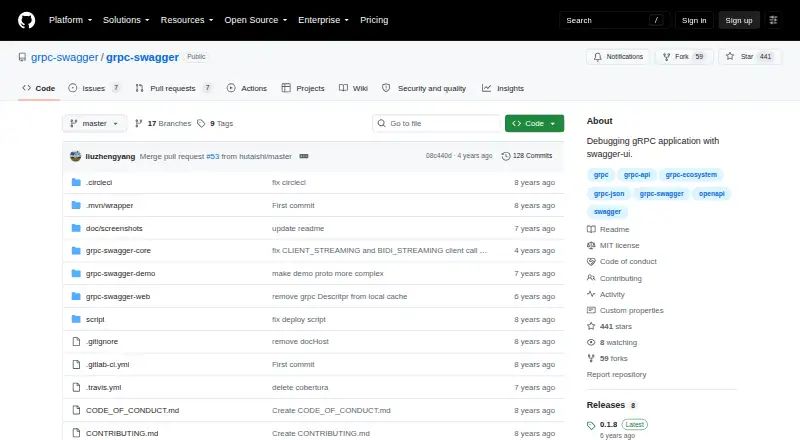
What gRPC Swagger is
gRPC Swagger is a free, open-source debugging tool for discovering and calling gRPC methods through Swagger UI. It uses gRPC reflection to find services and methods, then displays method definitions and parameters. To connect a service, register its host and port; the tool scans the endpoint for available services. The gRPC service must have reflection enabled for discovery. Setup does not require changes to proto files or related implementations. In Swagger UI, users can call a method with the “Try it out” button, supplying request data and headers in JSON format. The project can run from a released JAR or be built from source, and defaults to port 8080. Configuration can enable or disable listing registered services and set an interval for expiring a service registration after inactivity. Its documented API covers service registration, listing, method calls, and Swagger UI documentation. gRPC Swagger is self-hosted and lists API and web as platforms. It is provided under the MIT License, which permits use without charge subject to its conditions; the project also invites contributions through issues and pull requests.
Who it suits
gRPC Swagger suits developers who need to inspect and call gRPC methods through Swagger UI, provided their gRPC service has reflection enabled. It may also suit teams that want to run the tool themselves from a released JAR or source.
What it does well
- Free, open-source software under the MIT License
- Displays gRPC methods and parameters in Swagger UI
- Calls methods through the “Try it out” control
- Accepts JSON request data and headers
- Can run from a released JAR or source
What to know first
- The gRPC service must have reflection enabled
- The project is self-hosted
- Inactive service registrations can expire according to a configured interval
Limits
Service discovery requires reflection to be enabled on the gRPC service. An inactive registered service can expire after the configured interval.
Plans
| Plan | Billed and limits | Price |
|---|---|---|
| Open source | MIT-licensed software | Free |
As github.com lists them, read 7 Oct 2026. The maker's own page has the final word.
Getting started
- Enable reflection on the gRPC service
- Run the released JAR or build the project from source
- Register the service by entering its host and port
- Open Swagger UI to view discovered methods and parameters
- Use “Try it out” with JSON request data and headers
Verdict
Choose gRPC Swagger if you need a free, self-hosted way to discover and call gRPC methods in Swagger UI and can enable reflection on the service. Look elsewhere if the service cannot provide reflection or you need a hosted deployment.
Questions
Is gRPC Swagger free?
Yes. It is open source under the MIT License, which permits use without charge subject to its conditions.
What does gRPC Swagger do?
It uses gRPC reflection to discover services and methods, displays their definitions in Swagger UI, and lets users call methods there.
What does a gRPC service need for discovery?
Reflection must be enabled on the service. Setup does not require changes to proto files or related implementations.
How do I register a service?
Provide the gRPC endpoint’s host and port; the tool scans it for available services.
How can I run the project?
Run a released JAR or build from source. The default port is 8080.
Which platforms and deployment model are listed?
The listed platforms are API, self-hosted, and web; the deployment model is self-hosted.
Facts from gRPC Swagger's own pages
- API
- The documented endpoints include service registration, listing services, calling a gRPC method, and returning API documentation for Swagger UI. · github.com, 4 Oct 2026
- Configuration
- A setting can enable or disable listing registered services, and another can expire an inactive registered service after a specified number of seconds. · github.com, 4 Oct 2026
- Deployment
- The README documents running a released JAR or building from source, with port 8080 as the default. · github.com, 7 Oct 2026
- Endpoint registration
- The tool registers a gRPC endpoint by host and port, then scans for available services. · github.com, 4 Oct 2026
- Integrations
- The README describes integration with swagger-ui and use of the gRPC reflection feature. · github.com, 7 Oct 2026
- Latest listed release
- The releases page lists version 0.1.8 as the latest release and describes it as fixing duplicate services after registration. · github.com, 7 Oct 2026
- License
- The repository provides the software under the MIT License. · github.com, 7 Oct 2026
- Metadata
- The tool accepts JSON-formatted request data and JSON-formatted headers that it passes as metadata to the gRPC server. · github.com, 7 Oct 2026
- Method calls
- Users can call a gRPC method through Swagger UI’s “Try it out” button. · github.com, 7 Oct 2026
- Method definitions
- Swagger UI displays gRPC method and parameter definitions. · github.com, 7 Oct 2026
- Method testing
- Users can test a gRPC method with the Swagger UI “Try it out” button. · github.com, 4 Oct 2026
- Notable requirement
- The gRPC service must have reflection enabled for the tool to discover its services and methods. · github.com, 4 Oct 2026
- Purpose
- gRPC Swagger is a debugging tool that uses gRPC reflection and Swagger UI to list and call gRPC methods. · github.com, 7 Oct 2026
- Request format
- The request data and headers passed to the gRPC server are supplied in JSON format. · github.com, 4 Oct 2026
- Service definitions
- Swagger UI displays definitions of gRPC methods and their parameters. · github.com, 4 Oct 2026
- Service expiration
- A configurable expiration interval can remove a registered service after a period without access. · github.com, 7 Oct 2026
- Service listing
- A command-line parameter can enable listing registered services through the listServices API. · github.com, 7 Oct 2026
- Service registration
- Users register a gRPC endpoint by providing its host and port. · github.com, 7 Oct 2026
- Setup
- The README says users can enable reflection when starting their service without modifying proto files or related implementations. · github.com, 7 Oct 2026
- Support
- The README invites users to open an issue or pull request to contribute. · github.com, 7 Oct 2026
- Support and contributions
- The project invites users to open an issue or pull request to contribute. · github.com, 4 Oct 2026
Where gRPC Swagger stands on Freedom251
- gRPC Tools#10 of 24