Freedom251 › Text-to-Speech Software
GLM-TTS
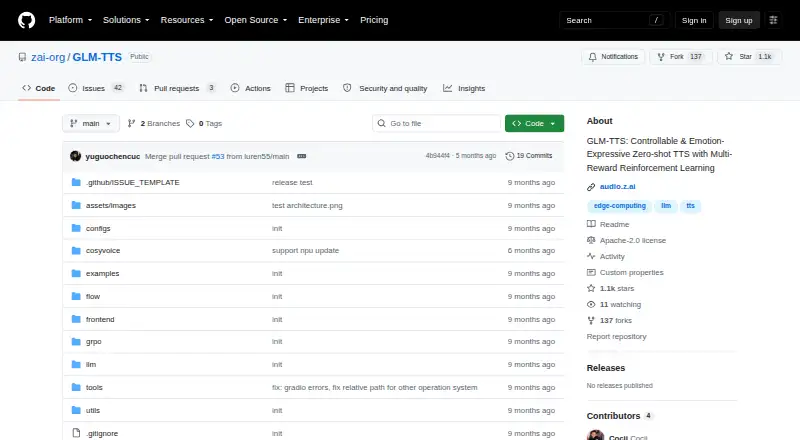
What GLM-TTS is
GLM-TTS is a free, open-source text-to-speech system for Linux, self-hosted deployment, and a web interface. Its large-language-model architecture generates speech-token sequences, then a Flow model converts them into audio waveforms. The project supports zero-shot voice cloning, real-time streaming, emotional expression, and prosody control. It primarily handles Chinese and also accepts mixed Chinese and English text. Phoneme-in combines phonemes with text to guide pronunciation for selected words, including polyphones and rare characters. Users can run command-line or shell-script inference, choose among sampling strategies and inference modes, or launch an interactive Gradio interface. WAV is the listed export format. Complete model weights are provided through Hugging Face or ModelScope. Setup instructions cover GPU and Ascend NPU environments and require Python 3.10–3.12. The repository displays an Apache-2.0 license and acknowledges CosyVoice, Llama, and Vocos. Commercial use is listed, along with text-to-video and image-to-video support.
Who it suits
It suits developers and teams wanting self-hosted, open-source speech synthesis with Chinese support, voice cloning, streaming, and pronunciation controls. GPU or Ascend NPU setup guidance is provided.
What it does well
- Open-source under Apache-2.0
- Supports zero-shot voice cloning
- Provides streaming audio generation
- Offers phoneme-level pronunciation control
- Includes Gradio web interface
What to know first
- Primarily supports Chinese
- Requires Python 3.10–3.12
- Setup targets GPU or Ascend NPU environments
- WAV is the listed export format
Verdict
GLM-TTS offers an open implementation with streaming, cloning, and expressive controls. Its language focus and hardware-oriented setup matter when evaluating deployment.
Facts from GLM-TTS's own pages
- Deployment hardware
- The repository provides separate setup instructions for GPU and NPU environments. · github.com, 13 Oct 2026
- Emotion control
- Its multi-reward reinforcement learning framework supports emotional expression and prosody control. · github.com, 13 Oct 2026
- Export formats
- WAV · github.com, 20 Sept 2026
- Hardware and setup
- The setup instructions cover GPU and Ascend NPU environments and specify Python 3.10–3.12. · github.com, 12 Oct 2026
- Inference
- The repository provides command-line and shell-script inference, plus an interactive web interface launched with Gradio. · github.com, 12 Oct 2026
- Inference options
- It supports phoneme-level text-to-speech, multiple sampling strategies, and multiple inference modes. · github.com, 13 Oct 2026
- Integrations
- The project acknowledges CosyVoice for frontend processing and vocoding, Llama as its language-model architecture, and Vocos as a vocoder. · github.com, 12 Oct 2026
- Languages
- It primarily supports Chinese and also supports English mixed text. · github.com, 13 Oct 2026
- License
- The repository identifies its license as Apache-2.0. · github.com, 13 Oct 2026
- Model architecture
- The system uses an LLM to generate speech token sequences and a Flow model to convert tokens into audio waveforms. · github.com, 13 Oct 2026
- Model downloads
- The complete model weights can be downloaded from Hugging Face or ModelScope. · github.com, 13 Oct 2026
- Platforms
- web,self_hosted · github.com, 20 Sept 2026
- Product
- GLM-TTS is a large-language-model-based text-to-speech system that supports zero-shot voice cloning and streaming inference. · github.com, 12 Oct 2026
- Pronunciation
- Phoneme-in supports hybrid phoneme and text input to control pronunciation of specific words, including polyphones and rare characters. · github.com, 12 Oct 2026
- Purpose
- GLM-TTS is a text-to-speech synthesis system based on large language models. · github.com, 13 Oct 2026
- Requirements
- The quick-start instructions specify Python 3.10 through 3.12. · github.com, 13 Oct 2026
- Security
- The repository page does not state security certifications or compliance claims. · github.com, 12 Oct 2026
- Streaming
- It supports real-time streaming audio generation for interactive applications. · github.com, 13 Oct 2026
- Support
- The project links to a technical report, Hugging Face, ModelScope, and an Audio.Z.AI site; the repository page does not specify a support service. · github.com, 12 Oct 2026
- Upcoming work
- The README lists a 2D Vocos vocoder update and reinforcement-learning-optimized model weights as coming soon. · github.com, 13 Oct 2026
- Voice cloning
- It supports zero-shot voice cloning from 3–10 seconds of prompt audio. · github.com, 13 Oct 2026
- Web interface
- The repository includes instructions for running an interactive web interface with Gradio. · github.com, 13 Oct 2026
Where GLM-TTS stands on Freedom251
- Text-to-Speech Software#79 of 223
- Text-to-speech tools#134 of 232