Freedom251 › Subscription Billing Software

GetPaidHQ
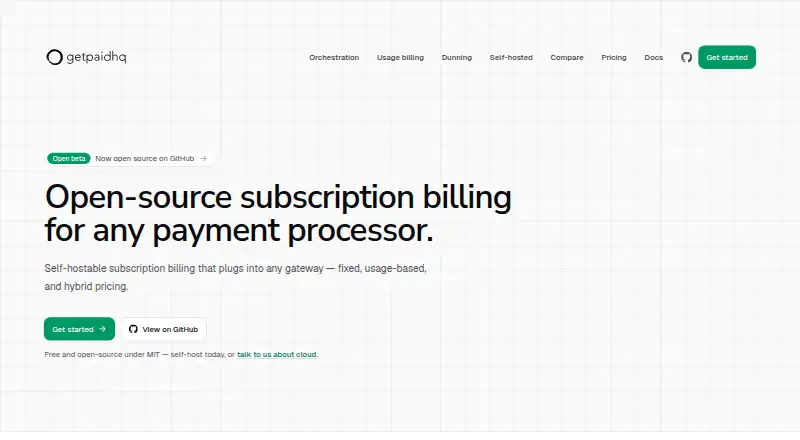
What GetPaidHQ is
GetPaidHQ is open-source subscription billing software that can run on a team’s own infrastructure and use a payment processor of its choice. It supports fixed, usage-based, tiered, and hybrid pricing within one subscription, as well as proration controls and multiple currencies. Charges can be routed by region, customer, or failover. Built-in dunning detects payment failures, retries them according to decline reason and customer history, and gives customers links to update their payment details.
The product provides a REST API, webhooks, idempotency keys, and typed SDKs for Node, Python, PHP, and Go. Checkout.com and Paystack are supported, and other processors can be added through its adapter interface. The MIT-licensed self-hosted plan has no software charge; customers pay for their own infrastructure. The maker says this keeps payment and customer data within that infrastructure. Community support is included. GetPaidHQ is currently in open beta, and its maker says managed Cloud is coming. Cloud pricing is being finalized, with early-access terms available by contacting the maker. The stated technology stack is Go, PostgreSQL, Temporal, and NATS. GetPaidHQ is positioned for teams that use regional, in-house, or multiple processors, or have data-residency and ownership requirements.
Who it suits
GetPaidHQ suits teams that need subscription billing with regional, in-house, or multiple payment processors, or that have data-residency or ownership requirements. It is also relevant to teams seeking to self-host open-source billing software and build around its API, SDKs, and webhooks.
What it does well
- Supports fixed, usage-based, tiered, and hybrid pricing in one subscription.
- Routes charges by region, customer, or failover.
- Retries failed payments based on decline reason and customer history.
- Includes REST API, webhooks, idempotency keys, and four typed SDKs.
- MIT-licensed self-hosted software has no software charge.
- Supports Checkout.com and Paystack, with an adapter interface for others.
What to know first
- Self-hosted customers pay for their own infrastructure.
- The product is currently in open beta.
- Managed Cloud is not yet available; pricing is being finalized.
- There is no customer billing portal.
Limits
The self-hosted plan has no software charge, but customers pay for their own infrastructure. The managed Cloud option is described as coming, with pricing being finalized and early-access terms available by contacting the maker.
Plans
| Plan | Billed and limits | Price |
|---|---|---|
| Self-hosted | Free under MIT · Fixed, usage-based, and hybrid pricing · Built-in dunning and invoicing · Bring your own gateway · Community support | Free |
| Cloud | Pricing is being finalized; contact for early-access terms · Fully managed hosting · Priority support and SLA · Onboarding assistance · Custom adapter development on request | On request |
As getpaidhq.co lists them, read 21 Oct 2026. The maker's own page has the final word.
Getting started
- Visit https://getpaidhq.co/.
- Run the MIT-licensed self-hosted product on your own infrastructure.
- Choose Checkout.com, Paystack, or add a processor through the adapter interface.
- Use the REST API, webhooks, or a typed SDK for Node, Python, PHP, or Go.
GetPaidHQ is open-source subscription billing software that you host on your own infrastructure and connect to payment processors. It is best suited to teams with regional or multiple-processor needs, or a strong requirement to control where customer and payment data reside. Its billing and routing flexibility is compelling, but it is in open beta and does not provide a customer billing portal.
Overview
GetPaidHQ brings fixed, usage-based, tiered, and hybrid pricing together within a single subscription. That breadth can help businesses avoid splitting more complex billing arrangements across separate systems. Proration controls and multi-currency billing add useful flexibility, though teams that need customers to manage their own billing through a portal will need another solution.
The product is currently in open beta. Self-hosting gives teams control over their infrastructure and data location, but also makes them responsible for operating that infrastructure. The maker labels its privacy policy a placeholder and advises review by qualified counsel before relying on it.
Key features
Billing and payment routing
Combining fixed, usage-based, tiered, and hybrid charges within one subscription can accommodate pricing that does not fit a simple flat recurring fee. Teams can route charges by region or customer, or configure failover. Checkout.com and Paystack are supported, with an adapter interface for adding other processors. This is a meaningful advantage for businesses with regional payment arrangements or more than one gateway, but the supported processor set is narrower out of the box than the routing flexibility might suggest.
Dunning and integrations
Built-in dunning detects failed payments and retries according to decline reason and customer history. Customer-facing payment-update links give customers a way to address payment problems, which can reduce the manual work of chasing failed charges. The REST API, webhooks, idempotency keys, and typed SDKs for Node, Python, PHP, and Go give engineering teams several integration paths. This toolkit is well suited to teams prepared to build around billing APIs; it is less suitable for businesses that need a ready-made customer portal.
Self-hosting and data
The MIT-licensed software can run on a customer's infrastructure without a software charge, and the maker says this keeps payment and customer data within that infrastructure. That suits organizations with data-residency or ownership requirements. The trade-off is operational responsibility and infrastructure cost. GetPaidHQ's stated stack is Go, PostgreSQL, Temporal, and NATS, details that may matter to teams assessing how it fits their technical environment.
Pricing
Self-hosted
The Self-hosted plan is free, billed Free under MIT. It includes fixed, usage-based, and hybrid pricing, built-in dunning and invoicing, bring-your-own-gateway support, and community support. There is no software charge, but customers pay for their own infrastructure. This is the practical starting point for engineering-led teams that want control and can manage hosting themselves. The plan does not include managed hosting or priority support.
Cloud
The Cloud plan has custom pricing: pricing is being finalized, with early-access terms available by contacting the maker. It is planned to include fully managed hosting, priority support and an SLA, onboarding assistance, and custom adapter development on request. Those services may suit teams that want GetPaidHQ's billing capabilities without running the infrastructure, but it is not yet presented as a generally available managed option.
Platforms
GetPaidHQ is available as a web product and through an API, with a self-hosted deployment option. The API and SDKs make it a natural fit for teams integrating billing into their own products rather than relying on a customer-facing portal.
Who it's for
GetPaidHQ is a strong fit for teams that need to combine billing models, select or route among processors, or keep payment and customer data on infrastructure they control. It is also a plausible choice for organizations willing to operate open-beta software and build integrations with its API. Teams that require a customer billing portal, managed hosting now, or a more established hosted service should look elsewhere.
Pros and cons
- Pros: Four billing models can coexist in one subscription, supporting more complex pricing structures.
- Pros: Routing by region, customer, or failover and an adapter interface support processor choice and extensibility.
- Pros: The MIT-licensed self-hosted plan has no software charge and keeps data within the customer's infrastructure, according to the maker.
- Pros: Automated dunning, payment-update links, and SDKs for four languages provide useful recovery and integration tools.
- Cons: There is no customer billing portal, so businesses wanting self-service account billing need another option.
- Cons: Self-hosting leaves infrastructure costs and operations to the customer, while the Cloud option is still forthcoming.
- Cons: Open beta status and a placeholder privacy policy call for caution, particularly for organizations with strict compliance needs.
Alternatives
Kill Bill is worth considering for teams seeking a freemium, open-source self-hosted core and a free trial, with deployments across API, desktop, web, and server platforms.
Billsby may suit teams that prefer a paid subscription service: its Core plan is $45 a month, with five users, one payment gateway, one tax region, and usage billing, plus 0.4% on revenue exceeding $15,000/mo.
Churn Buster is a more focused option for recovery analytics or dunning and cancellation flows; its Measure plan is free, while Dunning or Cancel Flows starts at $269 a month.
FOSSBilling is another free, open-source option for teams seeking self-hosted billing software.
Lago offers a free AGPLv3-licensed self-hosted open-source plan, making it an alternative for teams comfortable with that license; its Premium plan has custom pricing.
Pabbly Subscriptions may appeal to teams looking for a freemium subscription service, with a free plan capped at 50 customers and a paid Standard plan at $14 a month.
Paymenter is a free MIT-licensed open-source billing platform, with a PaaS option at €5 a month for teams that prefer that deployment route.
PayWhirl is another freemium option, with a free Starter plan and a 3.0% per-transaction charge before gateway processing fees.
Browse more options in Subscription Billing Software.
Verdict
Choose GetPaidHQ if your team needs flexible subscription models, control over payment routing, and the ability to keep billing data on infrastructure it operates. Its no-software-charge MIT self-hosted plan and integration tools make that combination attractive to technical teams. Look elsewhere if a customer billing portal is essential, you need managed Cloud today, or open-beta software is not appropriate for your operations.
Verdict
Choose GetPaidHQ if you want to self-host subscription billing, control payment routing, or use several billing models and processors. Look elsewhere if a customer billing portal is required, or if you need a managed Cloud service now.
Questions
Is GetPaidHQ free?
The Self-hosted plan is listed as free under MIT. Customers pay for their own infrastructure.
Is GetPaidHQ open source?
Yes. The self-hosted product is MIT-licensed.
Which payment processors does it support?
Checkout.com and Paystack are supported. Other processors can be added through the adapter interface.
Which billing models does GetPaidHQ support?
It supports fixed, usage-based, tiered, and hybrid pricing within a single subscription, along with proration controls and multiple currencies.
Can I use a customer billing portal?
No. GetPaidHQ does not offer a customer billing portal.
Is managed Cloud available?
The maker says managed Cloud is coming. Pricing is being finalized, and early-access terms are available by contacting the maker.
Facts from GetPaidHQ's own pages
- API
- The product provides a JSON REST API for customer, catalog, order, subscription, usage, invoice, payment, webhook, and dunning operations. · getpaidhq.co, 21 Oct 2026
- API and SDKs
- GetPaidHQ provides a REST API, typed SDKs for Node, Python, PHP, and Go, webhooks, and idempotency keys. · getpaidhq.co, 8 Oct 2026
- App listings
- The pages reviewed did not identify a GetPaidHQ listing in the Apple App Store, Google Play, Chrome Web Store, or Microsoft Store. · getpaidhq.co, 21 Oct 2026
- Authentication
- Most API requests require bearer API keys, and the documentation also describes an x-api-key header option. · getpaidhq.co, 21 Oct 2026
- Availability
- The maker describes GetPaidHQ as currently in open beta and says managed Cloud is coming. · getpaidhq.co, 8 Oct 2026
- Billing models
- It supports fixed, usage-based, tiered, and hybrid pricing within a single subscription. · getpaidhq.co, 8 Oct 2026
- Company details
- The maker describes GetPaidHQ as built by a small team but does not state a legal company name, headquarters, or founding year on its About page. · getpaidhq.co, 21 Oct 2026
- Data residency
- The maker says self-hosting keeps payment and customer data within the operator's infrastructure. · getpaidhq.co, 21 Oct 2026
- Documentation
- The documentation covers system architecture, self-hosting, deployment, billing, usage metering, dunning, and API references. · getpaidhq.co, 21 Oct 2026
- Documentation depth
- The API guide includes authentication, pagination, errors, rate limits, webhooks, and endpoint references. · getpaidhq.co, 21 Oct 2026
- Dunning
- Failed subscription payments can trigger configurable recovery campaigns with retries and customer payment-update tokens. · getpaidhq.co, 21 Oct 2026
- Funding
- The About page reviewed does not state funding or ownership details. · getpaidhq.co, 21 Oct 2026
- Independent review coverage
- The surfaced search results did not provide an opened independent customer-review page with a verifiable GetPaidHQ rating or review count. · getpaidhq.co, 21 Oct 2026
- Intended users
- The maker positions GetPaidHQ for teams using regional, in-house, or multiple processors, and teams with data-residency or ownership requirements. · getpaidhq.co, 8 Oct 2026
- Invoicing
- The project describes invoice generation and management, including line items and PDF generation, in its documentation. · getpaidhq.co, 21 Oct 2026
- Licence
- GetPaidHQ is open source under the MIT License. · github.com, 21 Oct 2026
- Limit: Cloud availability
- The maker says managed cloud is not yet available and asks interested teams to contact it for early access. · getpaidhq.co, 21 Oct 2026
- Limit: Operating requirements
- Self-hosting requires the customer to operate the infrastructure and configure services, databases, processors, and environment variables. · getpaidhq.co, 21 Oct 2026
- Managed cloud
- The managed cloud service is described as coming soon, and its pricing is still being finalized. · getpaidhq.co, 21 Oct 2026
- Payment gateways
- The maker says Checkout.com and Paystack are supported, with additional gateways possible through an adapter interface. · getpaidhq.co, 21 Oct 2026
- Payment links
- The project README lists hosted checkouts and shareable payment links with customer details and carts as supported capabilities. · github.com, 21 Oct 2026
- Payment routing
- The product supports routing charges per region, per customer, or for failover. · getpaidhq.co, 8 Oct 2026
- Privacy policy
- The maker labels its privacy policy a placeholder and says it should be reviewed by qualified counsel before reliance. · getpaidhq.co, 8 Oct 2026
- Processors
- Checkout.com and Paystack are supported, and other processors can be added through the adapter interface. · getpaidhq.co, 8 Oct 2026
Where GetPaidHQ stands on Freedom251
- Subscription Billing Software#4 of 49