Freedom251 › Energy Management Software
FTW
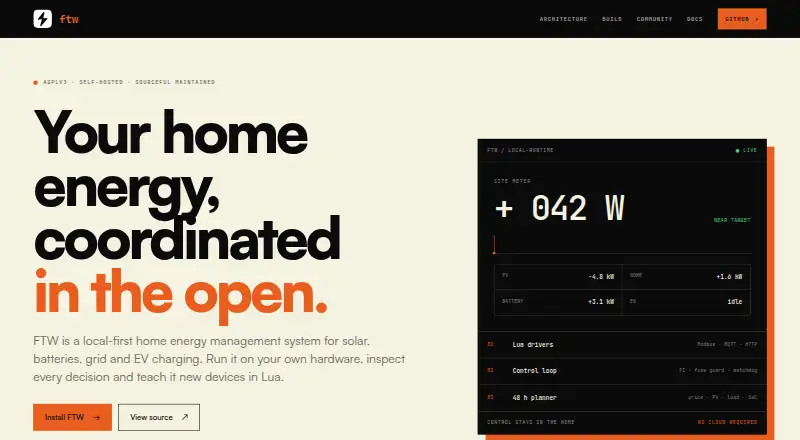
What FTW is
FTW brings supported solar equipment, batteries and car chargers from different brands into one home energy system. Its Energyplan considers charging needs, electricity prices and tariffs, solar production, household forecasts, battery state and efficiency when planning energy use. FTW Core checks suggested plans and commands against site and equipment limits, and can use a local fallback when the planner is unavailable. The beta reports whether controlled devices are following FTW, waiting, limited or need attention, drawing on device readings and, when available, separate meter confirmation.
Meters, inverters and batteries connect through Lua drivers; supported models, firmware and verified functions vary. OCPP 1.6J and 2.0.1 chargers can connect to FTW’s built-in server without a Lua driver, depending on the functions each charger supports. The API and Home Assistant are listed for observation or automation. FTW runs on a user’s own Raspberry Pi or Linux host, with installation paths for Linux and Docker. Active control requires a working site meter and confirmed main fuse rating. FTW is an early 0.x beta, and guided transfer of older settings and history is not ready. Sourceful Energy develops and maintains it.
Who it suits
FTW suits households that want supported solar, batteries and EV charging equipment from different brands coordinated on a self-hosted system. It is aimed at private household use and requires a working site meter and confirmed main fuse rating for active control.
What it does well
- Plans energy use around prices, tariffs, solar and household forecasts.
- Checks plans and commands against site and equipment limits.
- Keeps a local fallback if the planner is unavailable.
- Supports OCPP 1.6J and 2.0.1 chargers through its built-in server.
- Offers advanced energy monitoring, forecasting and automated utility data import.
What to know first
- The current release is an early 0.x beta.
- Guided transfer of older settings and history is not ready.
- Community support has no official warranty or response commitments.
- Energyplan use beyond a private household requires a separate written license.
Limits
FTW Community costs nothing for private household use. Community support is best-effort, and use of Energyplan outside a private household requires a separate Sourceful license; active control also stops dispatch when required site-meter data is stale.
Plans
| Plan | Billed and limits | Price |
|---|---|---|
| FTW Community | Private household use · Community support is best-effort · Other use of Energyplan requires a separate Sourceful license | Free |
As ftw.sourceful.energy lists them, read 8 Oct 2026. The maker's own page has the final word.
Getting started
- Visit the FTW website.
- Choose a Linux or Docker installation path for a Raspberry Pi or Linux host.
- Connect supported equipment using Lua drivers, or connect a compatible OCPP charger to the built-in server.
- Confirm the site meter works and the main fuse rating is set before active control.
FTW coordinates compatible solar, battery and car-charging equipment across brands in a home energy setup. It is aimed at private-household users comfortable running software on their own Raspberry Pi or Linux host. Its energy planning and local safeguards are compelling, but the early beta and limits on Energyplan use make it a cautious choice.
Overview
FTW brings household energy devices into a shared plan. Energyplan weighs charging needs, electricity prices and tariffs, solar, household forecasts, and battery state and efficiency when planning energy use. FTW Core then checks proposed plans and commands against site and equipment limits, with a local fallback if the planner is unavailable.
Separating planning from local checks is useful: the plan can account for competing household needs without making the planner the only control layer. Compatibility remains model- and firmware-dependent, however, and supported functions vary. FTW is not a universal bridge for every meter, inverter or battery.
Key features
Planning and safeguards
Energy forecasting and automated utility data import complement the planner's consideration of tariffs, solar and household needs. Active control requires a working site meter and a confirmed main fuse rating. If required meter data becomes stale, dispatch stops. That conservative boundary helps avoid acting on outdated readings, but makes reliable metering a prerequisite for automatic control.
Device status and integrations
The beta shows whether controlled devices are following FTW, waiting, limited or need attention. It uses device readings and, where available, separate meter confirmation, giving users a way to distinguish device-reported activity from independently confirmed results.
Lua drivers connect supported meters, inverters and batteries; model, firmware and verified-function coverage varies. OCPP 1.6J and 2.0.1 chargers can connect to FTW's built-in server without a Lua driver, subject to each charger's functions. The API and Home Assistant support observation or automation, not a promise of broader device compatibility.
Pricing
FTW Community: free. The plan is for private-household use and uses AGPLv3 code with a narrow Energyplan exception. The proprietary Energyplan worker is permitted with FTW in a private household; other use or distribution requires a separate written Sourceful license. The price is zero, but that does not make the worker unrestricted for commercial or other use.
Community support is best-effort from users and maintainers, with no official support, warranty, response-time or service-level commitments. This suits technically capable users who can handle installation and troubleshooting without formal assistance; it is a poor fit where a support commitment is essential.
Platforms
FTW runs on a user's own host, with Linux and Docker installation paths and Raspberry Pi or Linux deployment described. It also lists web and API platforms. Self-hosting gives the household control over deployment, but puts setup and ongoing operation on the user.
Who it's for
FTW is best for a private household with supported solar, batteries or EV charging, a working site meter, and the technical ability to maintain a self-hosted system. Its tariff-aware planning is especially relevant when charging and household energy needs must be coordinated. Users seeking a mature release, guided migration or official support should look elsewhere: FTW remains an early 0.x beta, and guided transfer of old settings and history is not ready.
Pros and cons
Pros
- Energy planning weighs tariffs, solar, forecasts, charging needs and battery efficiency, giving household decisions more context than a single device reading.
- FTW Core checks plans against site and equipment limits and keeps a local fallback if the planner is unavailable.
- OCPP charger connections can avoid a Lua driver, subject to charger capabilities.
- Stale required meter data stops dispatch rather than allowing control to continue on outdated readings.
Cons
- Compatibility depends on supported models, firmware and verified functions, so a household must confirm its equipment before relying on FTW.
- The early 0.x beta has no guided transfer of old settings and history, making migration less suitable for users expecting a polished transition.
- Community help has no official response times or service commitments.
- Energyplan's private-household permission is narrow; other use or distribution requires a separate written license.
Alternatives
Energy Management Software is the broader category to explore when comparing tools for energy operations.
Choose Enertiv instead if you want a paid platform with a free portfolio diagnostic using optional, read-only ESPM data, or need Android and iOS platforms.
BEMServer is another free, self-hosted open-source option for readers comparing Linux and web deployments; its listed plan leaves installation, configuration, maintenance and selected modules to consider.
Consider Honeywell Forge for product-specific offerings that include Advanced Process Control with term-based licensing and feature choices; pricing requires contacting Honeywell.
KERO is a paid alternative.
Spacewell is a paid alternative with Workplace, Energy and Asset Ultimate offerings; its Energy plan includes customized data points and unlimited admin users.
Verdigris is a paid alternative.
Arcadia Platform is an enterprise platform with custom pricing and a demo available by contacting Arcadia.
CIM PEAK is a paid alternative whose PEAK Platform pricing is based on data points, with partner and portfolio discounts and no user limit per building.
Verdict
Choose FTW if you can self-host a private household energy system and want planning that weighs tariffs, solar, charging needs and battery conditions, backed by local checks. Its strongest reason to choose it is that combination of planning and safeguards; its strongest reason to look elsewhere is the early beta, compounded by uneven device support and no official support commitment.
Verdict
Choose FTW if you want to coordinate supported home energy equipment on a Raspberry Pi or Linux host, with planning based on tariffs, solar and household needs. Look elsewhere if you need a mature release, guided migration, or official support commitments.
Questions
How much does FTW cost?
The FTW Community plan costs nothing for private household use.
Is FTW open source?
Its community code uses AGPLv3 with an Energyplan exception. The proprietary Energyplan worker is permitted with FTW for private household use; other use or distribution requires a separate written Sourceful license.
Where can I run FTW?
FTW runs on the user’s own host, with Linux and Docker installation paths and Raspberry Pi or Linux deployment described.
What equipment can connect?
Lua drivers connect supported meters, inverters and batteries, with supported models, firmware and verified functions varying. OCPP 1.6J and 2.0.1 chargers can connect through the built-in server, subject to their supported functions.
Does FTW work with Home Assistant?
The API and Home Assistant are listed for observation or automation.
Who makes FTW?
Sourceful Energy develops and maintains FTW.
Facts from FTW's own pages
- Beta status and migration
- The site describes the current release as an early 0.x beta; guided transfer of old settings and history is not ready. · ftw.sourceful.energy, 8 Oct 2026
- Community support
- FTW Community has no official support, warranty, response times or service-level commitments; help is best-effort from users and maintainers. · ftw.sourceful.energy, 8 Oct 2026
- Deployment
- FTW runs on the user's own host, with the homepage describing Raspberry Pi and Linux deployment. · ftw.sourceful.energy, 8 Oct 2026
- Device integrations
- Lua drivers connect supported meters, inverters and batteries; supported models, firmware and verified functions vary. · ftw.sourceful.energy, 8 Oct 2026
- Device status
- The beta distinguishes whether controlled devices follow FTW, are waiting, are limited or need attention, using device readings and, where available, separate meter confirmation. · ftw.sourceful.energy, 8 Oct 2026
- Energy planning
- Energyplan weighs charging needs, electricity prices, tariffs, solar and household forecasts, battery state and efficiency to plan energy use. · ftw.sourceful.energy, 8 Oct 2026
- EV charging
- OCPP 1.6J and 2.0.1 chargers can connect to FTW's built-in server without a Lua driver, subject to the charger’s supported functions. · ftw.sourceful.energy, 8 Oct 2026
- Founded
- 2022 · ftw.sourceful.energy, 28 Sept 2026
- Headquarters
- Kalmar, Sweden · ftw.sourceful.energy, 28 Sept 2026
- Home Assistant and API
- The architecture page lists API and Home Assistant for observation and automation. · ftw.sourceful.energy, 8 Oct 2026
- Installation
- The current release line is the 0.x beta, with installation paths for Linux and Docker; FTW runs on a Raspberry Pi or Linux host. · ftw.sourceful.energy, 8 Oct 2026
- License and use
- The community edition uses AGPLv3 with a narrow Energyplan exception; the proprietary Energyplan worker is permitted with FTW for a private household, while other use or distribution requires a separate written Sourceful license. · ftw.sourceful.energy, 8 Oct 2026
- Licensing
- FTW's open-source code uses AGPLv3 with an Energyplan exception; the Energyplan worker is permitted with FTW for private household use, while other use requires a separate written license. · ftw.sourceful.energy, 8 Oct 2026
- Local control
- FTW Core checks proposed plans and commands against site and equipment limits, and keeps a local fallback if the planner is unavailable. · ftw.sourceful.energy, 8 Oct 2026
- Maker
- Sourceful Energy develops and maintains FTW. · ftw.sourceful.energy, 8 Oct 2026
- Other integrations
- FTW lists API and Home Assistant for observation or automation. · ftw.sourceful.energy, 8 Oct 2026
- Purpose
- FTW makes supported solar, batteries and car charging from different brands work together at home. · ftw.sourceful.energy, 8 Oct 2026
- Requirements
- Active control requires a working site meter and confirmed main fuse rating. · ftw.sourceful.energy, 8 Oct 2026
- Safety limits
- Stale required site-meter data stops dispatch, and active control requires a working site meter and confirmed main fuse rating. · ftw.sourceful.energy, 8 Oct 2026
- Status
- FTW is described as an early beta, and versions 2.x and 3.x will receive no further updates. · ftw.sourceful.energy, 8 Oct 2026
Where FTW stands on Freedom251
- Energy Management Software#3 of 25