Freedom251 › AI Virtual Try-On Tools

Fitly
What Fitly is
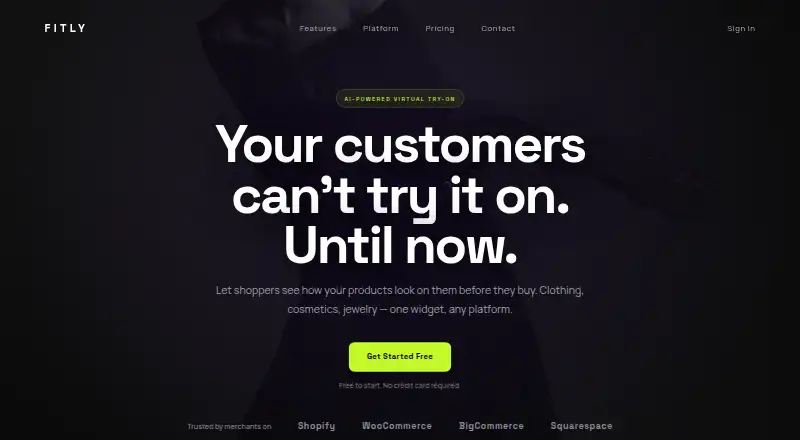
Fitly adds a virtual try-on widget to online stores, letting shoppers preview clothing, cosmetics, and jewelry on a photo of themselves. A shopper uploads a photo, which Fitly combines with a product image to create a result in 10–20 seconds. The widget works with Shopify, WooCommerce, BigCommerce, Squarespace, Wix, and custom sites that can use a script tag. Fitly can detect or pull product images from a store, without manual uploads, 3D scanning, or special photography. Merchants can adjust colors, button text, and widget placement, and white-labeling is available. Shoppers do not need an account, and the widget does not set cookies or track them across sites or sessions. Shopper photos are automatically deleted within 24 hours; generated try-on images remain until the merchant deletes them. Depending on merchant configuration, Google Gemini, xAI (Grok), and Replicate may receive shopper photos and garment images. The free plan includes 3 try-ons per month for 1 product. Paid plans start at $29/mo.
Who it suits
Fitly suits online merchants who want to add photo-based try-on to supported storefronts, including custom sites that accept a script tag. Shoppers can use it without creating an account.
What it does well
- Supports clothing, cosmetics, and jewelry try-ons.
- Works with six named store platforms and custom sites.
- Automatically detects or pulls store product images.
- Shopper photos are deleted within 24 hours.
What to know first
- Free plan allows 3 try-ons per month.
- Free plan is limited to 1 product.
- No formal SLA is offered.
Limits
The free plan permits three try-ons per month and one product, with basic widget customization and a Powered by Fitly badge. Starter costs $29/month and allows 150 try-ons monthly; Growth allows 500 for $79/month, and Scale allows 2,000 for $199/month.
Plans
| Plan | Billed and limits | Price |
|---|---|---|
| Free | $0/month · 3 try-ons per month · 1 product · basic widget customization · Fitly badge | Free |
| Scale | $199/mo · 2,000 try-ons per month · dedicated support · custom integrations | $199 a month |
| Starter | $29/month · 150 try-ons per month · unlimited products · custom widget styling · remove branding · email support | $29 a month |
| Growth | $79/month · 500 try-ons per month · priority support | $79 a month |
As usefitly.com lists them, read 14 Oct 2026. The maker's own page has the final word.
Getting started
- Open the Fitly website.
- Choose the Free plan or a paid plan starting at $29/month.
- Connect the widget to Shopify, WooCommerce, BigCommerce, Squarespace, Wix, or a custom site that can use a script tag.
- Allow Fitly to detect or pull product images from the store.
- Customize widget colors, button text, and positioning, and choose whether to use white-label presentation.
Fitly adds an AI try-on widget to online stores selling clothing, cosmetics, or jewelry. It is best suited to merchants who want to add photo-based previews without preparing special product imagery. Its appeal is a relatively accessible entry price and broad storefront compatibility; monthly try-on caps and the handling of shopper images deserve close attention.
Overview
Shoppers upload a photo, which Fitly combines with a product image to generate a preview in 10–20 seconds. Fitly can detect or pull product images from a store, avoiding manual uploads, 3D scanning, and special photography. That reduces merchant setup work, although shoppers must be willing to provide a photo to use the core experience.
Key features
Fitly covers clothing, cosmetics, and jewelry, and says it is expanding to more categories. Merchants can change widget colors, button text, and placement, with white-labeling available. This offers useful storefront control, while the listed category range may not suit stores selling other kinds of products.
Shopper privacy has both practical safeguards and a retention trade-off. Shoppers need no account, and the widget does not set cookies or track people across sites or sessions. Photos are automatically deleted within 24 hours, but generated try-on images persist until the merchant deletes them. Depending on merchant configuration, Google Gemini, xAI (Grok), and Replicate may receive shopper photos and garment images to generate results. Merchants should account for that processing and manage retained outputs deliberately.
Fitly lists approved-domain restrictions, HTTPS image URLs, SSRF protection, a 5 MB upload limit, and API-key authentication for endpoints. Stripe handles merchant payments, and Fitly says it does not store card numbers. Paid support ranges from email to dedicated support by tier, but there is no formal SLA—a meaningful limitation for stores that need a contractual uptime commitment.
Pricing
The Free plan costs nothing (billed $0/month) and allows 3 try-ons per month for 1 product, with basic widget customization and a Fitly badge. It is useful for a small evaluation, but its quota is too low for a sustained customer-facing rollout.
Starter costs $29 a month (billed $29/month) for 150 try-ons per month, unlimited products, custom styling, branding removal, and email support. It is the clearest fit for a smaller store that wants a branded live feature, though the monthly quota may constrain busy product pages. Growth costs $79 a month (billed $79/month) and raises the allowance to 500 try-ons per month with priority support; it suits merchants who need more capacity and faster support. Scale costs $199 a month (billed $199/mo) for 2,000 try-ons per month, dedicated support, and custom integrations, targeting larger or more integration-heavy deployments. Across paid tiers, capacity is capped monthly, so merchants should match the allowance to expected use.
Platforms
Fitly supports API and web use. Its widget works with Shopify, WooCommerce, BigCommerce, Squarespace, Wix, and custom-built sites that can use a script tag. That range makes it practical for merchants on common storefront platforms as well as sites with developer support.
Who it's for
Fitly is a sensible choice for online retailers seeking photo-based try-on across its supported categories, particularly when reducing product-image preparation and customizing a storefront widget matter. It is less suitable for merchants needing higher-volume use than the monthly tiers allow, a formal SLA, or a product category outside its current focus.
Pros and cons
- Pros: Store-image detection and broad platform support reduce setup friction for merchants with existing catalogs.
- Pros: Widget styling, white-labeling, and API access provide options for branded or custom integrations.
- Pros: No shopper account, cookies, or cross-site tracking are required for the widget.
- Cons: The free allowance of 3 monthly try-ons and 1 product is only suitable for a limited evaluation.
- Cons: Generated images remain until merchants delete them, and configured AI providers may receive shopper and garment images.
- Cons: There is no formal SLA, which may not meet operational requirements for stores that need a service commitment.
Alternatives
AI Virtual Try-On Tools is a useful place to compare options across the category. Choose TryOn Virtual if a free allowance of 25 sessions per month and three free AI-built 3D models better fit an initial evaluation; its usage pauses at the limit. DRESSX Virtual Try-On is a paid alternative with Android and iOS support and an enterprise offering built around tailored B2B try-on. PICTOFiT is a paid option for readers seeking Android or iOS support. Tryonixs may suit a Shopify merchant seeking a freemium option with a $19/mo Starter plan covering up to 25 products and basic analytics. WANNA is another paid option with Android and iOS support. FaceCake CAKE is another paid option with Android and iOS support. Style.me Virtual Fitting suits buyers prepared for custom monthly pricing based on digitized item quantity and traffic volume. Fittingbox Virtual Try-On is a paid alternative with a free trial and a $59 /month Bronze plan for up to 10 active products and up to 500 virtual try-ons.
Verdict
Choose Fitly if you want to add configurable, photo-based try-on to a supported storefront without preparing special product assets; the Starter plan makes that possible at $29 a month. Look elsewhere if your business needs a higher allowance, formal service guarantees, or a different approach to image retention and AI processing.
Verdict
Fitly provides a configurable try-on widget for several store platforms, with a free tier and paid plans from $29/mo. Merchants should review how photo deletion and the listed AI providers apply to their configuration.
Questions
Is Fitly free?
Yes. Its Free plan costs $0/month and includes three try-ons per month for one product.
How much do paid plans cost?
Paid plans start at $29/month. Starter is $29/month, Growth is $79/month, and Scale is $199/month.
Which platforms and stores does Fitly support?
Fitly is listed for API and web. Its widget works with Shopify, WooCommerce, BigCommerce, Squarespace, Wix, and custom-built sites that can use a script tag.
Do shoppers need an account?
No. Fitly says shoppers do not need an account, and the widget does not set cookies or track shoppers across sites or sessions.
How does Fitly handle shopper photos?
Shopper photos are automatically deleted within 24 hours. Depending on merchant configuration, Google Gemini, xAI (Grok), and Replicate may receive shopper photos and garment images to generate results.
What support and integrations do paid plans include?
Starter includes email support, Growth includes priority support, and Scale includes dedicated support and custom integrations. Fitly says it offers no formal SLA.
Facts from Fitly's own pages
- Accuracy limitation
- Fitly's terms warn that generated images are approximations and do not guarantee real-world fit, appearance, or feel. · usefitly.com, 14 Oct 2026
- AI providers
- Fitly says Google Gemini, xAI (Grok), and Replicate may receive shopper photos and garment images to generate try-on results, depending on merchant configuration. · usefitly.com, 4 Oct 2026
- Annual pricing
- The pricing section offers a yearly switch and advertises 20% savings, but the opened page shows only monthly dollar amounts. · usefitly.com, 14 Oct 2026
- API authentication
- Merchant installations receive an API key, and Fitly says all API endpoints require API-key authentication. · usefitly.com, 14 Oct 2026
- Chrome extension reach
- The Chrome Web Store listing shows 625 users and identifies the extension as a free virtual try-on for any retailer. · chromewebstore.google.com, 14 Oct 2026
- Company funding record
- Crunchbase shows five funding rounds for the Austin Fitly profile but obscures the amounts and dates. · crunchbase.com, 14 Oct 2026
- Company profile
- Crunchbase lists a private Fitly, Inc. as an active for-profit company headquartered in Austin, Texas, with 1–10 employees and Anthony Ortiz as founder and CEO. · crunchbase.com, 14 Oct 2026
- Customization
- Merchants can change widget colors, button text, and placement, with white-labeling available. · usefitly.com, 14 Oct 2026
- Domain controls
- The widget only operates on domains registered in the merchant dashboard through domain whitelisting. · usefitly.com, 14 Oct 2026
- Embed setup
- The homepage provides a script-tag installation using cdn.usefitly.com/widget.js and says setup takes about five minutes. · usefitly.com, 14 Oct 2026
- GDPR statement
- Fitly states that it is fully GDPR compliant and does not use shopper photos for facial recognition or model training. · usefitly.com, 14 Oct 2026
- Generation time
- Fitly says a try-on result normally takes 10–20 seconds. · usefitly.com, 14 Oct 2026
- How it works
- Shoppers upload a photo, which Fitly combines with a product image to generate a try-on result in 10–20 seconds. · usefitly.com, 4 Oct 2026
- Independent extension publisher
- The Chrome listing identifies Sreenand Mallisetty as the developer and gives a Chalfont, Pennsylvania address. · chromewebstore.google.com, 14 Oct 2026
- Licence
- Fitly's terms reserve ownership of the service, widget code, APIs, dashboard, and documentation and prohibit reverse engineering; no open-source licence is stated. · usefitly.com, 14 Oct 2026
- Limit: extension permissions
- Chrome-Stats flags high permission impact and access to Google APIs, Firebase, Cloud Run, and bitstudio.ai domains, advising installation caution. · chrome-stats.com, 14 Oct 2026
- Limit: image quality dependence
- A Fitly builder reported on Reddit that output accuracy depends on clear input photos and well-presented garment images; stretched or misleading garment photos can produce incorrect apparent fit. · reddit.com, 14 Oct 2026
- Payment processing
- Stripe handles merchant billing, while Fitly says it does not store credit-card numbers. · usefitly.com, 14 Oct 2026
- Payments
- Stripe processes merchant payments, and Fitly says it does not store credit card numbers. · usefitly.com, 4 Oct 2026
- Photo deletion
- Shopper photos are automatically deleted within 24 hours, while generated try-on images remain until the merchant deletes them. · usefitly.com, 14 Oct 2026
- Photo retention
- Shopper photos are automatically deleted within 24 hours, while generated try-on images are retained until the merchant deletes them. · usefitly.com, 4 Oct 2026
- Praise: usability
- Chrome-Stats summarizes reviewers as praising easier online shopping, an intuitive interface, realistic-looking results, and enjoyable outfit browsing. · chrome-stats.com, 14 Oct 2026
- Pricing inconsistency
- The pricing cards specify 3 free try-ons monthly, while the FAQ says the Free plan provides 10 try-ons monthly. · usefitly.com, 14 Oct 2026
- Privacy collection
- Shoppers do not need accounts, and Fitly says it does not collect their names, email addresses, or other personal identifiers. · usefitly.com, 14 Oct 2026
Where Fitly stands on Freedom251
- AI Virtual Try-On Tools#2 of 27