Freedom251 › Sanctions Screening Software
FinCrimeRadar
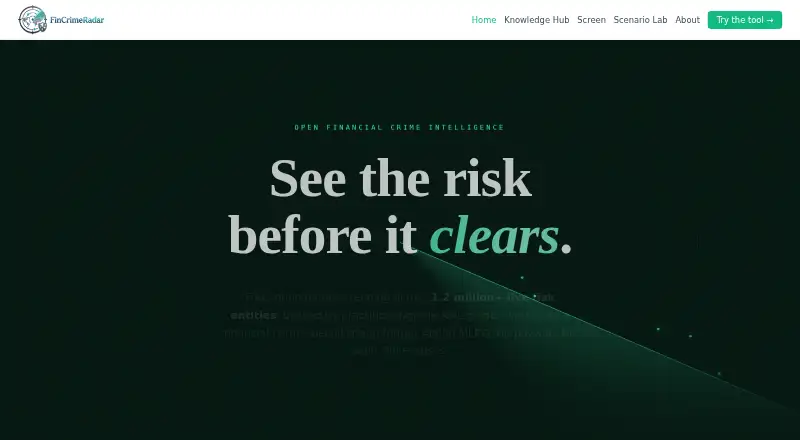
What FinCrimeRadar is
FinCrimeRadar is a free web resource for financial crime screening, regulatory intelligence, practitioner guides, and training for compliance professionals and students. Its screening tool checks names against sanctions lists, politically exposed person databases, and adverse media using a live OpenSanctions dataset containing over 1.2 million risk entities. Name matching uses a fuzzy-match threshold that users can adjust to balance potential missed matches against false positives.
The dataset draws sanctions and PEP information from official sources including OFAC, UK, EU, and UN lists. Sanctions data is checked daily against the OpenSanctions feed, and changes appear in a daily changelog. The adverse media search covers recent English-language news from a limited set of feeds, roughly the last 12 months; it is not curated or comprehensive.
Beyond screening, Scenario Lab provides interactive exercises for KYC and KYB investigations, fraud detection, and risk scoring. It is a trainer, not a certification. The Knowledge Hub offers free practitioner guides across six compliance domains, with simulators, typology tabs, and quizzes. Searches are processed in real time and FinCrimeRadar says it does not store, log, analyse, or share them. The site describes its screening as educational and says it should not replace regulated commercial screening or be the sole basis for compliance decisions.
Who it suits
FinCrimeRadar suits compliance professionals and students seeking free screening, learning exercises, and practitioner guides in a web browser. Its resources can support education and research, while its stated screening limitation makes it unsuitable as the sole basis for compliance decisions.
What it does well
- Screens sanctions, PEP databases, and adverse media.
- Uses a live OpenSanctions dataset with over 1.2 million risk entities.
- Allows adjustment of the fuzzy-matching threshold.
- Checks sanctions data daily and tracks changes in a changelog.
- Screening requires no sign-up.
What to know first
- Adverse media coverage is limited and not comprehensive.
- Searches do not monitor a saved list of names.
- Screening is educational and cannot serve as the sole basis for compliance decisions.
- Transaction screening is not available.
Limits
The adverse media search uses a limited set of recent English-language news feeds, roughly covering the last 12 months. Each screening search reflects data available at that time; the tool does not monitor saved names and must not be the sole basis for compliance decisions.
Plans
| Plan | Billed and limits | Price |
|---|---|---|
| Free | All platform features free · screening requires no sign-up · API free for educational use | Free |
As fincrimeradar.org lists them, read 7 Oct 2026. The maker's own page has the final word.
Getting started
- Visit the FinCrimeRadar website.
- Open the screening tool; screening requires no sign-up.
- Search a name against the available sanctions, PEP, and adverse media sources.
- Adjust the fuzzy-matching threshold as needed.
- Use Scenario Lab or the Knowledge Hub for training and guides.
FinCrimeRadar combines free web-based screening with practical compliance guidance and training. It is best suited to compliance learners and practitioners who need a no-sign-up way to explore screening and investigate scenarios. Its educational scope is useful; teams needing decision-grade screening or ongoing monitoring should choose a commercial tool.
Overview
The screening tool searches sanctions lists, PEP databases and adverse media across a live OpenSanctions dataset of more than 1.2 million risk entities. Sanctions data is checked daily against the OpenSanctions feed, and changes appear in a daily changelog. That makes it a useful point-in-time reference, but not a substitute for regulated commercial screening or the sole basis for compliance decisions.
Adverse-media coverage is more limited: it searches recent English-language news from a limited set of feeds, roughly covering the last 12 months. Because those results are not curated or comprehensive, use them as an investigative lead rather than a full reputational-risk assessment.
Key features
Name screening and data
Fuzzy matching includes an adjustable threshold, allowing users to trade off potential missed matches against false positives. The dataset includes sanctions and PEP information drawn from official sources, including OFAC, UK, EU and UN lists. Each search reflects the data available when it runs; FinCrimeRadar does not monitor saved names or alert users to later changes.
Training and guidance
Scenario Lab provides interactive exercises in KYC and KYB investigations, fraud detection and risk scoring. It is a training tool, not a certification program. The Knowledge Hub adds practitioner guides across six compliance domains, with simulators, typology tabs and quizzes. Together, these resources make the service more useful for learning and practice than a screening-only reference.
Privacy and security
FinCrimeRadar says screening queries are processed in real time and are not stored, logged, analysed or shared by the service. It also says the site uses HTTPS encryption, Cloudflare security protection and system access controls. These protections do not change the tool's stated educational limitation.
Pricing
The Free plan costs nothing and includes all platform features. Screening requires no sign-up, and the API is free for educational use. There is no free trial because the service is free. Its main trade-off is capability, not a paid-tier quota: screening is not transaction screening, saved-name monitoring is unavailable, and the tool is not intended to replace regulated commercial screening.
Platforms
FinCrimeRadar runs on the web. The plan describes API use as free for educational use, while the platform listing identifies web access; readers seeking a dedicated API workflow should confirm that the offering fits their needs.
Who it's for
Students and compliance professionals can use FinCrimeRadar to learn screening concepts, explore point-in-time name matches and work through investigation scenarios. It is less suitable for organizations that need transaction screening, ongoing monitoring, or a screening result they can rely on as the basis for a compliance decision.
Pros and cons
- Pros: Free screening without sign-up makes it easy to explore sanctions and PEP matches.
- Pros: Daily sanctions-data checks and an adjustable fuzzy-match threshold support practical investigation and learning.
- Pros: Scenario Lab and the Knowledge Hub add exercises and guidance beyond name lookup.
- Cons: Adverse-media search has limited English-language feeds and is not comprehensive, so it cannot provide a complete reputational-risk picture.
- Cons: Searches are point-in-time only; there is no saved-name monitoring or transaction screening.
- Cons: FinCrimeRadar says the tool is educational and should not be the sole basis for compliance decisions.
Alternatives
For a wider set of options, browse Sanctions Screening Software.
Choose OFACScreen if you want an API and web option with a 14-day trial that includes 25 searches, 3 users, 5 monitored names, CSV files up to 25 rows and a REST API. Its free-search plan is also listed as free.
SanctionsScreening.io offers a Pro plan for $29 a month and is available on web and API.
ScreeningHub is worth considering if you want API, web or self-hosted access: its free tier includes 100 screens per month, and its Starter plan is €79 a month.
For paid web-based screening, consider Eastnets SafeWatch AML.
NICE Actimize is a paid API and web option with pricing provided through a demo or expert consultation.
yente is a free alternative available through API, Linux, self-hosted and web platforms.
Enlighta Sanctions Screening is another paid API and web option.
FinScan offers paid AML and KYC solutions on API, self-hosted and web platforms, with pricing provided on request and a demo required.
Verdict
Choose FinCrimeRadar for free, accessible screening practice and useful compliance learning resources. Its broad educational toolkit is the strongest reason to use it; the lack of monitoring, transaction screening and decision-grade positioning is the reason to look elsewhere for operational compliance screening.
Verdict
Choose FinCrimeRadar for free web-based screening and educational resources for compliance work. Look elsewhere for regulated commercial screening, saved-name monitoring, transaction screening, or a certification program.
Questions
Does FinCrimeRadar cost anything?
Its Free plan costs nothing, and all platform features are free.
Do I need an account to screen a name?
No. Screening requires no sign-up.
What data does screening use?
It uses a live OpenSanctions dataset of over 1.2 million risk entities, including sanctions and PEP data from sources such as OFAC, UK, EU, and UN lists.
Does FinCrimeRadar provide ongoing monitoring?
No. It does not monitor a saved list of names; each search reflects the data available when it runs.
Is Scenario Lab a certification?
No. It is a free interactive trainer covering KYC and KYB investigations, fraud detection, and risk scoring.
Who built FinCrimeRadar?
The site says it was built by Pratik Zanke, a financial crime specialist and former Acting MLRO.
Facts from FinCrimeRadar's own pages
- Adverse media limits
- The adverse media check searches recent English-language news from a limited set of feeds, roughly covering the last 12 months, and is not curated or comprehensive. · fincrimeradar.org, 7 Oct 2026
- Compliance limitation
- FinCrimeRadar says its screening tool is educational and must not substitute for regulated commercial screening or serve as the sole basis for compliance decisions. · fincrimeradar.org, 7 Oct 2026
- Data refresh
- Sanctions data is checked daily against the OpenSanctions feed, and changes are tracked in a daily changelog. · fincrimeradar.org, 7 Oct 2026
- Data sources
- The screening dataset comes from OpenSanctions and includes sanctions and PEP data drawn from official sources including OFAC, UK, EU, and UN lists. · fincrimeradar.org, 7 Oct 2026
- Founded
- 2026 · fincrimeradar.org, 28 Sept 2026
- Headquarters
- London, United Kingdom · fincrimeradar.org, 28 Sept 2026
- Knowledge Hub
- The Knowledge Hub offers free practitioner guides across six compliance domains, with simulators, typology tabs, and quizzes. · fincrimeradar.org, 7 Oct 2026
- Maker
- The site was built by Pratik Zanke, a financial crime specialist and former Acting MLRO with around a decade of experience across international regulatory regimes. · fincrimeradar.org, 7 Oct 2026
- Matching
- Name screening uses fuzzy matching with an adjustable threshold to balance potential missed matches against false positives. · fincrimeradar.org, 7 Oct 2026
- Ongoing monitoring
- The tool does not monitor a saved list of names; each search reflects the data available when the search is run. · fincrimeradar.org, 7 Oct 2026
- Privacy
- Screening queries are processed in real time and are not stored, logged, analysed, or shared by FinCrimeRadar. · fincrimeradar.org, 7 Oct 2026
- Purpose
- FinCrimeRadar provides free financial crime screening, regulatory intelligence, practitioner guides, and training tools for compliance professionals and students. · fincrimeradar.org, 7 Oct 2026
- Screening
- The screening tool searches sanctions lists, PEP databases, and adverse media sources across a live OpenSanctions dataset of over 1.2 million risk entities. · fincrimeradar.org, 7 Oct 2026
- Security
- The site says it uses HTTPS encryption, Cloudflare security protection, and system access controls. · fincrimeradar.org, 7 Oct 2026
- Support
- The maker lists [email protected] for contact and privacy queries. · fincrimeradar.org, 7 Oct 2026
- Training
- Scenario Lab is a free interactive trainer covering KYC and KYB investigations, fraud detection, and risk scoring; it is not a certification. · fincrimeradar.org, 7 Oct 2026
Where FinCrimeRadar stands on Freedom251
- Sanctions Screening Software#2 of 24