Freedom251 › Feature Store Software
Feathr
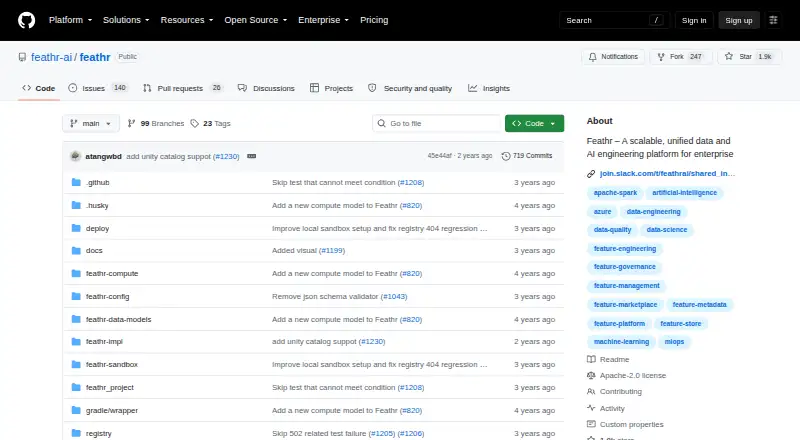
What Feathr is
Feathr is an open-source platform for engineering data and AI features: teams can define, register, and share transformations, then connect computed features to training data with point-in-time-correct joins intended to help prevent data leakage. Its Python APIs and customizable user-defined functions work with PySpark and Spark SQL. The same transformation interface supports offline batch, streaming, and online processing, including time-based aggregations, sliding-window joins, lookup features, and derived features. An optional UI and registry let teams search for features, inspect metadata and lineage, manage access, and share features. Registry backends include Azure Purview and ANSI SQL, and deployment exposes a REST API. Integrations include Azure Synapse, Databricks, Azure Machine Learning, Jupyter Notebook, Azure Blob Storage, AWS S3, Snowflake, Kafka, Redis, and Azure Cosmos DB. Feathr documents deployment on Azure, Databricks, or Azure Synapse, and also provides a Docker sandbox and locally installable Python client. It is free under the Apache License 2.0. Its FAQ notes a current limitation: preprocessing appears to accept only one UDF function.
Who it suits
Feathr suits data and machine-learning teams engineering reusable features for entities such as users, accounts, or items. It may not be needed for regular image recognition, according to its FAQ.
What it does well
- Supports offline batch, streaming, and online processing
- Point-in-time joins help avoid data leakage
- Registry supports feature search, lineage, and access controls
- Apache License 2.0 and open-source availability
- Integrates with Azure Synapse, Databricks, Kafka, and Snowflake
What to know first
- Preprocessing appears to accept only one UDF function
- Feature-level access control is not supported yet
- Feature monitoring is not supported
Limits
The project FAQ says preprocessing currently seems to accept only one UDF function, subject to change based on requirements. Feature-level access control is not supported yet.
Getting started
- Open the Feathr GitHub project.
- Install the Python client with pip or use the Docker sandbox.
- Choose a documented deployment route: Azure, Databricks, or Azure Synapse.
- Connect supported storage, compute, or machine-learning tools as needed.
- Define transformations and use the registry to find and share features.
Verdict
Feathr offers feature transformations, point-in-time joins, and a registry for sharing and governance across teams. Its stated UDF and feature-level access limits are worth considering before adoption.
Questions
Is Feathr free?
Yes. Feathr is free and open source under the Apache License 2.0.
Which platforms does Feathr support?
Its listed platforms are API, Linux, self-hosted, and web. The project documents Azure, Databricks, and Azure Synapse deployment, along with a Docker sandbox and Python client.
Does Feathr support online and offline features?
Yes. It supports online and offline stores and serving, as well as point-in-time joins.
Which integrations are listed?
They include Azure Synapse, Databricks, Azure Machine Learning, Jupyter Notebook, Azure Blob Storage, ADLS Gen2, AWS S3, Snowflake, Kafka, EventHub, Redis, and Azure Cosmos DB.
Who maintains Feathr?
The project is under the LF AI & Data Foundation and was open sourced in 2022.
Facts from Feathr's own pages
- AI modeling
- Feathr computes feature transformations and joins them to training data using point-in-time-correct semantics to help avoid data leakage. · github.com, 3 Oct 2026
- API
- The registry deployment exposes a REST API, and both the Feathr UI and Python client interact with it. · feathr-ai.github.io, 4 Oct 2026
- Cloud and compute integrations
- Documented integrations include Azure Synapse, Databricks, Azure Machine Learning, and Jupyter Notebook. · github.com, 3 Oct 2026
- Community support
- The project directs users to its Slack channel and GitHub Discussions for questions and discussion. · github.com, 3 Oct 2026
- Deployment
- The project documents Azure deployment and provides a self contained Docker sandbox, plus a locally installable Python client. · github.com, 4 Oct 2026
- Execution modes
- Its unified data transformation API works in offline batch, streaming, and online environments. · github.com, 4 Oct 2026
- Feature engineering
- It supports time based aggregations, sliding window joins, lookup features, and derived features with point in time correctness. · github.com, 4 Oct 2026
- Feature registry
- The built-in registry supports searching features, viewing data sources and lineage, and managing access controls. · github.com, 3 Oct 2026
- Founded
- 2017 · github.com, 28 Sept 2026
- Installation and deployment
- The project documents installing its Python client with pip and deploying Feathr on Azure, Databricks, or Azure Synapse; its sandbox is distributed as a Docker container. · github.com, 3 Oct 2026
- Integrations
- Listed integrations include Azure Blob Storage, ADLS Gen2, AWS S3, Azure SQL, Snowflake, Kafka, EventHub, Redis, Azure Cosmos DB, Databricks, and Azure Synapse. · github.com, 4 Oct 2026
- Intended use
- The FAQ says a feature store is typically useful when modeling entities such as users, accounts, or items, and may not be necessary for regular image recognition. · feathr-ai.github.io, 4 Oct 2026
- Interfaces
- Feathr provides Pythonic APIs and customizable user defined functions with native PySpark and Spark SQL support. · github.com, 4 Oct 2026
- License and availability
- The GitHub repository is public and its license file specifies Apache License 2.0. · github.com, 3 Oct 2026
- ML tools
- The project lists Azure Machine Learning, Jupyter Notebook, and Databricks Notebook as machine learning platform integrations. · github.com, 4 Oct 2026
- Notable limit
- The project FAQ says preprocessing currently seems to accept only one UDF function, subject to change based on requirements. · feathr-ai.github.io, 4 Oct 2026
- Processing modes
- Its unified transformation API supports offline batch, streaming, and online environments. · github.com, 3 Oct 2026
- Project status
- The README says Feathr was open sourced in 2022 and is a project under the LF AI & Data Foundation. · github.com, 4 Oct 2026
- Project stewardship
- The repository says Feathr is a project under the LF AI & Data Foundation and was open sourced in 2022. · github.com, 3 Oct 2026
- Purpose
- Feathr is a data and AI engineering platform for defining, registering, and sharing data and feature transformations. · github.com, 4 Oct 2026
- Registry and governance
- The optional UI and registry let users search features, inspect metadata and lineage, manage access controls, and share features across teams. · feathr-ai.github.io, 4 Oct 2026
- Registry backends
- The feature registry supports Azure Purview and ANSI SQL backends; role based access control requires a SQL service to store its related information. · feathr-ai.github.io, 4 Oct 2026
- Scale
- The project says Feathr can process billions of rows and petabyte scale data using optimizations such as bloom filters and salted joins. · github.com, 4 Oct 2026
- Secret handling
- The configuration guide says settings can be stored in Kubernetes secrets or a key vault, and that Azure Key Vault is currently supported for retrieving values. · feathr-ai.github.io, 3 Oct 2026
Where Feathr stands on Freedom251
- Feature Store Software#4 of 20