Freedom251 › AI Fact-Checking Tools

Eustace
What Eustace is
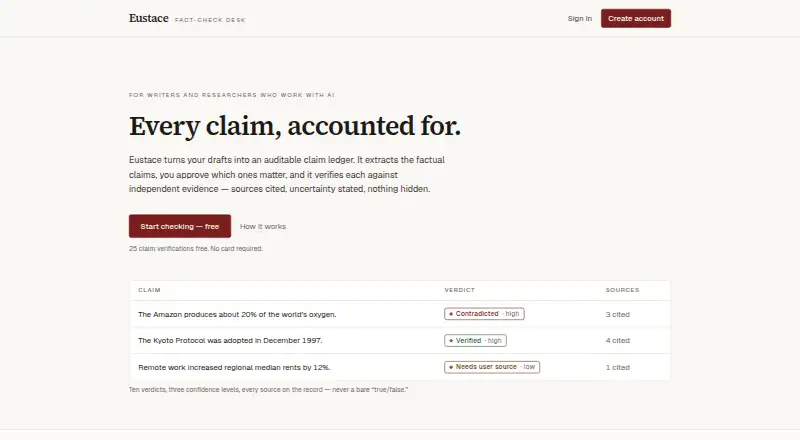
Eustace is a web-based fact-checking workspace for writers and researchers working with AI-assisted drafts. Users can paste text or import a URL, PDF, or Word file; scanned PDFs are processed with OCR. The service extracts candidate factual claims and shows their original quotes, so users can choose which ones to verify. Approved claims are checked against fresh web sources rather than the imported document. Its ledger uses ten verdicts and three confidence levels, and the product says it reports uncertainty when evidence is thin or mixed. Users can inspect sources, attach private evidence, override verdicts with the override recorded, and export a Markdown report with claims, verdicts, confidence, and citations. The Free plan includes 25 claim verifications for lifetime use, along with unlimited projects and documents. Pro costs $19 a month and includes 500 verifications each month; optional overage is $0.05 per claim and is off by default. Eustace says documents are not used to train AI models and user data is not sold. Automated results can be wrong, incomplete, or out of date.
Who it suits
Eustace suits writers and researchers who want to review factual claims in drafts and inspect supporting web evidence before making editorial decisions.
What it does well
- Accepts text, URLs, PDFs, and Word files.
- Scanned PDFs receive automatic OCR.
- Users approve claims before verification.
- Markdown reports include citations and confidence.
- Free plan includes unlimited projects and documents.
What to know first
- Free plan allows 25 lifetime verifications.
- Pro includes 500 verifications per month.
- Automated verdicts can be wrong or outdated.
Limits
Free includes 25 claim verifications for lifetime use. Pro includes 500 per month; optional overage is $0.05 per claim and off by default.
Plans
| Plan | Billed and limits | Price |
|---|---|---|
| Free | 25 claim verifications, yours to spend anytime · Unlimited projects and documents · Full ledger, overrides, and Markdown reports | Free |
| Pro | $180/year · 500 claim verifications every month · Optional overage at $0.05/claim — off by default · Everything in Free | $180 a year |
| Pro | $19/month · 500 claim verifications every month · Optional overage at $0.05/claim — off by default · Everything in Free | $19 a month |
As eustace.app lists them, read 7 Oct 2026. The maker's own page has the final word.
Getting started
- Open https://eustace.app/ in a web browser.
- Choose the Free plan or Pro plan.
- Paste text or import a URL, PDF, or Word file.
- Review candidate claims and approve the ones to verify.
Overview
Eustace is a web-based fact-checking workspace for writers and researchers working with AI-assisted drafts. It suits people who want to review claims individually, inspect evidence, and keep an exportable record. Its approval step and source-based checks offer editorial control, though its verdicts remain aids to judgment rather than final answers.
Key features
Bring in text by pasting it or importing a URL, PDF, or Word file; scanned PDFs are processed with OCR. Eustace extracts candidate factual claims alongside their original quotes, so users can choose what to send for verification instead of treating every sentence as a checkable assertion. That review step is useful for focused work, but still requires a person to decide which claims matter.
Approved claims are checked against fresh web sources, not simply against the submitted document. The ledger offers ten verdicts and three confidence levels, and reports uncertainty when evidence is thin or mixed. Users can inspect sources, attach private evidence, and override a verdict, with the override recorded. Markdown exports include claims, verdicts, confidence, and citations, making the process easier to share or revisit.
Those controls make Eustace more than a quick-check tool, but they do not make its conclusions definitive: automated verdicts, confidence labels, and summaries can be wrong, incomplete, or out of date. The service says it does not sell user data or use documents to train AI models. Its policy says documents and claims go to AI providers for extraction and verification; Tavily receives claim-derived search queries rather than the full document. Data is encrypted in transit with TLS and at rest by infrastructure providers, production access is restricted, and database rows are isolated by account. Questions and requests can be sent to [email protected].
Pricing
The Free plan costs nothing and includes 25 claim verifications for lifetime use, unlimited projects and documents, the full ledger, overrides, and Markdown reports. It is a capable way to try the workflow or handle occasional checks, but the fixed allowance is a hard ceiling rather than a monthly refill.
Pro costs $19 a month, billed $19/month. It includes 500 claim verifications every month and everything in Free. Optional overage costs $0.05 per claim and is off by default. This is the fit for working writers and researchers whose regular checking would exhaust the free allowance; lighter users may not need the recurring monthly quota.
Platforms
Eustace runs on the web. It accepts text, URLs, PDFs, and Word files, including scanned PDFs through OCR; no other platform is specified.
Who it's for
Eustace is best for writers and researchers who need a reviewable workflow for factual claims in drafts, particularly when they want to select claims, inspect web evidence, record overrides, and export citations. It is less suited to someone seeking an automatic final answer, or anyone who needs a mobile app or non-web workflow.
Pros and cons
- Claim-by-claim approval: Reviewers decide which extracted claims get checked, reducing the risk of treating every candidate as equally important.
- Auditable results: Source inspection, private evidence, recorded overrides, and citation-bearing Markdown reports preserve context for editorial review.
- Useful document coverage: URL, PDF, Word, pasted-text, and OCR input support common draft formats.
- Free allowance does not renew: 25 lifetime verifications make Free suitable for occasional use, not an ongoing checking workload.
- Verdicts need human review: The service warns that results can be wrong, incomplete, or outdated, so it is not a substitute for editorial judgment.
Alternatives
For a broader directory of options, see AI Fact-Checking Tools.
- VerumVerify is worth considering if Android or iOS access matters; its free plan includes three fact-checks per week, a global news feed, community results, and a basic credibility score.
- FactGuard may suit readers who want mobile or API access, with three free checks per day and a private on-device mode.
- Avancer Document Fact-Checker is an option for image and audio checks or self-hosting; its free plan includes one scan.
- Crowdee may fit image-verification needs, offering one free image verification per IP every 24 hours with a verdict, confidence score, and supporting indicators.
- Factward is an alternative for browser-extension access and shareable reports; its free plan allows two verifications a day, up to 10,000 characters and five claims per check.
- FAXTR is geared toward API use, with 1,000 API calls per month on its free plan.
- Groundery is worth a look for extension-based and live or recorded transcript checking; its free plan includes three hours of fact-checking per month and ten instant text checks.
- Omniscient AI offers a metered API option at $0.005 per fact-check request, alongside extension and web access.
Verdict
Choose Eustace if you need a web workspace that keeps claim selection, source review, overrides, and export together for draft fact-checking. Its strongest case is the traceable editorial workflow; its main caveat is that the automated conclusions can be mistaken, while the free quota is only 25 claims for life. For regular use, Pro supplies 500 checks each month; look elsewhere if you need mobile access, image or audio checking, or a verdict you can rely on without human review.
Verdict
Eustace organizes claim review around user approval, source inspection, and an exportable ledger. Its automated verdicts are intended to assist editorial judgment, not replace it.
Questions
Is Eustace free?
Yes. The Free plan costs nothing and includes 25 lifetime claim verifications, unlimited projects and documents, and the full ledger, overrides, and Markdown reports.
How much does Pro cost?
Pro costs $19 a month, billed at $19/month. It includes 500 claim verifications every month; optional overage costs $0.05 per claim and is off by default.
What files can I check?
You can paste text or import a URL, PDF, or Word file. Scanned PDFs are OCR'd automatically.
How does claim verification work?
Eustace extracts candidate factual claims for your review. Claims you approve are checked against fresh web sources.
What does Eustace say about document privacy?
Eustace says it does not sell user data or use documents to train AI models. Its policy says AI providers receive document text and claims for extraction and verification; Tavily receives search queries derived from claims rather than the whole document.
Can automated verdicts be relied on as final editorial decisions?
Eustace says automated verdicts, confidence labels, and summaries can be wrong, incomplete, or out of date, and are intended to assist editorial judgment.
Facts from Eustace's own pages
- AI processing
- The policy says AI model providers receive document text and claims for extraction and verification, while Tavily receives search queries derived from claims rather than the whole document. · eustace.app, 7 Oct 2026
- Audit and export
- Users can inspect sources, attach private evidence, override verdicts with the override recorded, and export a Markdown report with claims, verdicts, confidence, and citations. · eustace.app, 7 Oct 2026
- Claim review
- Eustace presents candidate factual claims with their original quotes and lets users approve which claims to queue for verification. · eustace.app, 7 Oct 2026
- Document input
- Users can paste text or import a URL, PDF, or Word file, and scanned PDFs are OCR'd automatically. · eustace.app, 7 Oct 2026
- Integrations and processors
- The privacy policy names Supabase, Vercel, Anthropic via Vercel AI Gateway, Tavily, RevenueCat, Stripe, Cloudflare, and Sentry as processors or service providers. · eustace.app, 7 Oct 2026
- Intended users
- The site describes Free as covering casual fact-checks and Pro as being for working writers and researchers. · eustace.app, 7 Oct 2026
- Privacy
- Eustace says it does not sell user data or use documents to train AI models. · eustace.app, 7 Oct 2026
- Purpose
- Eustace is a fact-checking workspace for writers and researchers who work with AI; it extracts factual claims from drafts and checks approved claims against independent evidence. · eustace.app, 7 Oct 2026
- Security
- The privacy policy says data is encrypted in transit with TLS and at rest by infrastructure providers, production data access is restricted, and database rows are isolated per account. · eustace.app, 7 Oct 2026
- Service limitation
- Eustace says automated verdicts, confidence labels, and summaries can be wrong, incomplete, or out of date, and are intended to assist editorial judgment. · eustace.app, 7 Oct 2026
- Support
- The site directs questions and requests to [email protected]. · eustace.app, 7 Oct 2026
- Verdicts
- The ledger uses ten verdicts and three confidence levels, and the product says it reports uncertainty when evidence is thin or mixed. · eustace.app, 7 Oct 2026
- Verification
- Each approved claim is checked against fresh web sources rather than against the user's own document. · eustace.app, 7 Oct 2026
- Verification limits
- The free plan has a fixed lifetime allowance of 25 claim verifications; Pro includes 500 per month, with optional overage at $0.05 per claim, off by default. · eustace.app, 7 Oct 2026
Where Eustace stands on Freedom251
- AI Fact-Checking Tools#5 of 21