Freedom251 › Temporary Email Services

EmptyInbox
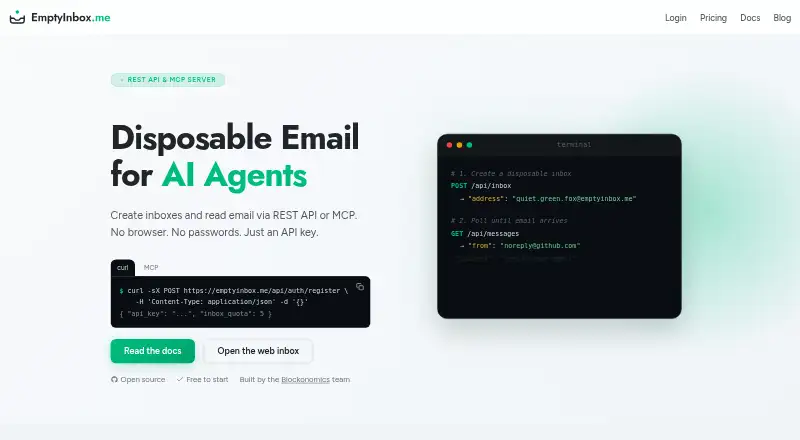
What EmptyInbox is
EmptyInbox provides disposable email inboxes for AI agents and developers through a REST API, MCP server and web inbox. A new address can be created for each task or agent run. Messages can be polled, or an MCP wait_for_message flow can receive email and extract verification codes. The web inbox uses passkey sign-in and displays extracted codes and links alongside messages. Each inbox creation consumes one credit, while receiving, listing and reading messages are free. Messages are deleted automatically after seven days. The service receives email only; it has no sending endpoint or SMTP credentials. The maker lists MCP-compatible agents, OpenAI GPT Actions, LangChain, CrewAI and OpenAPI-compatible frameworks as integration options, with guides for Playwright, Cypress, n8n and LangChain. The free plan includes five inbox credits, REST API and MCP access, polling and seven-day message retention. Paid top-ups start at $1, paid once for 10 credits; other listed packages cost $5, paid once, $15, paid once and $40, paid once. The maker says the project is open source under the MIT license.
Who it suits
EmptyInbox suits developers and AI-agent workflows that need temporary incoming email and verification-code extraction. Its REST API, MCP server and listed framework integrations support automated tasks.
What it does well
- A separate inbox can be created for each task.
- REST API and MCP access on the free plan.
- Reading and listing messages are free.
- Paid credits do not expire.
What to know first
- Messages are deleted after seven days.
- The service cannot send email.
- Inbox creation consumes credits.
- Quota purchases are non-refundable.
Limits
The free plan includes five inbox credits, and each inbox creation consumes one credit. Messages are automatically deleted after seven days. Paid credit bundles are one-time purchases, and quota purchases are non-refundable.
Plans
| Plan | Billed and limits | Price |
|---|---|---|
| Free | Forever free · 5 inbox credits · REST API and MCP access · email polling · messages auto-delete after 7 days | Free |
| Top-up — Micro | Bitcoin or USDT; credits never expire · 10 inbox credits · $0.10 per inbox | $1, paid once |
| Top-up — Standard | Bitcoin or USDT; credits never expire · 200 inbox credits · $0.075 per inbox | $15, paid once |
| Top-up — Bulk | Bitcoin or USDT; credits never expire · 750 inbox credits · $0.053 per inbox | $40, paid once |
| Top-up — Starter | Bitcoin or USDT; credits never expire · 50 inbox credits · $0.10 per inbox | $5, paid once |
As emptyinbox.me lists them, read 7 Oct 2026. The maker's own page has the final word.
Getting started
- Visit the EmptyInbox website.
- Choose the free plan or a one-time credit bundle.
- Create an account or use the web inbox's passkey sign-in.
- Create a disposable inbox for a task or agent run.
- Connect through the REST API or MCP server, or use the web inbox to read messages.
EmptyInbox is a disposable-email utility for developers and AI agents that need a separate incoming address for each automated task. It is best for verification and testing workflows built around REST, MCP, or a web inbox, rather than ordinary correspondence. Its credit-per-inbox pricing and receive-only operation should shape the decision.
Overview
A workflow can create a fresh address for an agent run, then poll for mail or use MCP's wait_for_message flow to wait for a message and extract a verification code. That task-specific model limits cross-run contamination and fits automated sign-up or test sequences, but it is less suitable when an address must remain a durable mailbox. Receiving, listing, and reading messages are free; creating each inbox consumes one credit, so address volume—not message volume—is the main usage cost.
Messages are deleted automatically after seven days. That is enough time for many verification flows, but it rules out using EmptyInbox as a long-term archive or audit record. The web inbox uses passkey sign-in and places extracted codes and links alongside messages, which gives people a practical fallback when an automation needs visual checking.
The privacy policy says account email addresses and passwords are not stored, and data is not sold or shared for advertising. Account creation is still associated with network data: the service records the network address and identified client software for every creation attempt, and keeps the address linked to a surviving account while that account exists.
Key features
- REST API and MCP server: REST supports programmatic inbox creation and retrieval, while MCP-compatible agents can wait for incoming mail instead of implementing their own polling loop. This is a strong fit for agent orchestration and scripted verification.
- Disposable addresses per run: New inboxes can be allocated to individual tasks or agent executions. The isolation is useful in parallel workflows, though every new inbox spends a credit.
- Code and link extraction: The web inbox displays extracted verification codes and links with messages, reducing the effort needed to identify the value an automated flow is waiting for.
- Automation integrations and guides: The maker points to MCP-compatible agents, OpenAI GPT Actions, LangChain, CrewAI, and OpenAPI-compatible frameworks, with workflow guides for Playwright, Cypress, n8n, and LangChain.
- Receive-only service: There is no email-sending endpoint and no SMTP credentials. Choose it for inbound verification, not for reply, notification, or two-way mail workflows.
- Open-source support model: The project is MIT-licensed and questions are directed to a GitHub issue. That suits teams comfortable using an issue tracker rather than expecting a conventional support desk.
Pricing
The free plan costs 0.00 USD and is free forever. It includes five inbox credits, REST API and MCP access, email polling, and seven-day automatic message deletion. It is appropriate for experiments, small test suites, and occasional agent runs; five creations will be exhausted quickly by repeated or parallel testing.
Paid access is sold as one-time credit top-ups, with credits that never expire. Micro costs 1.00 USD once for 10 credits ($0.10 per inbox), while Starter costs 5.00 USD once for 50 credits at the same per-inbox rate. Standard costs 15.00 USD once for 200 credits ($0.075 per inbox), and Bulk costs 40.00 USD once for 750 credits ($0.053 per inbox). Standard and Bulk are the sensible choices for recurring automation because they lower the creation cost; Micro and Starter suit smaller bursts without a recurring subscription. Quota purchases are non-refundable, and payment is by Bitcoin or USDT, which may be a constraint for buyers requiring card or invoice billing.
Platforms
EmptyInbox supports API access, Linux, and the web. The API and MCP interfaces target developer workflows, while the passkey-protected web inbox provides a browser-based way to inspect incoming messages.
Who it's for
Choose EmptyInbox for developers building disposable-email steps into Playwright, Cypress, n8n, LangChain, CrewAI, GPT Actions, or other API-compatible automation. It also fits AI-agent runs that need a fresh address and a wait-for-message operation. It is not the right tool for sending mail, preserving messages beyond seven days, or maintaining a conventional long-lived inbox.
Pros and cons
Pros
- Purpose-built automation interfaces: REST and MCP cover both conventional scripts and agent-oriented waiting.
- Free message handling: Listing, receiving, and reading do not consume credits, so traffic after inbox creation is not separately metered.
- Non-expiring top-up credits: Unused paid capacity remains available for later runs instead of requiring a monthly renewal.
- Useful browser fallback: Passkey sign-in plus extracted codes and links helps when an automated flow needs human inspection.
Cons
- Receive only: No sending endpoint or SMTP access excludes two-way email workflows.
- Seven-day deletion: Messages cannot serve as a long-term record.
- Creation-based quota: Every new inbox costs a credit, even though message operations are free.
- Limited free allowance: Five inbox credits make the free tier a short trial for high-volume testing.
- Non-refundable, crypto-only top-ups: Bitcoin or USDT payment and irreversible quota purchases reduce payment flexibility.
Alternatives
See the Temporary Email Services list for a broader comparison. Choose SecureTempMail instead when you need up to 30-day retention, private domains, attachment downloads, inbox history and search, or a wider set of desktop and mobile platforms for its 39.00 USD-per-year Premium plan.
Temp-Mail.org is a better fit for broad mobile and browser access, with free messages retained for 1–2 hours and a paid monthly tier. Pick 10 Minute Mail when a deliberately short, resettable 10-minute address is all you need. 1SecMail is an alternative for users wanting own domains, saved messages, inbox records, and attachment viewing. EmailOnDeck suits ad-supported, one-at-a-time disposable use with logs wiped securely. TempMailo offers save-and-restore inboxes and reply relay. Emailnator is suited to public, no-signup inboxes and up to 100 addresses at once, with messages deleted after 24 hours. EvilMail provides unlimited temporary generation with inbox lifetimes from 10 minutes to 24 hours.
Verdict
EmptyInbox is a strong choice for developers and AI-agent builders who need programmable, task-specific inbound mail through REST or MCP. Its permanent top-up credits, free message operations, and automation-oriented integrations keep recurring verification costs predictable. Look elsewhere if your workflow must send email, retain messages longer than seven days, or avoid credit purchases and crypto-only payment.
Verdict
EmptyInbox is oriented toward automated workflows that need temporary incoming email, with both API and web access. Its seven-day retention and lack of sending capability are important constraints to account for.
Questions
Is EmptyInbox free?
Yes. The Free plan costs nothing, billed Forever, and includes five inbox credits.
How much do paid credits cost?
One-time bundles are 1.00 USD for 10 credits, 5.00 USD for 50, 15.00 USD for 200, or 40.00 USD for 750. Payment is by Bitcoin or USDT, and credits do not expire.
Which platforms does EmptyInbox support?
The listed platforms are API, Linux, and web.
Can EmptyInbox send email?
No. It receives email only and has no sending endpoint or SMTP credentials.
Is EmptyInbox open source, and who maintains it?
Yes, it is open source under the MIT license. The Blockonomics team builds, supports, and maintains it.
How long are messages kept?
Messages are deleted automatically after seven days.
Facts from EmptyInbox's own pages
- Developer workflows
- The maker provides guides for Playwright, Cypress, n8n, and LangChain email workflows. · emptyinbox.me, 7 Oct 2026
- Inbox creation
- A new disposable email address can be created for each task or agent run. · emptyinbox.me, 7 Oct 2026
- Integrations
- The maker lists MCP-compatible agents, OpenAI GPT Actions, LangChain, CrewAI, and OpenAPI-compatible frameworks as integration options. · emptyinbox.me, 7 Oct 2026
- Maker
- The product is built, supported, and maintained by the Blockonomics team. · emptyinbox.me, 7 Oct 2026
- Message reading
- Users can poll messages or use the MCP wait_for_message flow to receive email and extract verification codes. · emptyinbox.me, 7 Oct 2026
- Network data
- The maker records the network address and identified client software for every account-creation attempt, and keeps the address associated with a surviving account while it exists. · emptyinbox.me, 7 Oct 2026
- Payment and limits
- Each inbox creation consumes one credit; receiving, listing, and reading messages are free, and quota purchases are non-refundable. · emptyinbox.me, 7 Oct 2026
- Privacy
- The privacy policy says the service does not store email addresses or passwords for accounts, and does not sell or share data for advertising. · emptyinbox.me, 7 Oct 2026
- Purpose
- EmptyInbox provides disposable email inboxes for AI agents and developers through a REST API and MCP server. · emptyinbox.me, 7 Oct 2026
- Retention
- Messages are deleted automatically after seven days. · emptyinbox.me, 7 Oct 2026
- Service limitation
- EmptyInbox receives email only and has no email-sending endpoint or SMTP credentials. · emptyinbox.me, 7 Oct 2026
- Support and source
- The maker directs users to open a GitHub issue for questions and says the project is open source under the MIT license. · emptyinbox.me, 7 Oct 2026
- Web inbox
- The web inbox uses passkey sign-in and displays extracted codes and links alongside messages. · emptyinbox.me, 7 Oct 2026
Where EmptyInbox stands on Freedom251
- Temporary Email Services#5 of 33
- Temporary email services#7 of 44