Freedom251 › Business Continuity Management Software
eFront ERM BCP
What eFront ERM BCP is
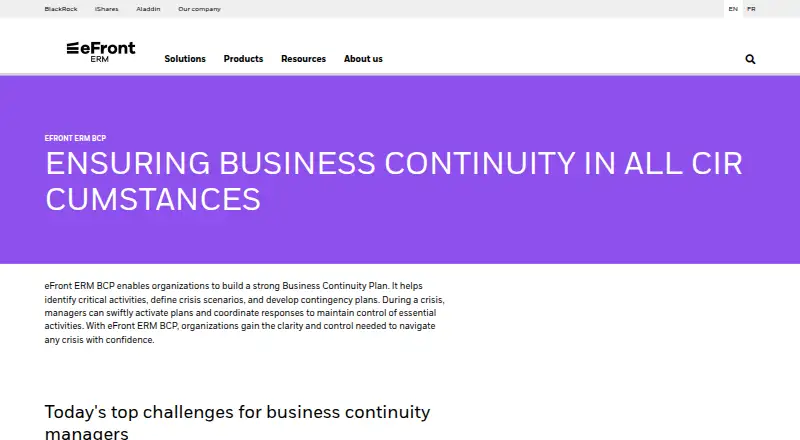
eFront ERM BCP helps organizations prepare for and manage business interruptions. It supports the identification of critical activities, definition of crisis scenarios and creation and activation of business continuity plans. Built-in Business Impact Analysis tools assess potential financial, legal, reputational and human consequences, then calculate Maximum Allowable Downtime. Teams can identify the human, IT and logistical resources needed for recovery and model both degraded operations and a return to normal. During a crisis, users can activate response plans, coordinate recovery, manage degraded operations, and track decisions and events in real time. The product provides a unified repository for continuity plans, entities, contacts, suppliers and services, with dashboards that group activities by supplier, service and criticality and monitor key performance indicators. Teams also have a shared workspace for procedures, coordinated actions and simulations. For ICT continuity, the product supports documenting critical activities, scenarios and crisis measures, and regularly testing plans for DORA Article 11 alignment. eFront ERM is modular, and eFront ERM Ready is described as a preconfigured solution deployable in a few weeks. The product page offers a contact form for pricing and inquiries. The listed platforms are web and API.
Who it suits
eFront ERM BCP suits organizations that need to document continuity plans, assess interruption impacts and coordinate recovery. Its stated target sectors include financial, industrial and services companies, as well as insurers.
What it does well
- Business Impact Analysis calculates Maximum Allowable Downtime
- Models degraded operations and return-to-normal scenarios
- Tracks crisis decisions and events in real time
- Central repository covers plans, contacts, suppliers and services
- Supports testing plans for DORA Article 11 alignment
What to know first
- Pricing is available on request
- The product is described for organizations and sector teams rather than individual use
Limits
Pricing is available on request. eFront ERM is modular, with organizations able to activate modules as needed and expand coverage as requirements evolve.
Plans
| Plan | Billed and limits | Price |
|---|---|---|
| eFront ERM BCP | Pricing not published; contact eFront for information | On request |
As efront.com lists them, read 8 Oct 2026. The maker's own page has the final word.
Getting started
- Visit the eFront ERM BCP website.
- Submit the product page contact form to request information.
- Discuss required modules and functional coverage with an eFront representative.
- Choose a deployment approach; eFront ERM Ready is a preconfigured option described as deployable in a few weeks.
- Use the web product or API platform for continuity planning and response.
eFront ERM BCP is a business continuity and crisis-response platform for organizations that need to assess disruption, plan recovery, and coordinate action. It is aimed at companies in financial, industrial, and services sectors, as well as insurers. Its value lies in linking impact analysis to recovery and response; the custom-priced, modular purchase is a less natural fit for teams seeking a simple standalone tool.
Overview
A shared repository brings continuity plans together with entities, contacts, suppliers, and services. That structure can help teams connect plans to the people and operational dependencies they rely on, rather than treating continuity documents as isolated files. eFront ERM also spans risk, control, internal audit, and compliance, allowing organizations to add modules as requirements evolve.
eFront ERM Ready is a preconfigured solution described as deployable in a few weeks, which may appeal to organizations that want a standard starting point. The broader modular model still means buyers need to determine the scope that fits their program. eFront says its support teams operate around the clock across client locations.
Key features
Impact analysis and recovery planning
Built-in Business Impact Analysis assesses financial, legal, reputational, and human consequences of interruptions and calculates Maximum Allowable Downtime. That gives continuity teams a structured basis for prioritizing recovery. The product also helps define required human, IT, and logistical resources and model both degraded operations and a return to normal service.
Coordinated crisis response
Teams can activate response plans, manage degraded operations, coordinate recovery, and track decisions and events in real time. A shared workspace gives teams access to procedures and supports coordinated actions and simulations. This combination is useful when continuity planning must extend into active incident management, though organizations should assess how the modules fit their operating model before buying.
ICT continuity, DORA and dashboards
For ICT continuity, the product supports maintaining plans, identifying critical activities, documenting scenarios, defining measures, and regularly testing plans for DORA Article 11 alignment. Dashboards categorize activities by supplier, service, and criticality and monitor key performance indicators. These capabilities support oversight of dependencies and readiness; they do not replace the organization's own testing and governance work.
Pricing
eFront ERM BCP uses custom pricing; contact eFront for a quote. The product page offers an inquiry form, with a representative contacting people who submit a request. No public seat limits, quotas, trial term, or renewal terms are stated. Because eFront ERM is modular, buyers should clarify which modules and deployment approach are included in a proposal.
Platforms
eFront ERM BCP is available on the web and through an API. A 2020 release announcement says its REST API covers entities, processes, incidents, and roles. That may matter to organizations connecting continuity data with other systems, while the stated API scope should be checked against specific integration needs.
Who it's for
The strongest fit is a company in finance, industry, or services, or an insurer, that needs formal impact analysis, documented recovery resources, and coordinated crisis response. Organizations seeking a wider risk, control, audit, and compliance environment may also value the modular suite. Smaller teams that need only a lightweight plan repository, or buyers who require transparent prices before engaging sales, should look elsewhere.
Pros and cons
- Pro: Impact analysis, recovery planning, and live response sit in one workflow, helping teams carry priorities from assessment into action.
- Pro: The unified repository covers plans and operational contacts, suppliers, and services, supporting dependency-aware planning.
- Pro: DORA-oriented ICT continuity capabilities and dashboards support structured oversight and recurring plan exercises.
- Con: Pricing is custom, so organizations cannot compare a public price or published seat and usage limits before contacting sales.
- Con: The modular scope requires buyers to decide which capabilities to activate, making it less straightforward than a narrowly focused continuity product.
Alternatives
Business Continuity Management Software is the directory's broader category for comparing continuity tools.
- Continuity2 may suit organizations that want a published annual license: its Meridian BCMS plan costs £20,000 a year for organizations with 0–500 staff and allows unlimited users within the organization. It supports Android, iOS, and web.
- Noggin Business Continuity Software is another paid web, API, Android, and iOS option; its sales consultants provide pricing estimates and a 30-minute demonstration.
- PremierOne CAD is a paid alternative available on Android, iOS, web, and Windows, with pricing by contacting sales.
- Quantivate Business Continuity Software is a paid web, API, Android, and iOS option; contact Quantivate for pricing, and request a demo through its product page.
- Riskonnect is another paid option for organizations considering a different risk-management product.
- Onspring is a paid web and API alternative with Bronze and Silver plans; Silver adds storage, a development environment, a non-production department environment, and 1K/month SMS messages over Bronze.
- Preparis is a paid option for Android, iOS, macOS, web, and Windows; request a demo for pricing.
- Rezilens is another paid alternative.
Verdict
Choose eFront ERM BCP if your organization needs continuity planning tied closely to impact analysis, recovery resources, and coordinated crisis response, particularly within a broader risk and compliance program. Its integrated workflow and DORA-oriented ICT continuity support are the main reasons to consider it. Look elsewhere if you need an immediately comparable public price, a clearly bounded standalone plan, or a lightweight continuity tool.
Verdict
Organizations that need structured continuity planning, impact analysis and coordinated crisis response should consider eFront ERM BCP. Contact eFront for pricing and to discuss the modules and deployment approach that fit the organization.
Questions
How much does eFront ERM BCP cost?
Pricing is available on request. The product page provides a contact form for inquiries.
What platforms does eFront ERM BCP support?
The listed platforms are web and API.
What does the product cover?
It supports business impact analysis, continuity planning, crisis response, recovery coordination and plan exercises.
Can it help with DORA Article 11 alignment?
It supports documenting ICT continuity plans, critical activities, crisis scenarios and measures, and regularly testing plans for DORA Article 11 alignment.
Can organizations choose which modules to use?
Yes. eFront ERM is modular, so organizations can activate modules as needed and expand coverage over time.
How can an organization get started?
Submit an inquiry through the product page contact form. eFront says a representative will contact people who submit an inquiry.
Facts from eFront ERM BCP's own pages
- API
- A 2020 product release announcement states that eFront ERM added a REST API for entities, processes, incidents, and roles. · efront.com, 8 Oct 2026
- Business impact analysis
- Built-in Business Impact Analysis tools assess financial, legal, reputational, and human consequences of interruptions and automatically calculate Maximum Allowable Downtime. · efront.com, 8 Oct 2026
- Collaboration
- The product provides a shared space for teams to access procedures, coordinate actions, and run simulations. · efront.com, 8 Oct 2026
- Company history
- eFront was founded in 1999 and was acquired by BlackRock in 2019, after which it operated as a specialized business unit within BlackRock Solutions. · efront.com, 8 Oct 2026
- Crisis response
- Users can activate response plans, manage degraded operations, coordinate recovery, and track decisions and events in real time. · efront.com, 8 Oct 2026
- Dashboards
- Dashboards categorize activities by supplier, service, and criticality and monitor key performance indicators. · efront.com, 8 Oct 2026
- Deployment
- eFront ERM Ready is described as a standard, preconfigured solution that can be deployed in a few weeks. · efront.com, 8 Oct 2026
- Founded
- 1999 · efront.com, 28 Sept 2026
- ICT continuity and DORA
- The product supports listing ICT continuity plans, identifying critical activities, documenting crisis scenarios, defining crisis measures, and regularly testing plans for DORA Article 11 alignment. · efront.com, 8 Oct 2026
- Integration
- The maker describes eFront ERM as a fully integrated modular solution for risk, control, internal audit, and compliance teams. · efront.com, 8 Oct 2026
- Intended customers
- eFront ERM serves companies in financial, industrial, and services sectors, as well as insurance companies. · efront.com, 8 Oct 2026
- Modular product
- eFront ERM is a modular risk management solution whose modules can be activated as needed and expanded as requirements evolve. · efront.com, 8 Oct 2026
- Plan repository
- The product provides a unified repository for continuity plans, entities, contacts, suppliers, and services. · efront.com, 8 Oct 2026
- Purpose
- eFront ERM BCP helps organizations identify critical activities, define crisis scenarios, and build and activate business continuity plans. · efront.com, 8 Oct 2026
- Recovery planning
- The product helps define needed human, IT, and logistical resources and simulate degraded and return-to-normal scenarios. · efront.com, 8 Oct 2026
- Recovery strategies
- Users can define the human, IT, and logistical resources needed for recovery and simulate degraded and return-to-normal scenarios. · efront.com, 8 Oct 2026
- Sales contact
- The product page provides a contact form, and says a representative will contact people who submit an inquiry. · efront.com, 8 Oct 2026
- Security
- The BCP page describes the team workspace as secure and shared. · efront.com, 8 Oct 2026
- Security and access
- The BCP page describes a secure shared space for teams to access procedures, coordinate actions, and run simulations. · efront.com, 8 Oct 2026
- Support
- eFront says committed support teams work around the clock, regardless of client location or time. · efront.com, 8 Oct 2026
- Target users
- eFront ERM serves companies in financial, industrial, and services sectors, as well as insurance companies. · efront.com, 8 Oct 2026