Freedom251 › Network Access Control Software

EasyNAC
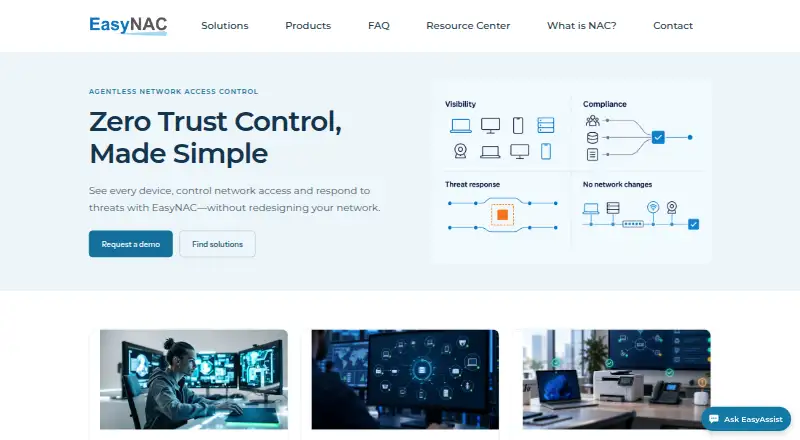
What EasyNAC is
EasyNAC provides network visibility and access control for devices on wired and wireless networks, including LANs. Typical deployments discover and profile devices without agents. The system uses out-of-band ARP enforcement to restrict unauthorized devices, and inline enforcement is available for remote access VPN protection. It can also respond to security events: when it receives syslog messages or email alerts from security systems, it can restrict the affected device. Integrations listed in its FAQ include Microsoft Active Directory and Entra ID, Defender, Intune, CrowdStrike Falcon, SentinelOne, and Sophos Central. Organizations can provide BYOD self-registration and guest registration through a captive portal, with configurable policies, approvals, and expiration times. The product line includes hardware and virtual appliances; virtual appliances can be deployed on-premises or in the cloud. Enforcer Sensors extend visibility and enforcement to remote sites and support Windows, Linux, and Raspberry Pi systems. Appliance models list maximum capacities from 300 to 10,000 devices, depending on VLANs, endpoints, and enabled features. Licensing counts concurrent unique MAC addresses seen in the past five minutes. Perpetual licenses and software subscriptions are available, while agents are purchased separately. InfoExpress makes EasyNAC.
Who it suits
EasyNAC suits organizations seeking visibility and access control across wired, wireless, and VPN-connected devices, with options for hardware, virtual, and hybrid deployment. It also fits environments that need guest or BYOD registration, remote-site sensors, or responses tied to security alerts.
What it does well
- Discovers and profiles devices without agents in typical deployments.
- Controls wired, wireless, and VPN access.
- Offers hardware and virtual appliance deployments.
- Supports guest and BYOD registration through a captive portal.
- Can restrict devices in response to security alerts.
- Integrates with listed identity and security products.
What to know first
- Pricing is available on request.
- Agents are purchased separately.
- IPv4 is required for management and most key features.
- Trusted-device enforcement is disabled above the 10% license grace amount.
Limits
Appliance models list maximum capacities from 300 to 10,000 devices, with actual capacity depending on VLANs, endpoints, and enabled features. If usage exceeds the license by more than 10%, protection continues, but enforcement for trusted devices above that grace amount is disabled. IPv4 is required for management and most key features.
Plans
| Plan | Billed and limits | Price |
|---|---|---|
| EasyNAC hardware or virtual appliance | Perpetual license typically; subscription options available · licensed by concurrent devices and remote offices · agents purchased separately | On request |
As easynac.com lists them, read 8 Oct 2026. The maker's own page has the final word.
Getting started
- Visit the EasyNAC website and request a demo.
- Discuss device counts, sites, and security requirements with the EasyNAC team.
- Choose a hardware or virtual appliance and a perpetual license or software subscription.
- Deploy a virtual appliance on-premises or in the cloud, if selected.
- Add Enforcer Sensors for remote sites if needed.
- Set concurrent-device licensing and purchase agents separately if required.
EasyNAC is a network access control product for discovering devices and enforcing access across wired and wireless networks. It suits organizations that need agentless visibility alongside configurable guest, BYOD, and threat-response controls. Its breadth is balanced by custom pricing, capacity limits, and an IPv4 requirement for management and most key features.
Overview
EasyNAC combines network visibility with Zero Trust access control. Typical deployments can discover and profile devices without endpoint agents, while access enforcement uses out-of-band ARP; inline enforcement is available to protect remote access VPNs. The FAQ says it works with managed or unmanaged switches without requiring switch, endpoint, or spanning-port configuration, which can make it a fit for networks where infrastructure changes are undesirable.
It can also receive event-based syslog messages or email alerts from security systems and restrict affected devices. A deception feature places fake services across protected VLANs or subnets to help detect hacking activity. These controls make EasyNAC more than an inventory tool, though organizations should weigh the IPv4 requirement against networks that rely heavily on IPv6.
Key features
- Discovery and enforcement: Agentless discovery profiles devices, and ARP enforcement restricts unauthorized devices without requiring changes to existing network infrastructure. Inline enforcement extends protection to remote access VPNs.
- Guest and BYOD access: Self-registration and a captive portal support guest and BYOD onboarding. Configurable approvals, expiration times, and access policies give administrators control over how that access is granted and retained.
- Threat response and endpoint checks: EasyNAC can respond to syslog messages or email alerts from security solutions by restricting a device. Integrations can check antivirus and patch status; optional agents provide more in-depth checks.
- Integrations: The FAQ names Microsoft Active Directory and Entra ID, Defender, Intune, CrowdStrike Falcon, SentinelOne, and Sophos Central.
- Remote-site sensors: Enforcer Sensors extend visibility and enforcement to remote sites. They support Windows 10 or later, selected Linux distributions, and EasyNAC Raspberry Pi OS on Raspberry Pi 4 or 5.
Pricing
EasyNAC is paid, with custom pricing for its hardware or virtual appliance. Perpetual licenses are typical, with software subscription options also available. Licensing is based on concurrent unique MAC addresses seen during the past five minutes; remote offices are also part of the licensing basis, and agents are purchased separately.
Appliance models range from 300 to 10,000 devices, but appropriate capacity depends on VLANs, endpoints, and enabled features. If usage exceeds the license, protection continues, but enforcement for trusted devices above a 10% grace amount is disabled. Organizations should confirm device capacity and licensing needs before choosing a model. EasyNAC invites prospective customers to request a demo and discuss device counts, sites, and security requirements.
Platforms
EasyNAC is available for Linux and Windows in a self-hosted, hybrid deployment model. Server appliances come as hardware or virtual appliances; the virtual Central Visibility Manager can run on-premises or in the cloud. IPv6 endpoints are supported in dual-stack environments, but IPv4 is required for management and most key features.
Who it's for
EasyNAC is a strong fit for organizations that need device discovery and access enforcement across wired and wireless networks, particularly those managing guest or BYOD access, remote offices, or responses tied to other security systems. Its appliance range and sensor options can suit deployments across multiple sites, provided capacity is matched to the network.
It is less suitable for organizations seeking a self-serve, publicly priced option, or for environments that cannot provide IPv4 for management and core features. Teams needing deeper endpoint checks should also account for separately purchased agents.
Pros and cons
- Pros: Agentless discovery and support for managed or unmanaged switches reduce reliance on endpoint agents and switch reconfiguration in typical deployments.
- Pros: Wired, wireless, and VPN access control combine with guest/BYOD registration and automated threat response in one product line.
- Pros: Hardware, virtual appliances, and remote-site sensors provide deployment choices for on-premises, cloud, and branch environments.
- Cons: Custom pricing and capacity that varies with VLANs, endpoints, and features make budgeting and model selection dependent on a sales discussion.
- Cons: Separate agent purchases add cost for organizations that need more in-depth endpoint checks.
- Cons: IPv4 is required for management and most key features, limiting its fit for IPv6-only environments.
Alternatives
For a broader comparison, see Network Access Control Software.
- PacketFence is the stronger candidate for teams wanting an open-source self-hosted edition with unlimited devices and full source code, as well as a free plan and trial.
- NACVIEW may suit organizations that want a freemium option, including a lifetime free tier limited to 20 simultaneously authorized endpoint devices.
- Arista NG Firewall is an alternative with a free plan and basic security and connectivity features, though its listed platform is web.
- SecureW2 Cloud NAC is another paid NAC option with pricing requested through a quote form.
- NACIO is another paid option for teams considering macOS, self-hosted, or Windows platforms.
- Arbiter offers an Asset Discovery plan at €29 a month after a 60-day free trial, but that plan provides visibility and inventory without access enforcement.
- Auconet BICS is another paid option with API and self-hosted platforms.
- Cloudi-Fi Cloud NAC is another paid option with pricing requested via contact form.
Verdict
Choose EasyNAC if you need network discovery, access enforcement, and configurable guest or BYOD access across wired and wireless environments, with options for VPN protection and remote sites. Its main advantage is the combination of agentless visibility, flexible enforcement, and event-driven response; its main drawbacks are custom pricing, device-capacity licensing, separately purchased agents, and the IPv4 requirement for management and most key features.
Verdict
Choose EasyNAC if your organization needs network discovery, access enforcement, and configurable guest or BYOD access across wired and wireless environments. Organizations evaluating it will need to request pricing and match device capacity to their VLANs, endpoints, and enabled features; IPv4 is required for management and most key features.
Questions
What does EasyNAC cost?
Pricing is available on request. Perpetual licenses and software subscriptions are offered, with licensing based on concurrent devices and remote offices; agents are purchased separately.
What platforms and deployment options does EasyNAC support?
EasyNAC supports Linux, Windows, and self-hosted deployments. Hardware and virtual appliances are available, and virtual appliances can run on-premises or in the cloud.
How does EasyNAC count licensed devices?
Licensing counts concurrent unique MAC addresses seen in the past five minutes. If use exceeds the license by more than 10%, enforcement for trusted devices above that grace amount is disabled, though protection continues.
Does EasyNAC support guest and BYOD access?
Yes. It offers guest registration and BYOD self-registration through a captive portal, with configurable access policies, approvals, and expiration times.
Which integrations are listed?
The FAQ lists Microsoft Active Directory and Entra ID, Defender, Intune, CrowdStrike Falcon, SentinelOne, and Sophos Central.
Who makes EasyNAC?
InfoExpress makes EasyNAC and identifies itself as a Silicon Valley-based cybersecurity company.
Facts from EasyNAC's own pages
- Access enforcement
- It uses out-of-band ARP enforcement, with inline enforcement available for remote access VPN protection. · easynac.com, 8 Oct 2026
- Agentless discovery
- It discovers and profiles devices without requiring agents for typical deployments. · easynac.com, 8 Oct 2026
- Automated response
- It can receive event-based syslog messages or email alerts from security solutions and restrict an affected device. · easynac.com, 8 Oct 2026
- Branch sensors
- Enforcer Sensors extend visibility and enforcement to remote sites and support Windows, Linux, and Raspberry Pi systems. · easynac.com, 8 Oct 2026
- Capacity limits
- Appliance models list maximum capacities from 300 to 10,000 devices; capacity depends on VLANs, endpoints, and enabled features. · easynac.com, 8 Oct 2026
- Company
- The company identifies InfoExpress as the maker of EasyNAC and describes itself as a Silicon Valley-based cybersecurity company. · easynac.com, 8 Oct 2026
- Compliance checks
- It can check endpoint antivirus and patch status through integrations, with optional agents for more in-depth checks. · easynac.com, 8 Oct 2026
- Deployment
- The product line includes hardware and virtual appliances; virtual appliances can be deployed on-premises or in the cloud. · easynac.com, 8 Oct 2026
- Deployment options
- Server appliances are offered as hardware or virtual appliances; the virtual Central Visibility Manager can be deployed on-premises or in the cloud. · easynac.com, 8 Oct 2026
- Enforcement
- It uses ARP enforcement to restrict unauthorized devices without requiring changes to existing network infrastructure. · easynac.com, 8 Oct 2026
- Guest and BYOD
- It offers BYOD self-registration and guest registration through a captive portal, with configurable access policies. · easynac.com, 8 Oct 2026
- Guest and BYOD access
- It provides self-registration for BYOD and guest access with configurable approvals, expiration times, and access policies. · easynac.com, 8 Oct 2026
- Integrations
- The FAQ lists integrations including Microsoft Active Directory and Entra ID, Defender, Intune, CrowdStrike Falcon, SentinelOne, and Sophos Central. · easynac.com, 8 Oct 2026
- IPv6 limitation
- IPv6 endpoints are supported in dual-stack environments, but IPv4 is required for management and most key features. · easynac.com, 8 Oct 2026
- License model
- Licensing is based on concurrent unique MAC addresses seen in the past five minutes; perpetual licenses and software subscriptions are available, and agents are purchased separately. · easynac.com, 8 Oct 2026
- License overage
- The FAQ says protection continues when a license is exceeded, but enforcement for trusted devices above a 10% grace amount is disabled. · easynac.com, 8 Oct 2026
- Licensing limit
- The concurrent-device license counts unique MAC addresses seen in the past five minutes; if usage exceeds the license by more than 10%, protection is disabled for trusted devices above that grace amount. · easynac.com, 8 Oct 2026
- Network compatibility
- The FAQ says EasyNAC works with managed or unmanaged switches and does not require switch, endpoint, or spanning-port configuration. · easynac.com, 8 Oct 2026
- Product
- EasyNAC provides network visibility and Zero Trust access control for devices on wired and wireless networks. · easynac.com, 8 Oct 2026
- Purpose
- EasyNAC provides network visibility and access control for devices on LAN and wireless networks. · easynac.com, 8 Oct 2026
- Sensor platforms
- Enforcer Sensors are supported on Windows 10 or later, selected Linux distributions, and EasyNAC Raspberry Pi OS on Raspberry Pi 4 or 5. · easynac.com, 8 Oct 2026
- Support
- EasyNAC provides a technical support portal for troubleshooting, configuration, and expert advice. · easynac.com, 8 Oct 2026
- Support and sales
- The product page invites organizations to request a demo and discuss device counts, sites, and security requirements with the EasyNAC team. · easynac.com, 8 Oct 2026
- Threat detection
- Its deception feature hosts fake services across protected VLANs or subnets to help detect hacking activity. · easynac.com, 8 Oct 2026
Where EasyNAC stands on Freedom251
- Network Access Control Software#13 of 23