Freedom251 › Data Version Control Tools
DVID
What DVID is
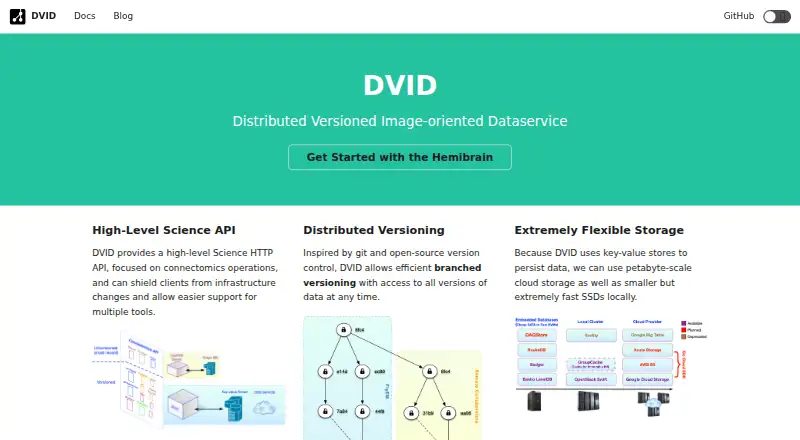
DVID is a free, open-source, self-hosted data service for image-oriented neural reconstruction, analysis, and visualization. Its science-focused REST HTTP API and command-line access support connectomics data and operations. Built-in types include 3D image and label volumes, sparse volumes, point annotations, label graphs, and regions of interest. Branched versioning lets users query different data versions without checking out committed data. Instances can use local embedded databases or cloud storage backends, and developers can add custom types with specialized HTTP APIs. DVID runs on Linux, macOS, and Windows after installation and configuration through a file defining ports, storage engines, and data locations. Listed clients include neuclease, intern, natverse, libdvid-cpp, Neuroglancer, neuTu, and Clio. The current developer build requires Go 1.25 or newer, CGO, a C compiler, and Python 3 or a configured Python path. It lacks domain-specific tools for comparing versions.
Who it suits
DVID suits research and engineering teams working with versioned connectomics or other image-oriented datasets. It is intended for organizations able to self-host and configure server storage.
What it does well
- Free and open source
- Branched version queries
- Multiple built-in scientific data types
- Local and cloud storage backends
- Extensible HTTP APIs
What to know first
- Self-hosted deployment required
- Developer build has several prerequisites
- No domain-specific version comparison tools
- Configuration file setup is required
Verdict
DVID provides versioned scientific data storage with broad client and backend options. Its self-hosting model and missing version-diff tools are important considerations for deployment planning.
Facts from DVID's own pages
- API
- DVID provides a science-driven REST HTTP API and command-line access. · dvid.io, 9 Oct 2026
- Clients
- Documented DVID clients include the neuclease Python library, intern, natverse, libdvid-cpp, Google neuroglancer, neuTu, and Clio. · github.com, 9 Oct 2026
- Dataset size
- The Hemibrain release page says its reduced databases total 1.2 TB and lets users choose which databases to download, with metadata required. · dvid.io, 8 Oct 2026
- Data types
- Its supported data includes multiscale image and label volumes, sparse volumes, point annotations, label graphs, regions of interest, and key-value data. · dvid.io, 9 Oct 2026
- Deployment
- DVID is a server that users install and configure with a file describing ports, storage engines, and data locations. · github.com, 8 Oct 2026
- Extensibility
- Users can add custom data types with specialized HTTP APIs. · dvid.io, 9 Oct 2026
- Hemibrain access
- The Hemibrain guide says users can request access to the updated V1.2 DVID dataset by contacting the team. · dvid.io, 9 Oct 2026
- Hemibrain requirements
- Running the Hemibrain reconstruction server requires downloading databases to local disks; the reduced release contains three versions totaling 1.2 TB. · dvid.io, 9 Oct 2026
- Integrations
- The About page says DVID can proxy to connectomics services including Google BrainMaps and OpenConnectome. · dvid.io, 9 Oct 2026
- Monitoring
- DVID can send mutation and activity logs to Kafka, which Janelia processes in Kibana for performance analysis. · dvid.io, 9 Oct 2026
- Notable limit
- DVID currently does not provide domain-specific diff tools for comparing data between versions. · github.com, 8 Oct 2026
- Notable limitation
- The repository documentation says DVID does not provide domain-specific tools to compare data between versions. · github.com, 9 Oct 2026
- Platforms
- The About page says DVID has been tested on macOS, Linux, and Windows 10+ Bash Shell. · dvid.io, 9 Oct 2026
- Purpose
- DVID is a distributed, versioned image-oriented data service built to support Janelia brain imaging, analysis, and visualization. · dvid.io, 9 Oct 2026
- Requirements
- The current developer build requires Go 1.25 or newer, CGO, a C compiler, and Python 3 or a configured Python path. · github.com, 8 Oct 2026
- Science API
- It provides a stable, domain-specific HTTP API for connectomics data and operations. · dvid.io, 8 Oct 2026
- Storage
- DVID can use different key-value storage systems, from local embedded stores to Google Cloud Storage. · dvid.io, 9 Oct 2026
- Support and security
- The opened maker pages describe configuration and documentation but do not state a support plan or security/compliance certification. · dvid.io, 8 Oct 2026
- Versioning
- It supports branched versioning and access to data across versions. · dvid.io, 9 Oct 2026
Where DVID stands on Freedom251
- Data Version Control Tools#34 of 36