Freedom251 › AI Singing Voice Generators
DiffSinger
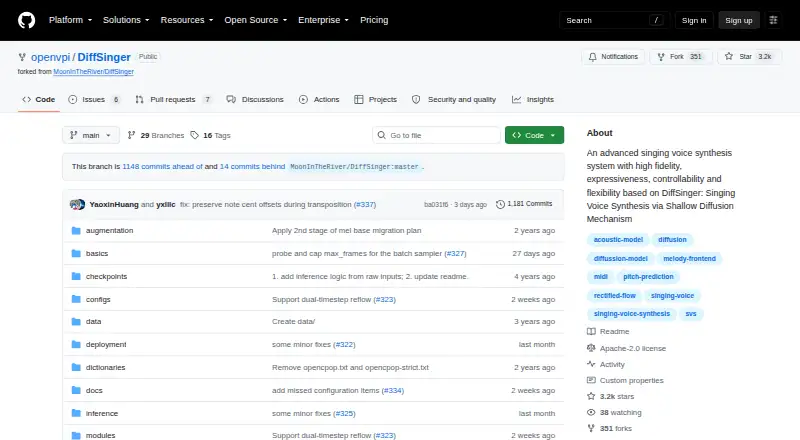
What DiffSinger is
DiffSinger is a self-hosted system for synthesizing singing voices with a shallow diffusion mechanism. Its maintained version adapts synthesized audio to a 44.1 kHz sampling rate, and the project includes improved acoustic models and accelerated diffusion sampling. Variance models and parameters can predict and control pitch, energy, breathiness, and other vocal aspects. The linked MakeDiffSinger project provides dataset-building pipelines and tools for slicing and labeling recordings. The getting-started guide covers dataset preprocessing, model training, and inference on DS files using variance or acoustic models. DiffSinger uses ONNX for deployment and links to OpenUtau and DiffScope for production or deployment; DiffScope is described as an editor under development. Users prepare their own data and assets. Installation requires Python 3.10 or later, with PyTorch 2.4.0 or later recommended. The repository prohibits generating a person's voice without their consent; its guide also includes a tool to remove speaker embeddings from checkpoints before model distribution. The project points users to tutorials, GitHub issues and discussions, and QQ and Discord groups for support.
Who it suits
It suits singing-voice synthesis practitioners and production teams preparing their own data and assets. The project describes its functionality as designed for production deployment and the singing voice synthesis community.
What it does well
- Free, open-source repository under Apache-2.0
- Controls pitch, energy, and breathiness
- MakeDiffSinger provides dataset-building tools
- ONNX deployment format
- Commercial use is allowed
What to know first
- Users must prepare their own data and assets
- Requires Python 3.10 or later
- PyTorch 2.4.0 or later is recommended
- Generating a person's voice without consent is prohibited
Limits
The free plan requires users to prepare their own data and assets. Installation requires Python 3.10 or later, and PyTorch 2.4.0 or later is recommended.
Plans
| Plan | Billed and limits | Price |
|---|---|---|
| DiffSinger | Apache-2.0 licensed repository · requires Python 3.10 or later · users prepare their own data and assets | Free |
As github.com lists them, read 4 Oct 2026. The maker's own page has the final word.
Getting started
- Open the DiffSinger repository and follow its getting-started guide.
- Install Python 3.10 or later; PyTorch 2.4.0 or later is recommended.
- Prepare a dataset, using MakeDiffSinger tools for recording slicing and labeling if useful.
- Preprocess the dataset and train a model.
- Run inference on DS files with a variance or acoustic model.
- Deploy using ONNX or explore the linked production projects.
Verdict
DiffSinger offers a configurable synthesis workflow, dataset tools, and ONNX deployment for users prepared to supply their own assets. Check the Python requirement and consent restriction before starting.
Questions
How much does DiffSinger cost?
The listed plan is free. The repository is Apache-2.0 licensed, and commercial use is allowed.
Is there a free plan or trial?
The plan is free, and there is no free trial.
What platforms does it support?
DiffSinger is self-hosted. The getting-started guide requires Python 3.10 or later and recommends PyTorch 2.4.0 or later.
Does it support MIDI or vocal input?
MIDI support is available; vocal input is not.
What format does it use for deployment?
ONNX is the deployment format. The repository also links OpenUtau and DiffScope as production or deployment projects.
Who makes DiffSinger?
DiffSinger is available through the OpenVPI GitHub repository.
Facts from DiffSinger's own pages
- Audio quality
- The maintained version adapts synthesized audio to a 44.1 kHz sampling rate instead of the original 24 kHz. · github.com, 4 Oct 2026
- Control
- Variance models and parameters allow prediction and control of pitch, energy, breathiness, and other aspects. · github.com, 4 Oct 2026
- Dataset tools
- The linked MakeDiffSinger project provides pipelines and tools for building DiffSinger datasets, including recording slicing and labeling tools. · github.com, 4 Oct 2026
- Deployment
- The guide states that DiffSinger uses ONNX as its deployment format. · github.com, 4 Oct 2026
- Editor integration
- The repository links OpenUtau and DiffScope as deployment or production projects; DiffScope is described as an editor powered by DiffSinger and is under development. · github.com, 4 Oct 2026
- Installation
- The getting-started guide requires Python 3.10 or later and recommends PyTorch 2.4.0 or later. · github.com, 4 Oct 2026
- Intended users
- The project says its functionality is designed for production deployment and the singing voice synthesis community. · github.com, 4 Oct 2026
- Model distribution
- The getting-started guide includes a utility to remove speaker embeddings from a checkpoint for data security when distributing models. · github.com, 4 Oct 2026
- Model improvements
- The project integrates improved acoustic models and diffusion sampling acceleration algorithms. · github.com, 4 Oct 2026
- Purpose
- DiffSinger is a singing voice synthesis system based on a shallow diffusion mechanism. · github.com, 4 Oct 2026
- Security and consent
- The repository prohibits using its functionality to generate someone's voice without that person's consent. · github.com, 4 Oct 2026
- Support
- The project points users to tutorials, GitHub issues and discussions, and QQ and Discord communication groups. · github.com, 4 Oct 2026
- Training and inference
- The guide describes preprocessing datasets, training models, and running inference on DS files using variance or acoustic models. · github.com, 4 Oct 2026
Where DiffSinger stands on Freedom251
- AI Singing Voice Generators#5 of 25