Freedom251 › AI Coding Assistants

dcode
by dcode
What dcode is
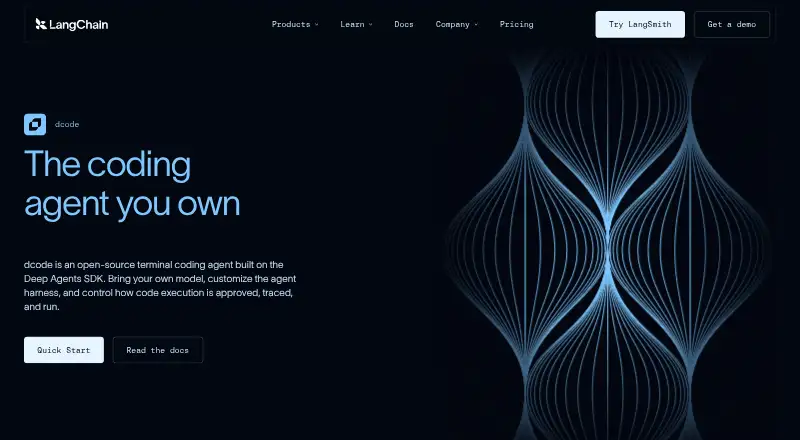
dcode is a free, open-source terminal coding agent built on the Deep Agents SDK. It runs on Linux and macOS and supports Zed. The tool is aimed at teams that want control over a coding agent’s model, tools, memory, approvals, and execution environment. Users provide their own provider keys through environment variables or a team secrets workflow, then can switch among OpenAI, Anthropic, Google, and compatible APIs. dcode supports interactive sessions and non-interactive tasks, including piped input up to 10 MiB. Before changing files, it proposes diffs for approval, and sensitive operations can require human approval. Configuration covers plugins, memory, skills, middleware, hooks, agents, and profiles. Documented capabilities include remote sandboxes, goals and rubrics, subagents, persistent memory, MCP tools, and LangSmith tracing. LangSmith can expose prompts, responses, tool calls, errors, and token usage. Non-interactive shell execution is disabled by default and can be allow-listed.
Who it suits
dcode suits teams seeking an inspectable, configurable coding agent with explicit control over models, tools, approvals, and execution. It is intended for Linux or macOS users comfortable supplying provider keys.
What it does well
- Free and open source
- Supports OpenAI, Anthropic, Google, and compatible APIs
- Diff approval before file changes
- Interactive and automated task modes
- Configurable plugins, memory, skills, and hooks
What to know first
- Windows is not officially supported
- Requires users to provide provider keys
- Piped input is limited to 10 MiB
- Shell execution is disabled by default non-interactively
Verdict
dcode emphasizes configurability and approval controls for terminal-based coding work. Teams must manage their own model credentials and account for platform and non-interactive execution limits.
Facts from dcode's own pages
- Agent customization
- Users can configure models, plugins, memory, skills, middleware, hooks, and agents. · langchain.com, 12 Oct 2026
- Coding agent
- Yes · langchain.com, 22 Sept 2026
- Authentication
- dcode uses bring-your-own-key authentication, with provider keys supplied as environment variables or through a team's secrets workflow. · langchain.com, 12 Oct 2026
- Capabilities
- Documented capabilities include remote sandboxes, goals and rubrics, subagents, persistent memory, human approval controls, custom skills, MCP tools, and LangSmith tracing. · docs.langchain.com, 12 Oct 2026
- Chat assistance
- Yes · langchain.com, 22 Sept 2026
- Code approval
- The agent proposes changes with diffs for approval before modifying files. · docs.langchain.com, 12 Oct 2026
- Company
- LangChain says it is headquartered in San Francisco, with offices in New York, Boston, and Amsterdam. · langchain.com, 12 Oct 2026
- Customization
- Users can customize the agent with plugins, memory, skills, middleware, hooks, agents, and configuration profiles. · langchain.com, 12 Oct 2026
- Execution controls
- The agent proposes changes with diffs for approval before modifying files, and human approval can be required for sensitive tool operations. · docs.langchain.com, 12 Oct 2026
- Founded
- LangChain says its co-founders started the company in early 2023. · langchain.com, 12 Oct 2026
- Headquarters
- San Francisco, California, United States · langchain.com, 28 Sept 2026
- Input limit
- The maximum piped input size is 10 MiB. · docs.langchain.com, 12 Oct 2026
- Integrations
- The documentation says OpenAI, Anthropic, and Google are available out of the box; web search uses Tavily, and external tools can be loaded from MCP servers. · docs.langchain.com, 12 Oct 2026
- Intended users
- The maker describes dcode as suited to teams that want an inspectable, configurable coding agent with control over its model, tools, memory, approvals, and execution environment. · langchain.com, 12 Oct 2026
- Maker
- LangChain says it is headquartered in San Francisco, started as a company in early 2023, and has offices in New York, Boston, and Amsterdam. · langchain.com, 12 Oct 2026
- Model providers
- It works with OpenAI, Anthropic, Google, and compatible APIs, and users can switch providers or models. · docs.langchain.com, 12 Oct 2026
- Model support
- It works with OpenAI, Anthropic, and OpenAI-compatible or Anthropic-compatible APIs, and supports switching models or providers. · langchain.com, 12 Oct 2026
- Non-interactive input limit
- The maximum piped input size in non-interactive mode is 10 MiB. · docs.langchain.com, 12 Oct 2026
- Product
- dcode is an open-source terminal coding agent built on the Deep Agents SDK. · langchain.com, 12 Oct 2026
- Purpose
- It is intended for teams that want control over the model, tools, memory, approvals, and execution environment behind a coding agent. · langchain.com, 12 Oct 2026
- Shell execution limit
- Shell execution is disabled by default in non-interactive mode and can be enabled with an allow-list; allowing all commands permits arbitrary shell execution without human confirmation. · docs.langchain.com, 12 Oct 2026
- Supported IDEs
- Zed · langchain.com, 22 Sept 2026
- Terminal access
- Yes · langchain.com, 22 Sept 2026
- Tracing and governance
- Connecting LangSmith can expose prompts, model responses, tool calls, errors, and token usage, while LangSmith and LLM Gateway provide cost policies, secrets redaction, and PII detection. · langchain.com, 12 Oct 2026
Where dcode stands on Freedom251
- AI Coding Assistants#76 of 102