Freedom251 › Research Data Management Software
Dataverse
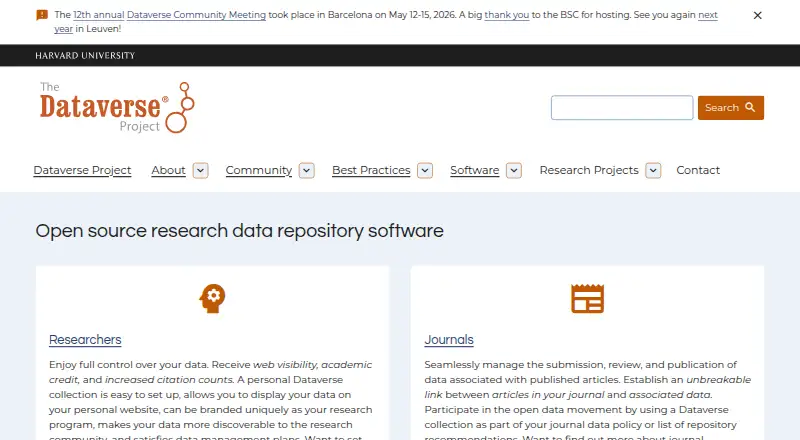
What Dataverse is
Dataverse is free, open-source software for running a web repository that shares, preserves, cites, explores, and analyzes research data. A repository contains Dataverse collections, which hold datasets, descriptive metadata, and data files. Users can upload, manage, publish, and download files, add rich metadata, define reuse terms, and keep published changes through versioning. The project identifies researchers, journals, institutions, and developers as use cases. Integrations are documented for GitHub, Dropbox, Open Science Framework, GitLab, iRODS, Globus, Galaxy, and JupyterHub, although its Integrations Dashboard is community software still being developed. Authentication can be local or remote, including Shibboleth and OAuth/OpenID Connect, while local passwords use salted hashes. It is self-hosted and requires Linux, Java, Payara, PostgreSQL, Solr, and jq. Operators should be comfortable with Linux commands; without R, tabular ingest and export are unavailable.
Who it suits
Dataverse suits researchers, journals, institutions, and developers that need a self-hosted research-data repository. It fits organizations able to install and configure the required Linux-based stack.
What it does well
- Free, open-source software
- Dataset versioning tracks published changes
- Rich metadata and reuse terms
- Remote and local authentication options
- Documented integrations with research tools
What to know first
- Self-hosted installation requires several components
- Linux and system administration skills needed
- R required for tabular ingest and export
- Integrations Dashboard remains in development
Limits
Dataverse is free software, but an institution or operator installs and configures it. Without R installed, tabular data ingest and export functionality described in the guide is unavailable.
Plans
| Plan | Billed and limits | Price |
|---|---|---|
| Dataverse Software | Open-source software; institution or operator installs and configures the repository | Free |
As dataverse.org lists them, read 8 Oct 2026. The maker's own page has the final word.
Getting started
- Review the Dataverse installation guide.
- Prepare Linux and the required Java, Payara, PostgreSQL, Solr, and jq components.
- Use RHEL or a derivative such as Rocky Linux, as recommended by the guide.
- Install and configure the repository, including its security settings.
- Optionally install R for the described tabular data ingest and export functionality.
Verdict
Dataverse provides a structured repository for publishing and managing research datasets, with metadata, versioning, authentication, and integrations. Its self-hosted deployment and required components make it most suitable for organizations with technical administration capacity.
Questions
Is Dataverse free?
Yes. Dataverse Software is listed as free as open-source software.
Who installs and hosts it?
An institution or operator installs and configures the repository. Its deployment model is self-hosted, with bring-your-own storage.
What does installation require?
The guide requires Linux, Java, Payara, PostgreSQL, Solr, and jq. It recommends RHEL or a derivative such as Rocky Linux.
Which integrations are documented?
They include GitHub, Dropbox, Open Science Framework, GitLab, iRODS, Globus, Galaxy, and JupyterHub. The Integrations Dashboard is community software currently in development.
Which authentication options does Dataverse support?
It supports local and remote authentication, including Shibboleth and OAuth/OpenID Connect.
Does Dataverse work without R?
The software can run without R, but tabular data ingest and export functionality described in the guide is unavailable.
Facts from Dataverse's own pages
- Core features
- Users can upload, manage, publish, and download data files; add rich metadata; set reuse terms; and track published dataset changes with versioning. · dataverse.org, 8 Oct 2026
- Installation
- The installation guide requires Linux, Java, Payara, PostgreSQL, Solr, and jq; it recommends RHEL or a derivative such as Rocky Linux. · guides.dataverse.org, 8 Oct 2026
- Installation skill requirement
- The installation guide says installers need to be comfortable with basic system tasks and Linux commands. · guides.dataverse.org, 8 Oct 2026
- Integrations
- Documented integrations include GitHub, Dropbox, Open Science Framework, GitLab, iRODS, Globus, Galaxy, and JupyterHub. · guides.dataverse.org, 8 Oct 2026
- Integration status
- The Integrations Dashboard is described as community software that is currently in development. · guides.dataverse.org, 8 Oct 2026
- Intended users
- The project describes use cases for researchers, journals, institutions, and developers. · dataverse.org, 8 Oct 2026
- Optional functionality
- Without R installed, the software can still run, but tabular data ingest and export functionality described in the guide is unavailable. · guides.dataverse.org, 8 Oct 2026
- Organization
- A Dataverse repository hosts virtual archives called Dataverse collections, which contain datasets with descriptive metadata and data files. · dataverse.org, 8 Oct 2026
- Purpose
- Dataverse is open-source web application software for sharing, preserving, citing, exploring, and analyzing research data. · dataverse.org, 8 Oct 2026
- Security
- The software supports remote and local authentication, including Shibboleth and OAuth/OpenID Connect; local account passwords are stored as salted hashes. · dataverse.org, 8 Oct 2026
- Security configuration
- The installation guidance covers securing Solr and API endpoints, forcing HTTPS, and using proxies. · dataverse.org, 8 Oct 2026
- Support
- The project says IQSS leads software development and provides user support with Harvard’s Open Data Assistance Program. · dataverse.org, 8 Oct 2026
Where Dataverse stands on Freedom251
- Research Data Management Software#1 of 33
- Data Version Control Tools#9 of 36