Freedom251 › Intrusion Detection and Prevention Software

CrowdSec
by CrowdSec
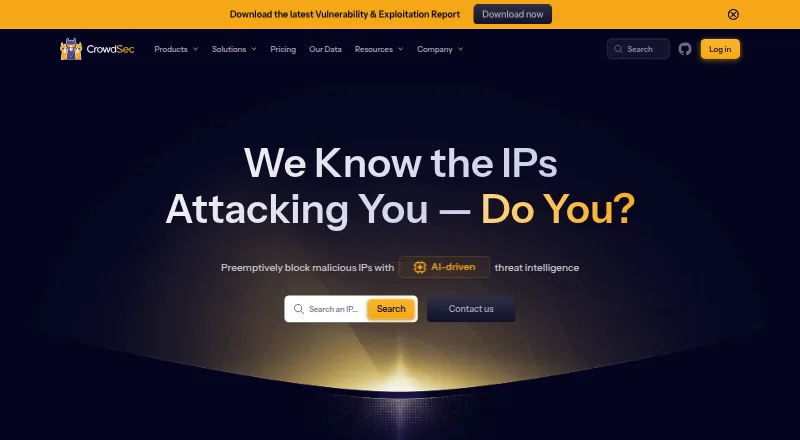
What CrowdSec is
CrowdSec is an open-source security stack that detects and blocks malicious IP addresses to help protect infrastructure and applications. Its Security Engine analyzes logs and requests for malicious behavior, while its Remediation Component blocks identified IPs across platforms. CrowdSec says the analysis happens locally and logs remain within the user's infrastructure. The AppSec Component can provide web application firewall protection for web applications. The free Community offering includes real-time decision management, audit support, AWS CloudTrail scenarios, CAPI allow lists, and Kubernetes audit acquisition. Its IP Reputation offering provides contextual information, activity timelines, autonomous system and IP range reputation, MITRE technique classifications, and hourly updated data. Listed integrations include Microsoft Sentinel, Juniper, AWS log sources, WordPress, Chrome Extension, Windows Firewall, Cloudflare, Docker, and Kubernetes. The Community Security Engine is free. The IP Reputation API costs $49 a month for 5,000 queries. Other offerings include blocklists and threat-intelligence services. CrowdSec lists users in industries including hosting, education, ecommerce, finance, government, media, and healthcare.
Who it suits
It may suit infrastructure and application security teams, including organizations in the industries CrowdSec lists. The free Community offering includes audit and cloud-native scenarios; commercial use of CrowdSec data in an offering requires its Partnership Program.
What it does well
- Security Engine analyzes logs and requests locally.
- Remediation Component blocks identified malicious IPs.
- AppSec can provide web application firewall protection.
- Community Security Engine is free.
- Integrations include Cloudflare, Docker, and Kubernetes.
What to know first
- IP Reputation API is $49 a month.
- Premium service and support lists $1K/month.
- Commercial data use in offerings requires the Partnership Program.
Limits
The free Community plan lists 3 blocklists. The IP Reputation API plan costs $49 a month and includes 5,000 queries; Platinum Blocklists and Live Exploit Tracker start at 1900.00 USD and $2,000 a month respectively for SMB.
Plans
| Plan | Billed and limits | Price |
|---|---|---|
| IP Reputation API | From $49/month · 5,000 queries · 32 context criteria · hourly updated data · multiple API keys · optional local replication | $49 a month |
| Platinum Blocklists | Starting at $1900/month for SMB · All blocklists · any number of company endpoints · firewall and CDN integrations | $1,900 a month |
| Live Exploit Tracker | Starting at $2k/month for SMB; company-size based · CVE exploitation status · attacker IPs · vendor targeting · hourly refreshed IPs · OEM pricing available | $2,000 a month |
| Community Security Engine | Free; the Security Engine is and always will be free · Open source MIT license · free CrowdSec Console account available | Free |
| Community | Free plan for enthusiasts and individuals · behavioral detection · security response automation | Free |
| IP Reputation API access | $49 /month for 5000 queries · 5000 queries | $49 a month |
| Local CTI replication | From $9K/month · Local synchronization of CrowdSec threat-intelligence data | $9,000 a month |
| CrowdSec Console Premium | Pay as you grow per enrolled Security Engine · Premium blocklist · alert-surge notifications · advanced stack management · health monitoring · extended alert retention · SaaS API · multi-channel notifications · optional emergency fixes $1K/month · optional premium support $1K/month | On request |
As crowdsec.net lists them, read 15 Oct 2026. The maker's own page has the final word.
Getting started
- Visit the CrowdSec website.
- Choose the Community Security Engine or another listed offering.
- Use the free Console account available with the Community Security Engine.
- Select a platform from the listed Linux, macOS, Windows, web, API, extension, or self-hosted options.
CrowdSec is an open-source security stack that detects suspicious behavior and blocks malicious IPs across infrastructure and web applications. It is best suited to operators who want local analysis and can manage their own security tooling. Its free engine is a strong starting point, but threat-intelligence services and premium support can become significant expenses.
Overview
The Security Engine analyzes logs and requests for attacks, while a separate Remediation Component blocks the IPs it identifies. The hybrid stack supports inline blocking, cloud workloads and multiple network scopes, giving infrastructure teams a way to connect detection with prevention. The AppSec Component can also provide web application firewall protection against current vulnerabilities.
Analysis takes place locally, and logs do not leave the user's infrastructure. CrowdSec's ecosystem service processes contextualized IP addresses with incident date, time and type, without directly identifying data in those lists. Its privacy policy says employee access requires multi-factor authentication and automated encryption is used where possible. CrowdSec was founded in 2020 and is headquartered in Montrouge, France.
Key features
Detection and blocking
Pairing behavior analysis with IP remediation is the product's central advantage: teams can act on detected threats rather than stopping at log monitoring. How useful that is depends on the platforms and integrations in a team's environment; the integration directory includes Windows Firewall, Cloudflare, Docker, Kubernetes, WordPress, AWS log sources, Microsoft Sentinel, Juniper and a Chrome Extension.
Application security and community tools
AppSec extends the stack to web application firewall protection, making CrowdSec relevant to teams securing web services as well as infrastructure. The free Community offering adds real-time decision management, audit support, AWS CloudTrail scenarios, CAPI allow lists and Kubernetes audit acquisition. That is a broad base for evaluating the engine before paying for commercial intelligence, though the feature set should not be mistaken for the separately priced services.
Threat intelligence
The IP Reputation service supplies 32 criteria of context, activity timelines, autonomous-system and IP-range reputation, MITRE technique classification and hourly updated data. This can add useful context to security decisions, but its query quota and recurring fee make it a distinct budget decision rather than an automatic extension of the free engine.
Pricing
CrowdSec uses a freemium model and offers a free trial. The Community Security Engine costs nothing, is open source under the MIT license, and comes with the option of a free CrowdSec Console account. The Community plan includes three blocklists; the engine itself is a sensible fit for teams that want core detection and prevention without a paid intelligence subscription.
IP Reputation API access costs $49 a month, billed monthly, for 5,000 queries. It suits teams that need enriched IP context at a defined volume, but the quota matters for high-volume use. Platinum Blocklists start at $1,900 a month for SMBs and provide access to all blocklists on any number of endpoints within the company. That company-wide endpoint access may fit organizations standardizing blocklists across many machines, but the starting price is a substantial step up from the API plan.
Live Exploit Tracker starts at $2,000 a month for SMBs; pricing is company-size based, and OEM pricing is available. Local CTI Replication synchronizes threat-intelligence and IP-reputation data locally and has custom pricing. CrowdSec Console Premium has custom pricing and includes a premium community blocklist, alert-surge notifications, advanced stack management, background-noise filtering, stack-health monitoring and centralized list management. Optional premium service and support are listed at $1K/month. Commercial use of CrowdSec data in another offering requires the Partnership Program, with partner pricing on request.
Platforms
CrowdSec supports API, extension, Linux, macOS, self-hosted, web and Windows environments. Its stated network scope, inline blocking and cloud workload support make it applicable across more than one layer of an infrastructure, while the integration directory gives teams specific connection points to assess against their existing tools.
Who it's for
The stack is suited to infrastructure and application operators who value local log analysis, want IP blocking, and are prepared to configure and maintain security tooling. CrowdSec identifies MSSPs, IT and services, hosting, education, ecommerce, finance, government, media and healthcare among its relevant industries. Smaller teams can begin with the free engine; organizations needing broader blocklist access, richer reputation data or premium management should weigh recurring commercial costs against their scale and needs.
Pros and cons
- Pros: Local analysis keeps logs within the user's infrastructure, while detection and remediation work together to identify and block malicious IPs.
- Pros: The free MIT-licensed engine and Community features provide a substantial starting point, including audit support and Kubernetes audit acquisition.
- Pros: AppSec adds web application firewall protection, extending the stack beyond infrastructure-focused detection.
- Cons: The free Community plan includes three blocklists, while all-blocklist access starts at $1,900 a month for SMBs.
- Cons: IP Reputation API access is capped at 5,000 queries per month for $49 a month, so teams with greater query needs must consider a different service arrangement.
- Cons: Premium Console pricing is custom, and optional premium service and support costs $1K/month, making the full operational cost harder to judge before contacting CrowdSec.
Alternatives
Wazuh is worth considering for teams seeking a freemium, self-hosted option with a free open-source plan and a paid Small plan starting at $571 a month.
OSSEC may suit users looking for a free, command-line option centered on core OSSEC rules, without dedicated support staff.
SELKS is a free, open-source alternative for Linux or self-hosted use, though it has no planned releases after January 1, 2025.
Suricata is a free, GPLv2 option for users seeking software that runs on Linux, macOS or Windows.
Arista NG Firewall is another freemium choice, with a free plan offering basic security and connectivity features with limited capabilities.
IPFire is a free, open-source firewall operating system with no feature tiers or licence renewals.
OPNsense offers a free Community Edition alongside Business Edition plans for users who want those editions compared.
pfSense offers free community firewall and router software, with a separate Plus Software plan.
Browse the Intrusion Detection and Prevention Software category to compare more options.
Verdict
CrowdSec is a strong fit for operators who want a free, locally analyzing engine that can detect and block malicious IPs across infrastructure and web applications. Its main reason to choose is the combination of detection, remediation and optional AppSec protection, backed by substantial Community features. Look elsewhere if you need a turnkey managed service, or if paid intelligence and blocklist pricing do not fit your budget.
Verdict
CrowdSec combines local behavior analysis with IP blocking and optional application protection. The free engine provides a starting point, while IP Reputation API access is $49 a month for 5,000 queries.
Questions
Is CrowdSec free?
The Community Security Engine is free and open source under an MIT license. The pricing model is freemium, and paid offerings are also available.
How much does the IP Reputation API cost?
The IP Reputation API is listed at $49 a month for 5,000 queries.
What platforms does CrowdSec support?
Listed platforms include API, extension, Linux, macOS, self-hosted, web, and Windows.
Where does CrowdSec analyze logs?
The Security Engine analyzes locally, and CrowdSec says logs never leave your infrastructure.
Can CrowdSec data be used commercially in another offering?
Commercial use of CrowdSec data in an offering is available through its Partnership Program, with partner pricing on request.
What does the IP Reputation offering include?
It includes contextual criteria, activity timelines, autonomous system and IP range reputation, MITRE technique classifications, and hourly updated data.
Facts from CrowdSec's own pages
- API integrations
- The CTI API documentation lists native integrations including Microsoft Sentinel, Splunk, TheHive, OpenCTI, Maltego, MISP, QRadar and Security Copilot. · docs.crowdsec.net, 15 Oct 2026
- Application security
- The AppSec Component turns the Security Engine into a web application firewall and can protect web applications from the latest vulnerabilities. · crowdsec.net, 28 Sept 2026
- AppSec
- AppSec rules are part of the log processor and can filter HTTP requests from compatible web servers. · docs.crowdsec.net, 15 Oct 2026
- Behavior detection
- The Security Engine analyzes logs and requests to detect malicious behaviors and attacks. · crowdsec.net, 28 Sept 2026
- Blocklist integrations
- Hosted blocklist endpoints support plain text, F5, FortiGate, Palo Alto, Check Point, Cisco, Juniper, MikroTik, pfSense, OPNsense, Sophos and remediation-component formats. · docs.crowdsec.net, 15 Oct 2026
- Commercial usage
- The pricing FAQ says commercial use of CrowdSec data in an offering is available through its Partnership Program, with partner pricing on request. · crowdsec.net, 28 Sept 2026
- Community features
- The free Community offering includes real-time decision management, audit support, AWS CloudTrail scenarios, CAPI allow lists, and Kubernetes audit acquisition. · crowdsec.net, 28 Sept 2026
- Community intelligence
- Participating engines share detected attacks and receive a curated community blocklist of validated attackers. · docs.crowdsec.net, 15 Oct 2026
- Company profile
- LinkedIn lists CrowdSec as a privately held computer and network security company with 11–50 employees, Paris headquarters and a 2020 founding year. · linkedin.com, 15 Oct 2026
- Data handling
- CrowdSec's privacy policy says only contextualized IP addresses with incident date, time, and type are processed in the described ecosystem service, and says no directly identifying data is included in those lists. · crowdsec.net, 28 Sept 2026
- Default ports
- The Security Engine uses localhost-bound TCP ports 6060 for Prometheus metrics and 8080 for its API by default. · docs.crowdsec.net, 15 Oct 2026
- Deployment
- Official documentation describes single-host, multi-machine, centralized-log, Kubernetes, container and WAF-only deployments. · docs.crowdsec.net, 15 Oct 2026
- Detection engine
- The log processor analyzes data sources and HTTP requests, while the Local API connects processors, remediation components and the Central API. · docs.crowdsec.net, 15 Oct 2026
- Documentation depth
- The documentation includes installation guides, architecture, data sources, remediation, APIs, integrations, compilation and contribution/testing guidance. · docs.crowdsec.net, 15 Oct 2026
- Founded
- 2020 · crowdsec.net, 28 Sept 2026
- Free plan
- Yes · crowdsec.net, 21 Sept 2026
- Funding
- CrowdSec announced a €14 million Series A funding round in 2022 led by BREEGA and Supernova Invest. · crowdsec.net, 15 Oct 2026
- Hardware requirements
- Recommended minimums are one CPU core, 100 MB free RAM, 1 GB free disk and amd64, arm64 or armhf hardware. · docs.crowdsec.net, 15 Oct 2026
- Headquarters
- Montrouge, France · crowdsec.net, 28 Sept 2026
- Integration examples
- The integrations directory lists Microsoft Sentinel, Juniper, AWS log sources, WordPress, Chrome Extension, Windows Firewall, Cloudflare, Docker, and Kubernetes integrations. · crowdsec.net, 28 Sept 2026
- Kubernetes requirements
- The documented Kubernetes installation requires kubectl and Helm, and the default SQLite database does not support replication. · docs.crowdsec.net, 15 Oct 2026
- Legal name and founders
- Crunchbase lists the legal name as CrowdSec SAS and founders Laurent Soubrevilla, Philippe Humeau and Thibault Koechlin. · crunchbase.com, 15 Oct 2026
- Licence
- The CrowdSec Security Engine repository is released under the MIT License. · github.com, 15 Oct 2026
- Limit: G2 users
- G2 reviewers report a steep learning curve for advanced configurations and weaker maturity in enterprise reporting, compliance and centralized management. · g2.com, 15 Oct 2026
Where CrowdSec stands on Freedom251
- Intrusion Detection and Prevention Software#1 of 39
- Firewall Software#3 of 81