Freedom251 › Disclosure Management Software
CoreFiling Seahorse
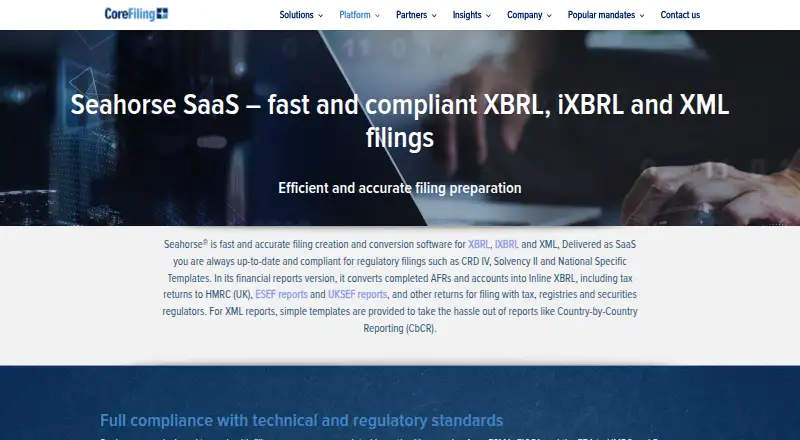
What CoreFiling Seahorse is
CoreFiling Seahorse is browser-based SaaS for preparing XBRL, iXBRL, and XML regulatory filings. It converts annual reports from PDF, Word, Excel, or InDesign into XHTML while retaining their visual design, and can prepare completed financial reports as Inline XBRL, including ESEF and UKSEF reports and UK HMRC tax returns. Machine-learning suggestions identify tags for report lines and provide confidence scores for review. Seahorse can tag financial tables in one pass and supports block and nested-block tagging for notes. It checks filings against ESMA conformance rules and the ESEF filing manual, showing errors and warnings as work proceeds. Its roll-over feature carries prior-year tagging choices into later reports. Country-by-Country Reporting support includes Excel templates plus conversion and validation; some prudential, regulatory, and statistical reporting can use CSV or specially formatted Excel inputs with templates. The product also offers API access for tagging and validation through the broader True North platform. CoreFiling says customers obtain licences, onboarding, and support through certified providers in Europe and the UK. The cloud product requires no installation. Pricing is on request.
Who it suits
It is aimed at in-house teams and tagging partners preparing ESEF reports. It may suit teams handling regulatory filings that need tagging suggestions and validation, provided they can review tags using accounting knowledge.
What it does well
- Converts several document formats into XHTML.
- Tag suggestions include confidence scores for review.
- Checks filings against ESMA and ESEF requirements.
- Roll-over carries prior-year tagging choices forward.
- Cloud access requires no installation.
What to know first
- Tagging needs accounting knowledge for review.
- The first year can take the most work.
- Regulator submission is not supported.
- Pricing is on request.
Limits
Pricing is available on request, and access is through licences obtained from certified providers in Europe and the UK. Tagging needs accounting knowledge for review, and the first year can require extra work, especially when creating taxonomy extensions.
Getting started
- Open the Seahorse website in a browser.
- Contact a certified provider in Europe or the UK about a licence.
- Arrange onboarding and support through the provider.
- Prepare source reports in PDF, Word, Excel, or InDesign, or use the available EPUB import for InDesign users.
- Review suggested tags, then validate the filing.
CoreFiling Seahorse is browser-based software for creating, converting, and validating regulatory filings in XBRL, iXBRL, and XML. It best suits in-house teams and tagging partners preparing financial or other regulated reports; its conversion and rollover tools can reduce repetitive work, but accounting review remains essential.
Overview
Seahorse brings document conversion, tagging, and rule checks into a SaaS workflow. It converts annual reports and accounts from PDF, Word, Excel, or InDesign into XHTML while retaining visual design, then supports Inline XBRL reporting for mandates including ESEF, UKSEF, and UK HMRC tax returns. EPUB import is available for InDesign users.
Its scope extends beyond annual financial reports: named use cases include CRD IV, Solvency II, National Specific Templates, and Country-by-Country Reporting. CbCR reports can be created from supplied Excel templates and checked against applicable business rules. For some prudential, regulatory, and statistical reporting, CSV files and specially formatted Excel sheets can be combined with templates.
Key features
Machine learning suggests tags for report lines and attaches confidence scores, giving reviewers a way to focus attention. Seahorse can tag financial tables in one pass and supports block and nested-block tagging for notes. These tools speed up preparation, but do not remove the need for informed checking: CoreFiling says tagging requires accounting knowledge, and taxonomy extensions can make the first year especially demanding.
Validation checks filings against ESMA conformance rules and the ESEF filing manual, displaying errors and warnings as users work. The prior-year rollover carries tagging decisions into subsequent reports, reducing repeated effort after an initial filing. The combination is useful for recurring reporting, but rollover does not make first-year setup effortless.
Seahorse runs in a browser without installation. CoreFiling describes document integration in which a vendor sends files for conversion, tagging, and validation; the broader True North platform also exposes tagging and validation through APIs. The product supports XBRL, validation rules, audit trails, and API access, but does not submit filings to regulators. CoreFiling states that it holds ISO 27001 certification, and Seahorse has XBRL International Report Creation Software certification.
Pricing
Seahorse is paid software with custom pricing. Customers obtain licences, onboarding, and support through certified providers in Europe and the UK. No plan tiers or seat quotas are described, so prospective buyers should request a quote suited to their reporting scope and provider arrangement. The practical cost to weigh is not only licensing: first-year tagging and taxonomy-extension review can also require substantial accounting expertise.
Platforms
Seahorse is cloud-based and runs on the web. Its API access supports integration through the broader True North platform, while browser access avoids local installation. Regulator submission is not included.
Who it's for
Seahorse is a strong fit for in-house reporting teams and tagging partners handling recurring ESEF or UKSEF reports, especially where preserving a report’s visual design and reusing prior-year tagging matter. It also fits organisations with CbCR or named prudential and regulatory reporting needs. It is less suited to teams without accounting expertise available for tag review, or buyers seeking software that submits filings directly to regulators.
Pros and cons
- Pros: Converts common office and design-file formats while preserving report appearance, helping teams carry established layouts into XHTML.
- Pros: Confidence-scored tagging, table and notes tagging, and prior-year rollover address several recurring sources of manual work.
- Pros: In-workflow ESMA and ESEF checks surface errors and warnings before filing, and the product also supports CbCR conversion and validation.
- Cons: Tag suggestions still need accounting review; the first reporting year can be particularly work-intensive when taxonomy extensions are needed.
- Cons: Pricing is custom, and licences, onboarding, and support are arranged through certified providers in Europe and the UK.
- Cons: Seahorse does not submit reports to regulators, leaving that step outside the product.
Alternatives
For a broader comparison, see Regulatory Reporting Software.
- Arelle is the alternative to consider if a free, open-source XBRL platform with desktop, Python, Docker, and community-plugin options better suits your workflow.
- REGnosys is worth considering if you want a freemium, web- or self-hosted option centered on the open-source Rosetta DSL.
- FIS Data Integrity Manager is another paid, web-based option for regulatory reporting.
- Altova Regulatory Solutions may suit buyers looking for a free plan or trial and a CbC Reporting App subscription priced from $999 a year per user.
- Amelkis XBRL is another paid web-based option, with a custom quote and a free demo for its Amelkis Filing plan.
- Elite Reporting Platform is another paid option, with web, mobile, desktop, and self-hosted platform support.
- Finguine is an alternative with self-hosted and web options and published annual On-Premise and Enterprise plans.
- LSEG Corporate Treasury Risk is another paid web-based product, with pricing available by contacting sales.
Verdict
Choose CoreFiling Seahorse if your team prepares recurring XBRL or iXBRL regulatory reports and values design-preserving conversion, validation, and reuse of prior-year tagging. Its main advantage is a workflow spanning conversion through validation; its main caveats are the accounting review burden, especially in year one, custom pricing, and the absence of regulator submission.
Verdict
Seahorse combines report conversion, tagging, and validation for several named regulatory reporting use cases. Teams should account for review work, especially during their first year, and obtain pricing through a request.
Questions
What does CoreFiling Seahorse do?
It creates and converts XBRL, iXBRL, and XML regulatory filings, and converts annual reports into XHTML while preserving their visual design.
What platforms does Seahorse support?
Seahorse runs as cloud software in a browser and requires no installation.
How much does Seahorse cost?
Pricing is available on request.
Which reporting formats and mandates does it support?
Named use cases include CRD IV, Solvency II, National Specific Templates, ESEF, UKSEF, and CbCR. It also prepares Inline XBRL reports and UK HMRC tax returns.
Does Seahorse validate filings?
Yes. It checks filings against ESMA conformance rules and the ESEF filing manual, displaying errors and warnings during work.
How do customers get Seahorse?
CoreFiling says customers obtain licences, onboarding, and support through certified providers in Europe and the UK.
Facts from CoreFiling Seahorse's own pages
- Automated tagging
- Its machine-learning engine suggests tags for report lines and provides confidence scores for review. · corefiling.com, 4 Oct 2026
- Browser access
- Seahorse runs as SaaS in the browser and requires no installation, according to CoreFiling’s ESEF software page. · corefiling.com, 4 Oct 2026
- Certification
- Seahorse holds XBRL International’s Report Creation Software certification. · corefiling.com, 4 Oct 2026
- Country-by-country reporting
- It provides Excel templates for CbCR and converts and validates the resulting reports against applicable business rules. · corefiling.com, 4 Oct 2026
- Data inputs
- For some prudential, regulatory, and statistical reporting, it accepts CSV and specially formatted Excel sheets that can be combined with templates. · corefiling.com, 4 Oct 2026
- ESG reporting
- CoreFiling says it works with standards setters and regulators to keep Seahorse ready for ESG reporting requirements. · corefiling.com, 4 Oct 2026
- Financial reports
- It converts completed annual financial reports and accounts into Inline XBRL, including ESEF and UKSEF reports and UK HMRC tax returns. · corefiling.com, 4 Oct 2026
- Founded
- 1997 · corefiling.com, 28 Sept 2026
- Headquarters
- Oxford, United Kingdom · corefiling.com, 28 Sept 2026
- Input formats
- It accepts PDF, Word, Excel and InDesign documents, with EPUB import available for InDesign users. · corefiling.com, 4 Oct 2026
- Integration
- CoreFiling describes document integration in which a vendor sends Word, Excel, PDF, or InDesign files for Seahorse conversion, tagging, and validation; the broader True North platform exposes tagging and validation through APIs. · corefiling.com, 4 Oct 2026
- Intended users
- CoreFiling describes Seahorse as serving in-house teams and tagging partners preparing ESEF reports. · corefiling.com, 4 Oct 2026
- Notable consideration
- CoreFiling says tagging requires accounting knowledge for review and that the first year can take the most work, especially when creating taxonomy extensions. · corefiling.com, 4 Oct 2026
- Other reporting
- For Country-by-Country Reporting, it provides Excel templates and converts and validates the resulting reports. · corefiling.com, 4 Oct 2026
- Prior-year rollover
- Its roll-over feature copies a company’s prior-year tagging decisions to reduce work in later reporting years. · corefiling.com, 4 Oct 2026
- Purpose
- Seahorse is SaaS software for creating and converting XBRL, iXBRL, and XML regulatory filings. · corefiling.com, 4 Oct 2026
- Report conversion
- It converts annual reports from PDF, Word, Excel, or InDesign into XHTML while preserving their visual design. · corefiling.com, 4 Oct 2026
- Roll-over
- The roll-over feature carries prior-year tagging decisions into subsequent reports. · corefiling.com, 4 Oct 2026
- Security
- CoreFiling states that it holds ISO 27001 certification for information security. · corefiling.com, 4 Oct 2026
- Support and access
- CoreFiling says customers obtain Seahorse licences, onboarding, and support through certified providers in Europe and the UK. · corefiling.com, 4 Oct 2026
- Supported mandates
- The product page names CRD IV, Solvency II, National Specific Templates, ESEF, UKSEF and CbCR among its reporting use cases. · corefiling.com, 4 Oct 2026
- Table and notes tagging
- It can tag financial tables in one pass and supports block and nested block tagging for notes. · corefiling.com, 4 Oct 2026
- Validation
- It checks filings against ESMA conformance rules and the ESEF filing manual, showing errors and warnings as users work. · corefiling.com, 4 Oct 2026
Where CoreFiling Seahorse stands on Freedom251
- Disclosure Management Software#6 of 17
- Regulatory Reporting Software#15 of 24