Freedom251 › Startup Databases
Community Data
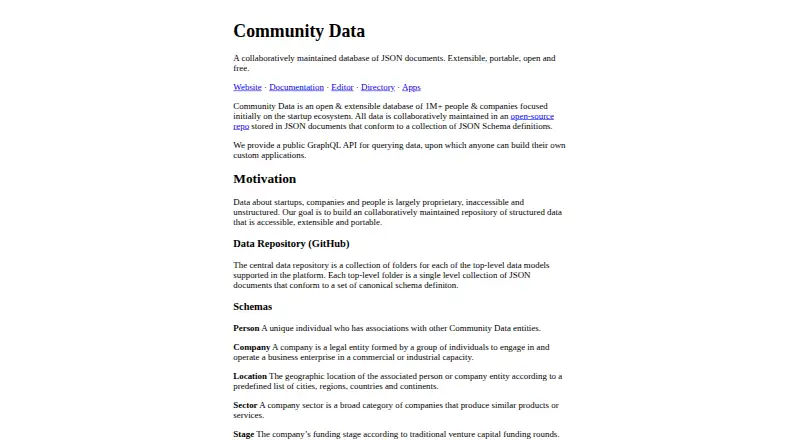
What Community Data is
Community Data is an open database of more than 1 million people and companies, initially focused on the startup ecosystem. Its records are collaboratively maintained as JSON documents in an open-source repository, following JSON Schema definitions. The listed schemas cover people, companies, locations, sectors, funding stages and curated collections. Developers can query the data through a public GraphQL API and build applications; anyone can also contribute by creating or editing a JSON file. Each repository commit is checked against its matching schema, and invalid documents cause rejection. Contributors may use a proof-of-concept Next.js editor that connects through the GitHub API and requires a GitHub account. Enhancer scripts can use public APIs or websites to organize information into the canonical schemas and import it. Verified document owners are recorded by GitHub username, and pull requests from listed owners are automatically merged without review. Schema changes are proposed by pull request and reviewed by core contributors during monthly governance calls. The project uses the MIT License, copyright 2025, and invites developers to build applications with its API and list them in the apps repository.
Who it suits
Community Data suits developers building applications with structured startup ecosystem data, as well as people who want to contribute records. Its GraphQL API also serves others who consume this open data.
What it does well
- Public GraphQL API supports custom applications.
- Database covers more than 1 million people and companies.
- Anyone can contribute JSON records.
- Commits are checked against JSON Schemas.
- Project uses the MIT License.
What to know first
- Initial focus is the startup ecosystem.
- Editor is described as a proof-of-concept.
- Listed owners' pull requests are automatically merged without review.
Limits
The listed Community Data plan is free. The editor is a proof-of-concept application and requires GitHub authentication.
Plans
| Plan | Billed and limits | Price |
|---|---|---|
| Community Data | Open-source database · public GraphQL API | Free |
As communitydata.io lists them, read 9 Oct 2026. The maker's own page has the final word.
Getting started
- Visit the Community Data website.
- Query the data through its public GraphQL API, or browse the open-source repository.
- To contribute, create or edit a JSON file in the repository.
- Alternatively, use the Next.js editor and authenticate with a GitHub account.
- For schema changes, propose them through a pull request.
Community Data is a shared database of startup people and companies, aimed chiefly at developers and others working with structured ecosystem data. Its public API and open contribution model make it useful as a data layer; it is less suited to readers who want a finished research product.
Overview
The project describes a database of more than 1 million people and companies, with company profiles and funding data. Its initial emphasis is the startup ecosystem. The data is maintained in an open-source repository and can be queried through a public GraphQL API, so the best fit is for people building applications or consuming data in their own workflows—not those seeking a turnkey directory.
Key features
Structured records and validation
Records are JSON documents organized around schemas for people, companies, locations, sectors, funding stages and curated collections. Every commit is checked against its corresponding JSON Schema, and documents that fail validation cause the commit to be rejected. That provides a consistent structure for contributors and API users, but structural validity does not by itself establish that a record is accurate or complete.
API and contribution model
Anyone can contribute by creating or editing a JSON file in the repository. Developers can query the public GraphQL API and build applications on top of the data; the project also invites them to list those apps in its apps repository. This openness is valuable for teams that want to shape the dataset or tailor an application, but it puts the work of building a useful workflow on the user.
Editor, enhancers and ownership
The project’s editor is a proof-of-concept Next.js application that uses the GitHub API, and contributors authenticate with GitHub accounts. Enhancer scripts can draw on public APIs or websites, structure information to match the canonical schemas and import it into the repository. For person records, Twitter, LinkedIn or a personal website can serve as proof sources. Verified owners are recorded by GitHub username, and pull requests from listed owners are automatically merged without review. That can reduce friction for trusted contributors, but it also makes ownership and account security important considerations.
Governance and license
Schema changes follow a separate route: they are proposed by pull request and reviewed by core contributors during monthly governance calls. The project uses the MIT License, copyright 2025. The distinction between reviewed schema changes and automatically merged owner contributions matters to anyone relying on the dataset’s structure or contributing records.
Pricing
Community Data is free. The Community Data plan costs nothing and includes the open-source database and public GraphQL API. There are no paid tiers or seat charges described, making it a low-cost option for builders who can work with the API and repository. The trade-off is not a cheaper-versus-premium feature split: users should expect to assemble their own applications and workflows.
Platforms
Community Data is available on the web and through an API. API access suits software integrations and custom applications; the web presence and GitHub-based editor support browsing and contributing, with GitHub authentication required for the editor.
Who it's for
Choose Community Data if you are a developer, data consumer or contributor who wants startup ecosystem records in an open, structured format and can make use of a GraphQL API. It is a weaker fit for buyers who need a packaged research interface or a conventional workflow rather than a dataset to query and extend.
Pros and cons
Pros
- Large stated coverage: more than 1 million people and companies gives builders a substantial base for applications focused on the startup ecosystem.
- Open access and contribution: a public GraphQL API and repository contributions let users consume and improve the same dataset without a paid plan.
- Schema checks: commit validation rejects documents that do not conform to the applicable JSON Schema, supporting consistent data structure.
Cons
- Requires a builder’s mindset: the API and repository are data infrastructure, not a finished company research workflow.
- Owner contributions bypass review: verified owners’ pull requests merge automatically, a meaningful governance trade-off for users relying on contributed records.
- Editor is a proof of concept: contributors need GitHub accounts, and the editor’s stated status may not suit teams seeking a mature data-entry interface.
Alternatives
Startup Databases is a useful category starting point if you want to compare options beyond a shared open dataset.
Tracxn is worth considering if you want a freemium alternative with a free trial, mobile and browser platforms, and a Premium plan described as offering unrestricted access, taxonomy, custom reports and analysis.
Discover Startups may suit a startup seeking a dedicated profile visible to investors and media through its free directory plan.
FlareSight is an alternative for company browsing through web and API, with its free plan covering 127,228+ companies, all search filters, five profile views per day, one view-only watchlist and a weekly email digest.
Selva offers a free public view of identity, description and rolled-up totals, with a separate free login tier that adds round structure and dates, a portfolio list and hidden amounts.
StartupDB is another free API-oriented option, offering a database, MCP server and REST API without an account or API key, with 120 requests per minute per IP and no daily cap.
Dealflow.Africa offers free-forever startup access with no credit card required.
Europe Startup Database provides a free account for browsing its database.
The Venture Codex is another database currently offered at no cost.
Verdict
Community Data is a strong choice for developers and data users who want a free, extensible startup dataset with a public GraphQL API and the ability to contribute directly. Its main advantage is open access to structured records at substantial stated scale; its main caution is that verified owners’ contributions are merged without review. Look elsewhere if you need a finished research product rather than a dataset to build on.
Verdict
Community Data offers a large, collaboratively maintained dataset with a public API and schema validation. Contributors should note that verified owners' pull requests are merged without review, while schema changes go through a separate review process.
Questions
How much does Community Data cost?
The listed Community Data plan is free.
What data does it contain?
The database covers more than 1 million people and companies, initially focused on the startup ecosystem. Schemas cover people, companies, locations, sectors, funding stages, and curated collections.
How can developers access the data?
A public GraphQL API lets developers query the data and build custom applications.
Can anyone contribute?
Yes. Anyone can contribute by creating or editing a JSON file in the repository.
Does the editor require an account?
Yes. The proof-of-concept Next.js editor uses the GitHub API, and contributors authenticate with GitHub accounts.
What license does the project use?
The site states that the project uses the MIT License, copyright 2025.
Facts from Community Data's own pages
- API
- The project provides a public GraphQL API for querying data and building custom applications. · communitydata.io, 9 Oct 2026
- Contributions
- Anyone can contribute by creating or editing a JSON file in the repository. · communitydata.io, 9 Oct 2026
- Coverage
- The site describes the database as containing more than 1 million people and companies. · communitydata.io, 9 Oct 2026
- Data enhancers
- Enhancer scripts can use public APIs or websites to structure information and import it into the repository. · communitydata.io, 8 Oct 2026
- Data format
- Data is stored in an open-source repository as JSON documents that conform to JSON Schema definitions. · communitydata.io, 9 Oct 2026
- Data models
- The listed schemas cover people, companies, locations, sectors, funding stages and collections. · communitydata.io, 9 Oct 2026
- Data ownership
- A contributor can prove ownership of a data document through a core disambiguation attribute, and the verification service records the contributor's GitHub username as an owner. · communitydata.io, 9 Oct 2026
- Editor
- The proof-of-concept data editor is a Next.js application that interacts with the GitHub API, and contributors authenticate with GitHub accounts. · communitydata.io, 9 Oct 2026
- Enhancers
- Data enhancer scripts can consume public APIs or websites, structure information to the canonical schemas and import it into the repository. · communitydata.io, 9 Oct 2026
- Governance
- Schema change proposals are reviewed by core contributors during monthly governance calls. · communitydata.io, 9 Oct 2026
- Integrations
- The site describes connections to GitHub for repository contributions and the editor, and Twitter, LinkedIn, or a personal website as possible proof sources for person records. · communitydata.io, 8 Oct 2026
- Intended users
- The public GraphQL API and open data repository are presented for developers building applications and others consuming or contributing structured startup ecosystem data. · communitydata.io, 8 Oct 2026
- License
- The site states that the project is licensed under the MIT License, copyright 2025. · communitydata.io, 9 Oct 2026
- Ownership
- Verified owners of a data document are recorded by GitHub username, and pull requests from listed owners are automatically merged without review. · communitydata.io, 8 Oct 2026
- Purpose
- Community Data is a collaboratively maintained database of JSON documents focused initially on the startup ecosystem. · communitydata.io, 9 Oct 2026
- Third-party apps
- The project invites developers to build applications using its GraphQL API and list them in the apps repository. · communitydata.io, 9 Oct 2026
- Validation
- Each repository commit is validated against its corresponding JSON Schema, and invalid documents reject the commit. · communitydata.io, 9 Oct 2026
Where Community Data stands on Freedom251
- Startup Databases#2 of 26