Freedom251 › Automated Grading Software

codePost
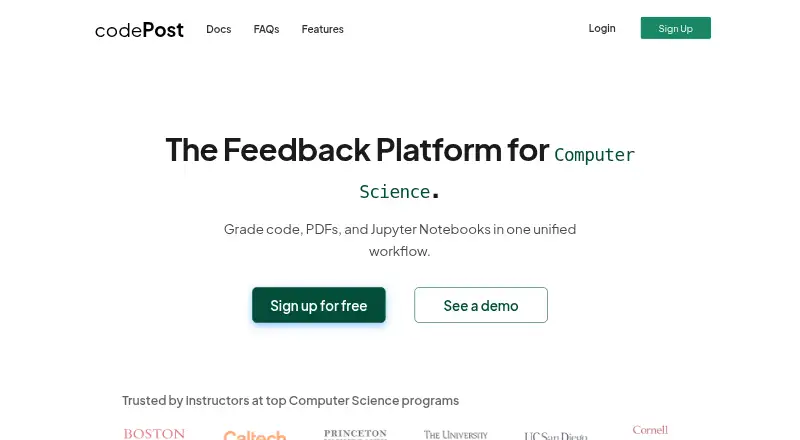
What codePost is
codePost is a feedback platform for grading code, PDFs, and Jupyter Notebooks. It gives instructors split-panel code review with inline highlighting, comment cards that apply point deductions, and shared rubrics. They can add inline Markdown comments to code, gray out template code, annotate notebooks and text files, and apply rubric items. Its autograder runs unit tests or custom test scripts on submissions in Docker-based sandboxed containers. Instructors can expose selected tests to students, limit test runs, and require particular uploaded filenames. Built-in language support includes Python, Java, C/C++, Node.js, R, and more. Native integrations include Canvas, Blackboard, Jupyter Notebooks, GitHub, JSFiddle, Brightspace, CodePen, Repl.it, Pearson Revel, and homegrown systems. An SDK and REST API provide programmatic access. For large courses, the platform includes roster management, LMS synchronization, granular TA permissions, and shared rubrics. Its stated users include instructors, graders, and students in undergraduate, high-school, and bootcamp computer science courses. The Free service is listed as free for computer science educators. The former codepost.io service was donated to Rutgers University's Department of Computer Science; its web version was scheduled to shut down permanently on January 1, 2026.
Who it suits
codePost suits instructors and graders who need to review and grade code, PDFs, or notebooks, especially in large computer science courses. Its LMS integrations, roster tools, TA permissions, and automated testing may also serve undergraduate, high-school, and bootcamp teaching teams.
What it does well
- Supports code, PDFs, and Jupyter Notebooks for grading.
- Combines inline feedback, point deductions, and shared rubrics.
- Runs unit tests or custom scripts in Docker-based isolation.
- Instructors can control visible tests and limit test runs.
- Provides native integrations with multiple LMS and coding tools.
- Offers an SDK and REST API.
What to know first
- The free service is for computer science educators.
- Math autograding is not supported.
- Written-work OCR is not supported.
- The web version was scheduled to shut down permanently on January 1, 2026.
Limits
The free service is described for computer science educators. Math autograding and written-work OCR are not supported. The web version was scheduled to shut down permanently on January 1, 2026.
Plans
| Plan | Billed and limits | Price |
|---|---|---|
| Free service | free service for computer science educators · Computer science educators | Free |
As codepost.cs.rutgers.edu lists them, read 30 Sept 2026. The maker's own page has the final word.
Getting started
- Visit https://codepost.cs.rutgers.edu/.
- Use the free service, listed as free for computer science educators.
- Connect through a native integration such as Canvas, Blackboard, or Jupyter Notebooks, if applicable.
- Submit code, PDFs, or Jupyter Notebooks for review and grading.
- Configure rubrics, feedback, and automated tests for course submissions.
Verdict
Consider codePost if your course needs structured code feedback, rubric-based grading, and sandboxed autograding, with integrations or API access. Its stated free service is for computer science educators, and the scheduled web shutdown date is important to weigh when choosing it.
Questions
How much does codePost cost?
The Free service is listed as free for computer science educators.
What can instructors grade with codePost?
It is a feedback platform for grading code, PDFs, and Jupyter Notebooks.
Can codePost automatically test submissions?
Yes. It runs unit tests or custom test scripts in Docker-based sandboxed containers.
Which integrations does codePost offer?
Native integrations include Canvas, Blackboard, Jupyter Notebooks, GitHub, JSFiddle, Brightspace, CodePen, Repl.it, Pearson Revel, and homegrown systems.
Does codePost provide an API?
Yes. Programmatic access is available through an SDK or REST API.
When was the web version scheduled to shut down?
The web version was scheduled to shut down permanently on January 1, 2026.
Facts from codePost's own pages
- Annotation
- Instructors can annotate code with inline Markdown comments, gray out template code, annotate Jupyter notebooks and text files, and apply rubric items. · codepost.cs.rutgers.edu, 30 Sept 2026
- API access
- codePost offers programmatic access through an SDK or REST API. · codepost.cs.rutgers.edu, 30 Sept 2026
- Autograding
- codePost runs unit tests or custom test scripts automatically on submissions in sandboxed containers. · codepost.cs.rutgers.edu, 30 Sept 2026
- Availability
- The former codepost.io service operated as a free service for computer science educators and was donated to Rutgers University's Department of Computer Science; its web version was scheduled to shut down permanently on January 1, 2026. · codepost.io, 30 Sept 2026
- Code review
- The platform provides split-panel code review with inline highlighting, comment cards with point deductions, and shared rubrics. · codepost.cs.rutgers.edu, 30 Sept 2026
- Course scale
- The platform is designed for large courses, with roster management, LMS synchronization, granular TA permissions, and shared rubrics. · codepost.cs.rutgers.edu, 30 Sept 2026
- Integrations
- Native integrations include Canvas, Blackboard, Jupyter Notebooks, GitHub, JSFiddle, Brightspace, CodePen, Repl.it, Pearson Revel, and homegrown systems. · codepost.cs.rutgers.edu, 30 Sept 2026
- Languages
- The platform has built-in support for Python, Java, C/C++, Node.js, R, and more. · codepost.cs.rutgers.edu, 30 Sept 2026
- Purpose
- codePost is a feedback platform for grading code, PDFs, and Jupyter Notebooks. · codepost.cs.rutgers.edu, 30 Sept 2026
- Sandboxing
- The autograder uses Docker-based isolation for testing student code. · codepost.cs.rutgers.edu, 30 Sept 2026
- Test controls
- Instructors can expose a subset of tests on student submission, limit test runs, and require specific uploaded filenames. · codepost.cs.rutgers.edu, 30 Sept 2026
- Users
- The stated audience includes instructors, graders, and students in computer science courses, including undergraduate, high-school, and bootcamp teaching. · codepost.io, 30 Sept 2026
Where codePost stands on Freedom251
- Automated Grading Software#6 of 33