Freedom251 › Statistical Analysis Software
Chi
by Chi
What Chi is
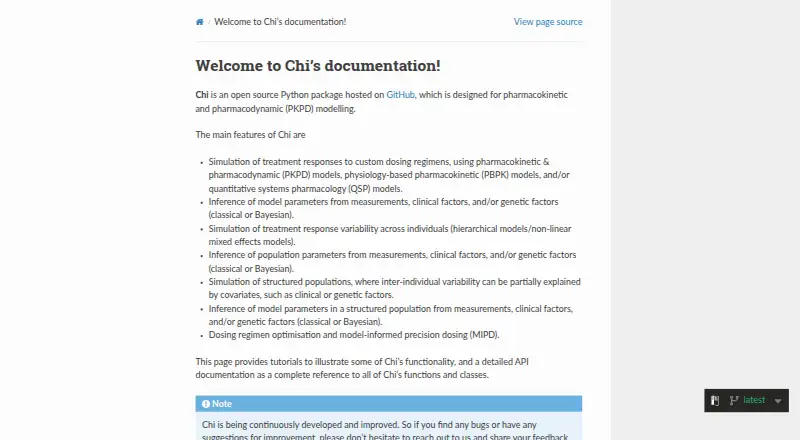
Chi is an open-source Python package for pharmacokinetic and pharmacodynamic (PKPD) modelling. It can simulate treatment responses for custom dosing regimens with PKPD, physiologically based pharmacokinetic (PBPK), and quantitative systems pharmacology (QSP) models. For parameter inference, it supports classical and Bayesian approaches using measurements, clinical factors, or genetic factors. Population modelling can represent differences in treatment response with hierarchical or non-linear mixed effects models; structured populations can also use covariates to account for some individual variation. Chi supports dosing regimen optimisation and model-informed precision dosing (MIPD).
The package is free and distributed on PyPI as `chi-drm`; in Python, it is imported as `chi`. SBML is its listed data import format. Chi uses Myokit to solve ordinary differential equations and compute sensitivities. It runs as desktop software on Linux, macOS, and Windows. Ubuntu and macOS users must install Sundials separately, while Chi installs it automatically on Windows. Documentation includes tutorials and detailed API references, and maintainers invite bug reports and improvement suggestions. The GitHub repository identifies its license as BSD-3-Clause.
Who it suits
Chi suits researchers and developers working on PKPD models, treatment-response simulations, or parameter inference in Python. Its population modelling and dosing optimisation features are relevant to work that accounts for variation between individuals or informs precision dosing.
What it does well
- Free, open-source Python package under BSD-3-Clause.
- Simulates custom dosing regimens with PKPD, PBPK, or QSP models.
- Supports classical and Bayesian parameter inference.
- Models population variation with mixed effects and covariates.
- Includes dosing optimisation and model-informed precision dosing.
- Runs on Linux, macOS, and Windows.
What to know first
- Ubuntu and macOS users must install Sundials separately.
- Use requires working with a Python package.
Plans
| Plan | Billed and limits | Price |
|---|---|---|
| Chi | Open source Python package | Free |
As chi.readthedocs.io lists them, read 11 Oct 2026. The maker's own page has the final word.
Getting started
- Open the Chi documentation website for tutorials and API documentation.
- Install `chi-drm` from PyPI with `pip install chi-drm`.
- Import the package in Python as `chi`.
- On Ubuntu or macOS, install Sundials separately; on Windows, Chi installs it automatically.
Verdict
Choose Chi if you need a free Python package for PKPD modelling, treatment simulation, inference, population modelling, or dosing optimisation. Look elsewhere if you need software that does not require Python, or if separate Sundials setup on Ubuntu or macOS is unsuitable.
Questions
How much does Chi cost?
Chi is free to use. Its listed plan is free.
Is Chi open source?
Yes. Chi is open source, and its GitHub repository identifies the license as BSD-3-Clause.
Which platforms does Chi support?
Chi runs as desktop software on Linux, macOS, and Windows.
How do I install Chi?
Install the `chi-drm` package from PyPI with `pip install chi-drm`, then import it as `chi` in Python.
Do I need to install Sundials separately?
Ubuntu and macOS users must install Sundials separately. Chi installs Sundials automatically on Windows.
What data import format is listed?
SBML is listed as Chi's data import format.
Facts from Chi's own pages
- Bayesian analysis
- Yes · chi.readthedocs.io, 24 Sept 2026
- Cost
- Chi is open source and free to use. · chi.readthedocs.io, 11 Oct 2026
- Data import formats
- SBML · chi.readthedocs.io, 24 Sept 2026
- Dependency
- Chi uses the open source Python package Myokit to solve ordinary differential equations and compute sensitivities efficiently. · chi.readthedocs.io, 11 Oct 2026
- Deployment
- desktop · chi.readthedocs.io, 24 Sept 2026
- Documentation
- The documentation provides tutorials and detailed API documentation for Chi functions and classes. · chi.readthedocs.io, 11 Oct 2026
- Dosing optimization
- It supports dosing regimen optimisation and model-informed precision dosing (MIPD). · chi.readthedocs.io, 11 Oct 2026
- Founded
- 2024 · chi.readthedocs.io, 19 Oct 2026
- Free plan
- Yes · chi.readthedocs.io, 24 Sept 2026
- Import name
- After installation, the package is imported in Python as `chi`. · chi.readthedocs.io, 11 Oct 2026
- Installation
- The package is distributed as `chi-drm` on PyPI and can be installed with `pip install chi-drm`. · chi.readthedocs.io, 11 Oct 2026
- License
- The GitHub repository identifies the software license as BSD-3-Clause. · github.com, 11 Oct 2026
- Parameter inference
- It supports classical or Bayesian inference of model parameters from measurements, clinical factors, and/or genetic factors. · chi.readthedocs.io, 11 Oct 2026
- Platform setup
- On Ubuntu and macOS, users must install Sundials separately; on Windows, Chi installs Sundials automatically. · chi.readthedocs.io, 11 Oct 2026
- Population modelling
- It can simulate treatment response variability across individuals using hierarchical or non-linear mixed effects models. · chi.readthedocs.io, 11 Oct 2026
- Purpose
- Chi is an open source Python package designed for pharmacokinetic and pharmacodynamic (PKPD) modelling. · chi.readthedocs.io, 11 Oct 2026
- Scripting support
- Yes · chi.readthedocs.io, 24 Sept 2026
- Structured populations
- It supports structured populations where inter-individual variability can be partially explained by covariates such as clinical or genetic factors. · chi.readthedocs.io, 11 Oct 2026
- Support
- The documentation invites users to report bugs or suggest improvements by reaching out to the maintainers. · chi.readthedocs.io, 11 Oct 2026
- Treatment simulations
- It simulates treatment responses for custom dosing regimens using PKPD, PBPK, and/or QSP models. · chi.readthedocs.io, 11 Oct 2026
Where Chi stands on Freedom251
- Statistical Analysis Software#19 of 106