Freedom251 › Third Party Security Risk Management

Certa Third-Party Risk Management
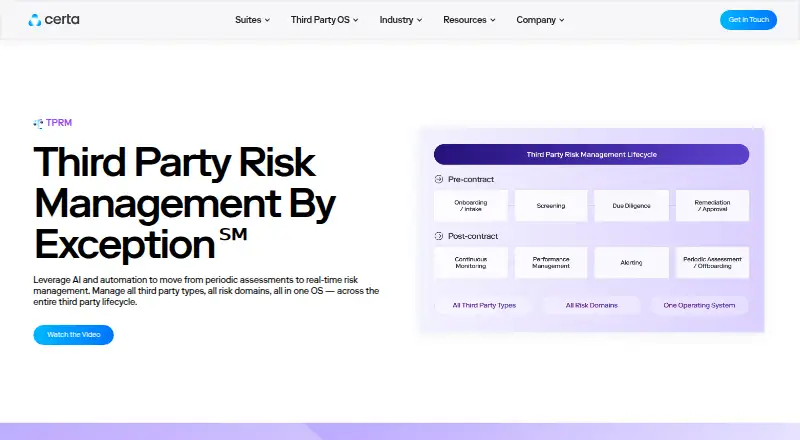
What Certa Third-Party Risk Management is
Certa Third-Party Risk Management uses AI and automation to manage third-party risk throughout the relationship, shifting from periodic assessments toward real-time risk management. Its dynamic due diligence draws on internal and external data sources for continuous risk assessment. The platform can autofill vendor questionnaires and use existing evidence to prefill information-security assessments, while evidence collection and framework mapping support assessment work. Users can create or update rules and workflows in natural language without coding, or use the drag-and-drop Studio and templates for SOC 2 reports, privacy questionnaires, and other needs. Workflows can route work, flag important events, and automate decisions using preset risk factors.
Certa offers more than 130 integrations to connect data providers and existing systems. The platform supports millions of records and more than 50 languages. Reporting includes live dashboards and export-friendly tables with drill-downs. Security features include AES 256-bit encryption in transit and at rest, Bring Your Own Key encryption, role-based access controls, one-time passwords, privileged access management via Vault, and CIS-compliant infrastructure. Certa’s Trust Center includes GDPR, SOC 1 Type 2, SOC 2 Type 2, and ISO/IEC 27001:2022 compliance materials. The product is web-based and paid, with pricing on request. Prospects can contact a Certa expert.
Who it suits
Certa suits organizations that need ongoing third-party risk assessment, evidence collection, and monitoring in one web platform. Its workflow tools, integrations, multilingual support, and reporting may suit teams handling large or varied vendor programs.
What it does well
- Continuously assesses risk using internal and external data.
- Autofills vendor questionnaires and information-security assessments.
- Builds rules and workflows using natural language without coding.
- Offers more than 130 integrations.
- Supports millions of records and more than 50 languages.
- Provides real-time dashboards and drill-down reports.
What to know first
- Paid product with pricing on request.
- Available on web only.
Getting started
- Visit the Certa TPRM website.
- Contact a Certa expert to discuss the product and request pricing.
- Use the web platform to configure rules and workflows with natural language or the drag-and-drop Studio.
Certa Third-Party Risk Management is an enterprise-oriented platform for assessing vendors and tracking risk as it changes. It is a strong fit for teams that need configurable assessments, automated workflows, and reporting across a large third-party population. Its central advantage is continuous monitoring; its main trade-offs are custom pricing and a web-and-API footprint.
Overview
Certa is designed to move third-party risk work beyond periodic reviews, using ongoing assessment and automation across the vendor lifecycle. Teams can combine due diligence, evidence collection, questionnaire handling, and workflow decisions in one platform. That breadth should suit organizations with established risk processes and enough volume to benefit from standardization; smaller teams with occasional reviews may find an enterprise-oriented system more than they need.
Key features
Dynamic due diligence draws on internal and external data, while continuous monitoring reviews updated documents, data feeds, and internal systems. This gives risk teams a way to respond as a vendor’s profile changes between scheduled assessments. How useful that is depends on whether the signals and preset risk factors align with the organization’s review and escalation practices.
Questionnaire autofill and AI-assisted prefill of information-security assessments reuse existing evidence to cut repetitive data entry. A questionnaire library, framework mapping, and evidence collection support the assessment process; drag-and-drop templates cover SOC 2 reports, privacy questionnaires, and other uses. These capabilities are most valuable for teams handling recurring assessments, where reuse can reduce administrative work.
Users can create or revise rules and workflows in natural language without coding, or build them in the drag-and-drop Studio. The platform can route work, flag events, and automate decisions using preset risk factors. That can make repeatable reviews more consistent, while teams with complex approval requirements should ensure the available rules match their governance needs.
Certa says it offers more than 130 integrations and supports over 50 languages. It also says the platform can handle millions of records and entities, making its stated scale relevant to large, geographically distributed programs. Reporting includes real-time dashboards and export-friendly tabular reports with drill-downs, which can help teams examine results at different levels.
Security features include AES 256-bit encryption in transit and at rest, Bring Your Own Key encryption, privileged access management via Vault, CIS-compliant infrastructure, role-based access controls, one-time passwords, and audit trails for edits, views, notifications, and alerts. Certa’s Trust Center provides compliance materials for GDPR, SOC 1 Type 2, SOC 2 Type 2, and ISO/IEC 27001:2022.
Pricing
Certa uses paid, custom pricing. The TPRM page directs prospective customers to contact a Certa expert; it does not offer a stated trial. That sales-led approach is suited to organizations evaluating a broad risk program, but buyers cannot compare a published entry price or trial before beginning a conversation.
Platforms
Certa supports web and API access. Organizations seeking a desktop or mobile app should consider another option.
Who it's for
Certa is best suited to enterprise risk and compliance teams managing many third parties, recurring assessments, and ongoing monitoring. Its workflow tools, integrations, language support, and stated capacity for millions of records point to large programs that need repeatable processes. Teams with limited vendor volumes or a need for mobile access may be better served elsewhere.
Pros and cons
- Pros: Continuous monitoring of documents, data feeds, and internal systems can surface changes between periodic reviews.
- Pros: Questionnaire autofill, evidence reuse, and workflow automation can reduce repeated work across recurring assessments.
- Pros: More than 130 integrations, support for over 50 languages, and stated capacity for millions of records suit large, distributed programs.
- Cons: Custom pricing and no stated trial make early cost and fit comparisons harder.
- Cons: Web and API are the listed platforms, leaving mobile and desktop app seekers without a fit.
- Cons: Automated decisions rely on preset risk factors, so teams must ensure those rules suit their own oversight requirements.
Alternatives
SecurityScorecard Third-Party Risk Management is worth considering when a free starting point matters: its free plan covers security ratings for an organization’s own domain, digital footprint management, issue prioritization and alerts, questionnaire response, and self-monitoring.
Diligent Audit is an alternative for buyers seeking a product with Android and iOS apps as well as web and API access.
nBoardPortal is another paid option, with iOS and web platforms.
Riskonnect may suit buyers who want an integrated risk management product with implementation options tied to project size, complexity, and customization.
Whistic offers a free plan and may suit teams looking for standardized frameworks, vendor review workflows, automated reassessments and notifications, and vendor risk scoring.
Black Kite Third-Party Cyber Risk is a paid web-based alternative with Standard and Enterprise plans; its Standard plan includes unlimited users and onboarding, enablement, configuration, and environment tuning.
Covasant TPRM is another paid alternative.
Gartner Third-Party Cybersecurity Insights is a paid web-based alternative that directs prospective buyers to submit contact information to get started.
Browse more options in Third-Party Risk Management Software or IT Vendor Management Software.
Verdict
Choose Certa if your enterprise risk team needs continuous third-party assessment, reusable evidence, configurable workflows, and reporting at substantial scale. The breadth of automation and stated capacity are its clearest strengths. Look elsewhere if you need published pricing, a trial, or a desktop or mobile platform.
Verdict
Choose Certa if your organization needs continuous third-party risk management with automated assessments, workflows, and reporting. Buyers who need a desktop or mobile platform should look elsewhere; pricing requires contacting Certa.
Questions
How much does Certa Third-Party Risk Management cost?
It is a paid product, and pricing is on request.
Which platforms does Certa support?
Certa Third-Party Risk Management is available on the web.
Can it monitor third-party risk continuously?
Yes. It uses dynamic due diligence with internal and external data sources for continuous risk assessment.
Does Certa support integrations?
Yes. Certa offers more than 130 integrations for data providers and existing systems.
What security and compliance materials are available?
Certa describes AES 256-bit encryption in transit and at rest, Bring Your Own Key encryption, and several access controls. Its Trust Center includes GDPR, SOC 1 Type 2, SOC 2 Type 2, and ISO/IEC 27001:2022 compliance materials.
Facts from Certa Third-Party Risk Management's own pages
- Access controls
- The platform lists privileged access management via Vault, CIS-compliant infrastructure, role-based access controls, and one-time passwords. · certa.ai, 8 Oct 2026
- Access controls and audit
- The platform lists privileged access management, role-based access controls, one-time passwords, and audit trails covering edits, views, notifications, and alerts. · certa.ai, 9 Oct 2026
- Assessments
- The platform supports dynamic due diligence, questionnaire autofill, and AI prefill of information-security assessments using existing evidence. · certa.ai, 9 Oct 2026
- Company background
- Certa says it was founded to simplify business processes and identifies Jagmeet Lamba as its Founder and CEO. · certa.ai, 8 Oct 2026
- Company origin
- Certa says its founder and CEO, Jagmeet Lamba, started the company to simplify business processes after seeing vendor onboarding inefficiencies. · certa.ai, 9 Oct 2026
- Compliance
- Certa’s Trust Center lists GDPR, SOC 1 Type 2, SOC 2 Type 2, and ISO/IEC 27001:2022 compliance materials. · trust.certa.ai, 8 Oct 2026
- Continuous monitoring
- It reviews updated documents, data feeds, and internal systems for continuous assessment. · certa.ai, 9 Oct 2026
- Due diligence
- The product continuously assesses risk using dynamic due diligence that draws on internal and external data sources. · certa.ai, 8 Oct 2026
- Integrations
- Certa states that it offers more than 130 integrations for connecting data providers and existing systems. · certa.ai, 8 Oct 2026
- Integrations and languages
- Certa states that its platform has 130+ integrations and supports 50+ languages. · certa.ai, 9 Oct 2026
- Intended users
- Certa describes its TPRM results and offering in an enterprise context and features experts in third-party compliance and risk. · certa.ai, 9 Oct 2026
- Pricing and trial
- The TPRM page invites visitors to contact a Certa expert and does not state a price or trial offer. · certa.ai, 9 Oct 2026
- Purpose
- Certa TPRM uses AI and automation to manage third-party risks across the third-party lifecycle. · certa.ai, 9 Oct 2026
- Questionnaires
- Certa can autofill vendor questionnaires and use existing evidence to prefill information-security assessments. · certa.ai, 8 Oct 2026
- Reporting
- Certa provides real-time reporting and dashboards, plus export-friendly tabular reports with drill-down capabilities. · certa.ai, 8 Oct 2026
- Risk decisions
- AI agents can automate screening, scoring, and adjudication, while a decision engine uses preset risk factors. · certa.ai, 9 Oct 2026
- Scale
- Certa says the platform can handle millions of records and entities. · certa.ai, 9 Oct 2026
- Scale and languages
- The platform page says Certa supports millions of records and more than 50 languages. · certa.ai, 8 Oct 2026
- Security
- Certa says data is encrypted with AES 256-bit encryption in transit and at rest, and offers Bring Your Own Key encryption. · certa.ai, 9 Oct 2026
- Security certifications
- Certa’s Trust Center lists SOC 1 Type 2 and SOC 2 Type 2 compliance documents. · trust.certa.ai, 9 Oct 2026
- Support and sales
- Certa’s TPRM page invites prospects to get in touch with a Certa expert. · certa.ai, 8 Oct 2026
- Templates
- Certa offers drag-and-drop templates for SOC 2 reports, privacy questionnaires, and other use cases. · certa.ai, 8 Oct 2026
- Workflow design
- Users can configure workflows, forms, rules, and logic without writing code, using a drag-and-drop studio and chat-based Vibe Configuration. · certa.ai, 9 Oct 2026
Where Certa Third-Party Risk Management stands on Freedom251
- Third Party Security Risk Management#6 of 15
- Third Party & Supplier Risk Management Software#10 of 23
- Vendor Management#8 of 18
- Third-Party Risk Management Software#17 of 31
- IT Vendor Management Software#25 of 41