Freedom251 › DevOps analytics software

CDviz
What CDviz is
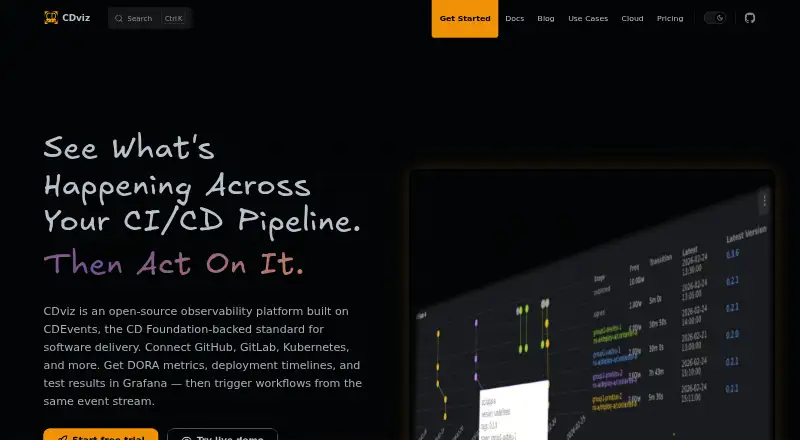
CDviz is an open-source platform for collecting, storing, and visualizing software delivery events using the CDEvents standard. Its Collector ingests events from GitHub, GitLab, ArgoCD, Kubernetes, custom webhooks, and HTTP polling, then normalizes them. Grafana dashboards cover DORA metrics, deployments, incidents, and artifact timelines. Events are stored in PostgreSQL with TimescaleDB; ClickHouse can be a Collector sink, but the dashboards currently require PostgreSQL. Teams can send the event stream to downstream automation through webhooks, Kafka, NATS, or SSE. The Collector, database schemas, Grafana components, and transformers are available under Apache 2.0 for free self-hosting. CDviz Cloud receives pipeline event metadata through customer-configured GitHub or GitLab webhooks, without reading source code or requiring write access. Community is free forever; Cloud costs €20 per organization per month excluding VAT, and Pro costs €200 per organization per month excluding VAT. A 14-day trial is listed.
Who it suits
CDviz suits software delivery teams that want DORA metrics, deployment tracking, incident views, or delivery-event automation. It offers self-hosting and cloud options, with Cloud described for teams of 1–5.
What it does well
- Apache 2.0 components can be self-hosted free.
- Dashboards cover DORA metrics and deployment tracking.
- Accepts events from multiple delivery tools.
- Event streams can trigger downstream automation.
- Cloud does not read source code.
What to know first
- Grafana dashboards currently require PostgreSQL.
- Cloud is described for teams of 1–5.
- Cloud and Pro prices exclude VAT.
Limits
Community is self-hosted. Cloud is described for teams of 1–5 and optionally imports up to 30 days of history; its €20 per organization monthly price excludes VAT. Grafana dashboards require PostgreSQL, including when ClickHouse is used as a Collector sink.
Plans
| Plan | Billed and limits | Price |
|---|---|---|
| Community | Forever free · Self-hosted · collector, database schemas, Grafana components · community support | Free |
| Cloud | Per organization, not per seat; excludes VAT · Hosted and managed · GitHub and GitLab · teams of 1–5 · optional 30-day history import · email and Discord support | €20 a month |
| Pro | Per organization, not per seat; excludes VAT · Self-hosted · on-premise deployment · email and Discord support · 1 business days response time | €200 a month |
As cdviz.dev lists them, read 3 Oct 2026. The maker's own page has the final word.
Getting started
- Visit the CDviz website.
- Choose Community for free self-hosting, Cloud for a managed plan, or Pro for self-hosted on-premise deployment.
- For Cloud, configure a GitHub or GitLab webhook to send pipeline event metadata.
- Connect event sources such as GitHub, GitLab, ArgoCD, Kubernetes, custom webhooks, or HTTP polling.
- Use PostgreSQL for the Grafana dashboards; ClickHouse is available as a Collector sink.
- Optionally import up to 30 days of Cloud history with a customer-created, scoped read-only token.
CDviz is an open-source software-delivery observability platform for teams that need a common event stream across CI/CD and infrastructure tools. It suits organizations comfortable with self-hosting or with a small managed deployment, while the PostgreSQL requirement for Grafana dashboards is an important architectural constraint. The result is a capable delivery-metrics stack, but not a universal fit for teams wanting a purely source-code-independent dashboard service.
Overview
CDviz collects software-delivery events, converts them to the CDEvents standard, stores them, and presents them through Grafana. Its dashboards address DORA, delivery, and reliability metrics, including deployment activity, incidents, and artifact timelines. The same event stream can feed automation through webhooks, Kafka, NATS, or server-sent events, so it can support operational workflows as well as reporting.
The open-source Collector, database schemas, Grafana components, and transformers are Apache 2.0 licensed. Teams can therefore run the core stack without a subscription and retain control of their deployment and telemetry. CDviz Cloud offers a managed alternative: it receives pipeline metadata through a customer-configured GitHub or GitLab webhook, does not read source code or require write access, and isolates each organization’s data in a managed database.
Key features
Collection and normalization
The Collector accepts events from GitHub, GitLab, Bitbucket, Forgejo, Gitea, Jenkins, ArgoCD, Kubernetes, Argo Workflows, custom webhooks, and HTTP polling. It also connects with Jira, JUnit, TAP, SARIF, PostgreSQL, and other listed delivery systems, then normalizes incoming signals into CDEvents. That breadth is useful when engineering groups have a mixed toolchain; teams using only one provider may not need the full integration surface.
Dashboards and storage
Grafana views cover DORA metrics, deployment tracking, incidents, and artifact timelines, giving engineering and reliability leaders a shared way to follow delivery performance. PostgreSQL with TimescaleDB is the platform’s storage path for these dashboards. ClickHouse can be used as a Collector sink, but the Grafana dashboards currently require PostgreSQL, so a ClickHouse-first architecture still needs PostgreSQL for visualization.
Cloud controls and automation
Cloud can optionally import up to 30 days of history using a read-only token created and scoped by the customer. Its event outputs can trigger downstream systems through webhooks, Kafka, NATS, or SSE. This combination favors teams that want delivery data to become an input to automation rather than remain a static analytics record.
Pricing
| Plan | Price and terms | What you get |
|---|---|---|
| Community | 0.00 EUR, free forever | Self-hosted Collector, database schemas, and Grafana components with community support. |
| Cloud | €20 a month per organization, excluding VAT | Hosted and managed service for GitHub and GitLab teams of 1–5, optional 30-day history import, email and Discord support. |
| Pro | €200 a month per organization, excluding VAT | Self-hosted on-premise deployment, email and Discord support, and a one-business-day response time. |
Community is the practical choice for teams that can operate infrastructure and accept community support; its free-forever status removes subscription cost but leaves deployment responsibility with you. Cloud is aimed at teams of one to five and charges per organization rather than per seat, which is straightforward for a small group. Larger teams must discuss seats, repositories, or broader access with the maker. The 14-day trial provides a short evaluation window, while Cloud’s optional history import reaches only 30 days. Pro adds on-premise delivery and faster support for organizations that need a commercial support commitment, but its €200 monthly organization fee is substantially higher than Cloud and still excludes VAT.
Platforms
CDviz is offered through an API and web interface, with Linux support and self-hosted deployment. Deployment choices are cloud or self-hosted; the latter covers both the free Community components and the on-premise Pro plan. Support is provided through documentation and community channels, with email and Discord included on Cloud and Pro.
Who it's for
Small teams with GitHub or GitLab pipelines can use Cloud for a managed introduction to DORA and delivery tracking. Mid-market and enterprise engineering organizations are better candidates for self-hosting when data control, on-premise operation, or integration with varied tools matters. CDviz is less suitable when PostgreSQL cannot be part of the dashboard architecture, or when a team wants broad historical analytics beyond Cloud’s optional 30-day import without negotiating a larger arrangement.
Pros and cons
Pros
- Apache 2.0 self-hosted components avoid subscription fees and support infrastructure control.
- CDEvents normalization and broad source coverage bring heterogeneous delivery signals into one stream.
- Grafana dashboards address DORA, delivery, reliability, incidents, and artifacts in one reporting layer.
- Webhook, Kafka, NATS, and SSE outputs make the event stream useful for automation.
- Cloud uses webhook metadata without source-code access or write permissions.
Cons
- Grafana dashboards require PostgreSQL even though ClickHouse is available as a Collector sink.
- Cloud is scoped to teams of 1–5, with larger access requiring a conversation with the maker.
- Community support is the trade-off for the free plan; priority response is reserved for Pro.
- Pro’s €200-per-month organization price may be excessive for teams that only need hosted dashboards.
Alternatives
For a broader directory of options, see DevOps analytics software.
Apache DevLake is the closer alternative when a free, open-source, self-hosted dev-data platform is the priority. Choose DevDynamics instead for a free plan capped at nine contributors, one team, and three Git repositories with Jira and GitHub integration. Deviera fits teams wanting a free workspace for one repository, five automations, and three members, with paid expansion at $25 per seat monthly. HCL DevOps Velocity offers a free Community Edition for two to three licenses and a commercial Standard Edition. Middleware is a broader observability option with Android, iOS, desktop, web, and API clients and a free tier including up to 100GB of data. PanDev Metrics is better for personal developer profiles, gamification, statistics, and achievement showcases. Codealike focuses on personal productivity analysis through IDE and browser plugins, with a free Basic plan. GitClear suits teams seeking repository and commit analysis, with its free Starter plan covering up to three repositories and six months of analysis.
Verdict
Choose CDviz if you want CDEvents-based delivery observability, open-source self-hosting, and dashboards that connect metrics to automation. It is especially compelling for organizations with mixed delivery tooling and a need for infrastructure control. Look elsewhere if PostgreSQL is unacceptable for dashboards, if your team exceeds Cloud’s small-team scope without wanting a custom arrangement, or if you need a simpler hosted analytics product with less operational responsibility.
Verdict
CDviz offers delivery-event collection and dashboards, with free self-hosting as well as managed and on-premise plans. Check the PostgreSQL dashboard requirement and per-organization pricing when choosing a deployment.
Questions
Is CDviz free?
Yes. The Community plan is free forever and includes self-hosted Collector, database schemas, and Grafana components.
How much do the paid plans cost?
Cloud costs €20 per organization per month, and Pro costs €200 per organization per month. Both prices exclude VAT; Cloud is billed per organization, not per seat.
Is there a free trial?
Yes. A 14-day trial is listed.
Which platforms and deployment options are available?
Listed platforms are API, Linux, self-hosted, and web. Deployment options are cloud and self-hosted.
What integrations does CDviz support?
Listed integrations include GitHub, GitLab, Bitbucket, Forgejo, Gitea, Jenkins, ArgoCD, Kubernetes, Jira, JUnit, TAP, SARIF, PostgreSQL, ClickHouse, Grafana, CDEvents, and Argo Workflows.
Is CDviz open source, and who makes it?
The Collector, database schemas, Grafana components, and transformers are Apache 2.0 licensed. CDviz is built by Alchim312, which describes itself as a French company.
Facts from CDviz's own pages
- Automation
- The event stream can trigger downstream automation through webhooks, Kafka, NATS, or SSE. · cdviz.dev, 3 Oct 2026
- Cloud access
- CDviz Cloud receives pipeline event metadata through a customer-configured GitHub or GitLab webhook and never reads source code or needs write access. · cdviz.dev, 3 Oct 2026
- Cloud audience
- Cloud is described as a plan for teams of 1–5, and the page says larger teams can contact the maker about seats, repositories, or wider access. · cdviz.dev, 3 Oct 2026
- Cloud data
- Cloud pipeline event metadata is stored in a managed database isolated per organization. · cdviz.dev, 3 Oct 2026
- Cloud history import
- Cloud optionally imports up to 30 days of history using a read-only token that the customer creates and scopes. · cdviz.dev, 3 Oct 2026
- Company size fit
- small, mid market, enterprise · cdviz.dev, 20 Sept 2026
- Deployment
- cloud, self hosted · cdviz.dev, 20 Sept 2026
- Event collection
- The Collector ingests events from GitHub, GitLab, ArgoCD, Kubernetes, custom webhooks, and HTTP polling, then normalizes them to CDEvents. · cdviz.dev, 3 Oct 2026
- Integrations
- The pricing page lists GitHub, GitLab, Bitbucket, Forgejo, Gitea, Jenkins, ArgoCD, Kubernetes, Jira, and test and quality reports among its supported integrations. · cdviz.dev, 3 Oct 2026
- Maker
- CDviz is built by Alchim312, which the maker describes as a French company. · cdviz.dev, 3 Oct 2026
- Metrics and dashboards
- Its Grafana dashboards cover DORA metrics, deployment tracking, incidents, and artifact timelines. · cdviz.dev, 3 Oct 2026
- Open source
- The Collector, database schemas, Grafana components, and transformers are offered under the Apache 2.0 license and can be self-hosted for free. · cdviz.dev, 3 Oct 2026
- Product
- CDviz is an open-source SDLC observability platform that collects, stores, and visualizes software delivery events using the CDEvents standard. · cdviz.dev, 3 Oct 2026
- Storage
- The platform stores events in PostgreSQL with TimescaleDB; ClickHouse is available as a Collector sink, while the Grafana dashboards currently require PostgreSQL. · cdviz.dev, 3 Oct 2026
- Support
- Community includes community support, while Cloud and Pro include email and Discord support. · cdviz.dev, 3 Oct 2026
- Support channels
- email, community, docs · cdviz.dev, 20 Sept 2026
Where CDviz stands on Freedom251
- DevOps analytics software#2 of 48