Freedom251 › Software Synthesizers

Cardinal
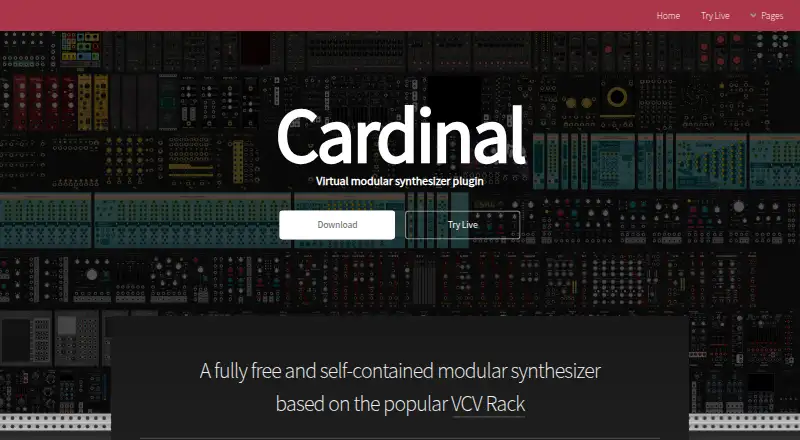
What Cardinal is
Cardinal is a free, open-source modular synthesizer based on VCV Rack, offered as a standalone app and plugin. It bundles 1,382 modules from 84 authors or brands and does not load external modules or connect to the official Rack library or store. Plugin formats listed are AudioUnit, CLAP, LV2, VST2, and VST3, with Main, Synth, and FX variants supporting MIDI input and output. The Main variant provides eight audio inputs and outputs and ten CV inputs and outputs, but is unavailable in AU and VST2 and is not yet available in CLAP. Mini offers a smaller hand-picked selection with two audio ports and five CV ports, only as LV2 and standalone. OSC can remotely control patches and parameters in standalone use, not in plugin use. Cardinal is licensed under GPLv3+. The project describes it as stable, while noting CLAP support is in progress and VST3 plugin hosting inside Carla or Ildaeil is experimental.
Who it suits
Cardinal suits people looking for a free, open-source modular synthesizer as a standalone app or plugin. Its bundled modules are a fit for users who do not need to add modules to an existing build.
What it does well
- Free and open-source under GPLv3+.
- Includes 1,382 modules from 84 authors or brands.
- Main, Synth, and FX support MIDI input and output.
- Standalone use supports OSC remote control.
What to know first
- Cannot load external modules or add modules to a build.
- Main is unavailable in AU and VST2.
- CLAP support is still in progress.
- VST3 hosting in Carla or Ildaeil is experimental.
Limits
Cardinal's free build includes its built-in modules, but cannot accept added modules or connect to the official Rack library or store. Mini has a hand-picked selection, two audio ports, and five CV ports; Main has eight audio inputs and outputs and ten CV inputs and outputs, with format availability limits.
Plans
| Plan | Billed and limits | Price |
|---|---|---|
| Free | Fully free and open-source · Cardinal builds include built-in modules; adding modules to an existing build is not possible | Free |
| Cardinal | free/open-source · fixed built-in module set · no external module installation | Free |
As cardinal.kx.studio lists them, read 29 Sept 2026. The maker's own page has the final word.
Getting started
- Visit https://cardinal.kx.studio/.
- Choose the standalone app or a listed plugin format for your platform.
- Select Main, Synth, or FX; Mini is available as LV2 or standalone.
- Use the included modules, or report bugs on GitHub and join the #cardinal IRC room on Libera.Chat for discussion.
Cardinal is a free, open-source modular synthesizer built on VCV Rack, offered as a standalone application and as a plugin. It is best for musicians who want a large ready-made module set in an audio workflow; its fixed contents make it a poor fit for anyone who depends on third-party modules.
Overview
Cardinal turns modular synthesis into a self-contained instrument, bundling 1,382 modules from 84 authors or brands. That gives newcomers and established patch builders a broad palette without requiring a separate module library. The trade-off is firm: Cardinal cannot load external modules, connect to the official Rack library or store, or accept additions to an existing build. It suits users content to work within the bundle, not those who want to assemble a continually changing collection.
Key features
Plugin formats and variants
The plugin is available in AudioUnit, CLAP, LV2, VST2 and VST3 formats. Main, Synth and FX variants all support MIDI input and output, which gives users several ways to fit Cardinal into a host-based workflow. Main has 8 audio inputs and outputs and 10 CV inputs and outputs, but it is unavailable in AU and VST2 and is not yet available in CLAP. That makes host and format choice consequential if Main’s routing is central to a setup.
Mini takes a different approach: it has a small hand-picked module selection, 2 audio ports and 5 CV ports, and is available only as LV2 or standalone. It may suit a compact installation, but users seeking the full bundled selection should consider the other variants.
Standalone control and privacy
The standalone application supports OSC remote control of patches and parameters; that control is not available in the plugin. The project says included modules are not allowed online access such as phone-home activity, and describes removing online access from the plugin and included modules. For users who want remote control, Cardinal therefore makes standalone the relevant choice.
Cardinal supports MPE and is described by its maker as stable. CLAP support remains a work in progress, while VST3 plugin hosting inside Carla or Ildaeil is experimental. Those caveats matter for users relying on either of those particular workflows. Cardinal is licensed under GPLv3+. Bug reports are directed to GitHub, and community discussion takes place in the #cardinal IRC room on Libera.Chat.
Pricing
Cardinal is fully free and open source: the Free plan costs nothing. It includes Cardinal’s built-in modules, with no added-module option for an existing build. There are no paid tiers to weigh against that bundle; the practical limit is the fixed module set, rather than a stated seat cap or usage quota.
Platforms
Cardinal is available on Linux, macOS, Windows and the web. It also has a standalone application, alongside the plugin formats described above. Variant availability is narrower than the overall platform list: Mini is LV2 and standalone only, while Main is unavailable in AU and VST2 and is not yet available in CLAP.
Who it's for
Cardinal is a strong fit for musicians who want a substantial modular environment at no cost, particularly those who value a conventional plugin as well as standalone use and can work with the included modules. It is less suitable for users who need the official Rack library, third-party module expansion, or OSC control while running the plugin. The maker points users seeking official support and a larger module collection toward Rack Pro.
Pros and cons
- Pros: 1,382 included modules from 84 authors or brands provide a broad starting collection without a fee.
- Pros: Standalone and five plugin formats give users multiple ways to use the modular engine, with MIDI input and output across Main, Synth and FX.
- Pros: MPE support and standalone OSC remote control add useful control options for compatible workflows.
- Cons: The module collection cannot be expanded, ruling out users who depend on external modules or the official Rack library.
- Cons: Main’s I/O capacity is not offered in AU or VST2, and Main is not yet available in CLAP.
- Cons: Mini’s smaller selection and LV2/standalone-only availability make it a narrower option rather than a general substitute.
Alternatives
For users who want a different kind of free or low-cost music tool, these options offer distinct trade-offs:
- VCV Rack is the direct alternative for users drawn to Rack’s ecosystem: its free Rack 2 plan is standalone, open source and includes free modules, while Cardinal deliberately excludes the official library and store.
- DefleMask may suit someone seeking a tracker-based music application instead; its full plan costs $14.99, paid once, while its free legacy version is 32-bit, unsupported and described as a demo.
- Sonic Pi is another free, open-source choice, developed by over 200 contributors since 2012, for readers who prefer that project to Cardinal’s modular synthesizer approach.
- Vital offers a free Basic plan with 75 presets, 25 wavetables and full synth features; pick it if that defined preset-and-wavetable synth package better suits your needs than modular patching.
- Dexed is free software under GPL v3 for readers considering a different free instrument.
- Helm is a pay-what-you-want standalone or plugin option for GNU/Linux, Mac OSX and Windows, including 32-bit and 64-bit versions.
- Surge XT is free and open-source under GPL3, and may suit users seeking a virtual instrument plugin on Windows, macOS or Linux.
- Synth1 is freeware in VSTi/AU plugin form for macOS and Windows.
Browse the Software Synthesizers directory for more options.
Verdict
Choose Cardinal if you want an extensive modular synthesizer in standalone and plugin forms without paying, and the included module set is enough for your work. The bundle’s breadth is its strongest reason to choose it; the inability to add modules is the clearest reason to look elsewhere, especially toward Rack Pro if official support and a larger collection matter.
Verdict
Cardinal provides a large bundled modular-synthesis environment in standalone and plugin forms. Its fixed module set and variant format limits are important to consider before choosing it.
Questions
How much does Cardinal cost?
Cardinal is free. Its Free plan is listed as free.
What platforms and plugin formats does it support?
The listed platforms are Linux, macOS, web, and Windows. Plugin formats listed are AudioUnit, CLAP, LV2, VST2, and VST3.
Can I add modules or use the official Rack library?
No. Cardinal does not load external modules or connect to the official Rack library or store, and modules cannot be added to an existing build.
Is Cardinal open source?
Yes. It is licensed under GPLv3+.
Does Cardinal support MIDI and OSC?
Main, Synth, and FX support MIDI input and output. OSC remote control for patches and parameters is available in standalone use, not as a plugin.
What are the known stability qualifications?
The project describes Cardinal as stable. CLAP support is a work in progress, and VST3 plugin hosting inside Carla or Ildaeil is experimental.
Facts from Cardinal's own pages
- Build architectures
- Official releases include Linux armhf, arm64, i686, riscv64 and x86_64 builds plus universal Intel/ARM macOS and 32/64-bit Windows installers. · github.com, 14 Oct 2026
- Built-in modules
- The home page lists 1,382 included modules from 84 authors or brands. · cardinal.kx.studio, 29 Sept 2026
- Changelog event
- Cardinal 23.09 was released on 2023-09-17 and made OSC remote control an official feature. · kx.studio, 14 Oct 2026
- CV integration
- The LV2 implementation exposes real CV inputs and outputs for connecting to other modular systems. · cardinal.kx.studio, 14 Oct 2026
- Documentation depth
- The official site documents OSC activation, ports, message formats and headless configuration, while general usage relies heavily on VCV Rack documentation. · cardinal.kx.studio, 14 Oct 2026
- External modules
- Cardinal does not load external modules or connect to the official Rack library/store, and adding modules to a Cardinal build is not possible. · cardinal.kx.studio, 29 Sept 2026
- Included modules
- The project homepage reports 1,382 built-in modules from 84 authors or brands. · cardinal.kx.studio, 14 Oct 2026
- Installer security
- The macOS and Windows installers are unsigned and can trigger untrusted-developer warnings. · github.com, 14 Oct 2026
- Intended users
- The maker says Cardinal was created to provide Rack as a conventional open-source audio plugin and notes that Rack Pro may suit users seeking official support and its larger module collection. · cardinal.kx.studio, 29 Sept 2026
- Internal hosting
- Cardinal includes modules for hosting other plugins through Carla and Ildaeil. · cardinal.kx.studio, 14 Oct 2026
- License
- The Cardinal project is licensed under GPLv3 or later. · cardinal.kx.studio, 14 Oct 2026
- Limit: fixed configuration
- Synth and Software reported that users cannot add missing or paid VCV modules without modifying and compiling the source themselves. · synthandsoftware.com, 14 Oct 2026
- Limit: host compatibility
- Project release notes characterize Windows plugin behavior as problematic and Linux/X11 compatibility as dependent on the host DAW. · kx.studio, 14 Oct 2026
- Limit: standalone latency controls
- The same review found that standalone output-device selection was unavailable and changing the buffer setting did not audibly change latency. · synthandsoftware.com, 14 Oct 2026
- Limit: standalone Windows audio
- A reviewer reported clicking, crashes after sample-rate changes and unreliable audio-input behavior in the Windows standalone application. · synthandsoftware.com, 14 Oct 2026
- Main variant limits
- Main provides 8 audio inputs and outputs and 10 CV inputs and outputs; it is unavailable in AU and VST2, and the page says it is not yet available in CLAP. · cardinal.kx.studio, 29 Sept 2026
- Maker
- DISTRHO is an open-source cross-platform audio-plugin project led and primarily coded by Filipe Coelho (falkTX), under the KXStudio umbrella. · distrho.kx.studio, 14 Oct 2026
- Mini variant
- Mini is a reduced LV2 and standalone variant with a small module set, two audio ports and five CV ports. · github.com, 14 Oct 2026
- Module extensibility
- Users cannot install new modules into an existing build; additional open-source modules must be integrated at build time. · cardinal.kx.studio, 14 Oct 2026
- Module licensing rule
- Included modules must use licenses compatible with GPLv3+; GPLv3-only modules are excluded. · cardinal.kx.studio, 14 Oct 2026
- OSC API
- Standalone Cardinal supports OSC remote control of patches and parameters from version 23.09 onward. · cardinal.kx.studio, 14 Oct 2026
- OSC defaults
- The OSC server defaults to port 2228 and headless builds can select another port with CARDINAL_REMOTE_HOST_PORT. · cardinal.kx.studio, 14 Oct 2026
- OSC limitations
- OSC control is unavailable when Cardinal runs as a plugin, and parameter discovery is still undocumented for one message type. · cardinal.kx.studio, 14 Oct 2026
- OSC remote control
- OSC can remotely control patches and parameters in standalone Cardinal, but is not available when Cardinal is used as a plugin. · cardinal.kx.studio, 29 Sept 2026
Where Cardinal stands on Freedom251
- Software Synthesizers#1 of 38