Freedom251 › Biometric Authentication Software

Callsign Behavioral Biometrics
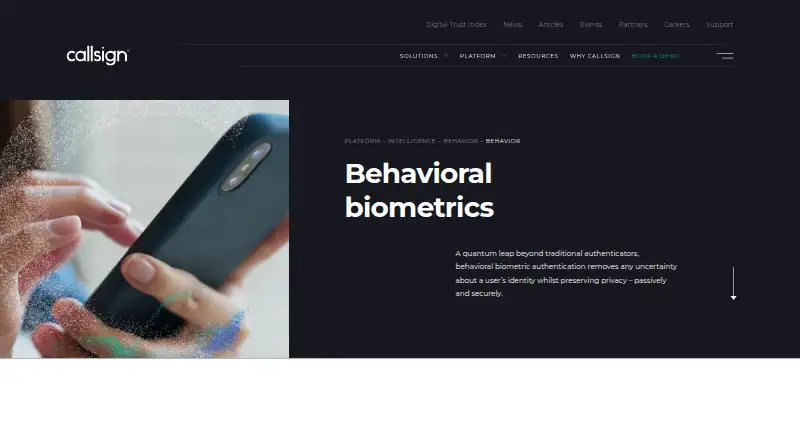
What Callsign Behavioral Biometrics is
Callsign Behavioral Biometrics helps organizations authenticate customers and prevent fraud across digital journeys. It identifies users through behavioral patterns such as typing, PIN entry, swipes, and how they hold a device, with passive authentication intended to reduce interruptions. Keystroke analysis compares typing with learned patterns and adapts as behavior changes. Behavioral PIN authentication considers button timing, pressure, speed, angle, and hand or device movement. Users can also authenticate by swiping away a notification; Callsign says this takes under 100 milliseconds. The Intelligence Engine assesses device, location, behavior, and third-party signals. It can detect malware, bots, jailbroken or tampered devices, and emulators, and can compare a current location with typical behavior. When identity is uncertain, it can request additional authentication and coordinate the next steps. Callsign offers REST APIs and back-end integration, with on-premise or cloud deployment and single-tenant or multi-tenant options. Its listed security measures include TLS in transit, AES-256-bit encryption at rest, and ISO 27001, ISO 27017, ISO 27018, and SOC 2 Type II. Pricing is on request.
Who it suits
It suits organizations seeking behavioral authentication and fraud prevention across digital customer journeys. Its deployment and integration options are intended to support organizations of different sizes.
What it does well
- Analyzes typing, PIN, swipe, and device-handling behavior
- Can detect malware, bots, and tampered devices
- Offers REST APIs and back-end integration
- Supports on-premise and cloud deployment
- Lists TLS, AES-256-bit, and security attestations
What to know first
- Pricing is available only on request
- Step-up authentication may be needed when identity is uncertain
Getting started
- Visit the Callsign Behavioral Biometrics product page.
- Book a demo to discuss the product and pricing.
- Choose an on-premise or cloud deployment and a single-tenant or multi-tenant setup.
- Integrate through REST APIs with back-end systems.
- Contact [email protected] with product-use questions or problems.
Verdict
Callsign combines passive behavioral signals with risk assessment and step-up authentication options. Organizations should request a demo and pricing details to assess fit.
Questions
How much does Callsign Behavioral Biometrics cost?
Pricing is on request. The product page directs visitors to book a demo.
Which platforms does it support?
Listed platforms include web, iOS, Android, Windows, API, and self-hosted deployment.
How can it be deployed?
Callsign offers on-premise or cloud deployment, with single-tenant and multi-tenant options.
What behavioral methods does it use?
It analyzes keystrokes, PIN entry, swipes, and device handling. The listed biometric methods also include facial recognition and fingerprint.
What security certifications and protections does Callsign list?
Callsign lists ISO 27001, ISO 27017, ISO 27018, and SOC 2 Type II. It says data in transit uses TLS and data at rest uses AES-256-bit encryption.
How can customers get help?
Callsign lists [email protected] for questions about using the product or reporting problems.
Facts from Callsign Behavioral Biometrics's own pages
- Authentication orchestration
- Callsign says uncertain users can be routed to step-up authenticators, after which the platform orchestrates their onward journey. · callsign.com, 7 Oct 2026
- Behavioral PIN
- Behavioral PIN authentication analyzes when and how buttons are pressed, including finger pressure, speed, angle, and hand or device movement. · callsign.com, 7 Oct 2026
- Behavioral signals
- Callsign analyzes keystroke dynamics, PIN entry, swipes, and how users hold their devices to help identify them. · callsign.com, 7 Oct 2026
- Compliance
- The behavioral biometrics page calls swipe authentication an EBA-approved, PSD2-compliant inherence factor. · callsign.com, 7 Oct 2026
- Data protection
- Callsign says data in transit is protected with TLS and data at rest with AES-256-bit encryption. · callsign.com, 7 Oct 2026
- Deployment scale
- Callsign offers multi-tenant and single-tenant solutions and says they can scale to organizations of any size. · callsign.com, 7 Oct 2026
- Founded
- 2012 · callsign.com, 28 Sept 2026
- Headquarters
- London, United Kingdom · callsign.com, 28 Sept 2026
- Integration
- The integration page describes REST APIs, back-end system integration, and deployment on-premise or in the cloud. · callsign.com, 7 Oct 2026
- Integration and deployment
- Callsign offers REST APIs and says its solutions can be deployed on-premise or in the cloud and integrated with back-end systems. · callsign.com, 7 Oct 2026
- Intended customers
- Callsign describes its platform as helping organizations authenticate customers and prevent fraud across digital journeys. · callsign.com, 7 Oct 2026
- Keystroke dynamics
- The system compares typing behavior with learned patterns and uses machine learning to adapt as behavior changes. · callsign.com, 7 Oct 2026
- Location signals
- It compares a user's current location with typical behavior and can refuse a request or request additional authentication when they do not align. · callsign.com, 7 Oct 2026
- Passive authentication
- The product describes behavioral biometrics as passive authentication intended to minimize interruptions to the customer journey. · callsign.com, 7 Oct 2026
- Pricing availability
- The product page directs visitors to book a demo and does not state a price. · callsign.com, 7 Oct 2026
- Privacy
- Callsign says its data obfuscation techniques analyze behaviors rather than individuals and that its data collection points are event based. · callsign.com, 7 Oct 2026
- Purpose
- Callsign describes Behavioral Biometrics as passive authentication that identifies users from their behavioral patterns while preserving privacy. · callsign.com, 7 Oct 2026
- Risk signals
- The Intelligence Engine passively analyzes data across device, location, behavior, and third-party systems. · callsign.com, 7 Oct 2026
- Security certifications
- Callsign lists ISO 27001, ISO 27017, ISO 27018, and SOC 2 Type II among its certifications or attestations. · callsign.com, 7 Oct 2026
- Security controls
- The integration page lists adaptable enterprise security policies including IP restriction, mutual authentication, and direct access through a cloud provider. · callsign.com, 7 Oct 2026
- Step-up authentication
- When the user cannot be positively identified, Callsign says users can be routed to step-up authenticators. · callsign.com, 7 Oct 2026
- Support
- Callsign lists customer support at [email protected] for questions about using the product or problems. · callsign.com, 7 Oct 2026
- Swipe authentication
- Callsign says users can authenticate by swiping away a notification, and that authentication takes under 100 milliseconds. · callsign.com, 7 Oct 2026
- Threat detection
- The Intelligence Engine analyzes data across device, location, behavior, and third-party systems to help detect threats including malware, bots, scams, and telecom fraud. · callsign.com, 7 Oct 2026
Where Callsign Behavioral Biometrics stands on Freedom251
- Biometric Authentication Software#28 of 45