Freedom251 › Environment Management

Bunnyshell
What Bunnyshell is
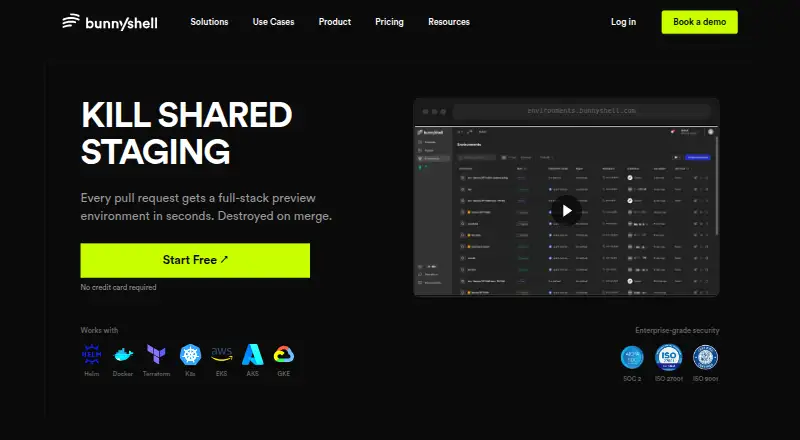
Bunnyshell creates production-like environments for pull requests, giving engineering teams a place to work with changes before they merge. It can create an environment when a pull request opens and remove it when the request merges. One Environment as Code definition can coordinate Docker Compose, Helm charts, Terraform, and Kubernetes manifests. Its listed Git integrations are GitHub, GitLab, Azure DevOps, and Bitbucket, and pull request deployments do not require CI changes. Teams can connect Kubernetes clusters from AWS EKS, Google Cloud GKE, Azure AKS, DigitalOcean, Scaleway, and DT Cloud, or use a managed cluster. Support for private, on-premise, and air-gapped clusters is also listed. Bunnyshell says customer code and data remain in the customer’s infrastructure for its Kubernetes-connected product, and that data is encrypted at rest and in transit using keys managed with Hashicorp Vault. The company lists SOC 2 Type II, ISO 27001, and ISO 9001 certifications. Startup is $0.01 a month, billed at $0.007 per active environment minute. Scaleup and Enterprise use custom pricing; Scaleup requires at least 20 users.
Who it suits
Bunnyshell suits engineering teams, developers, engineering leaders, and platform teams that need pull-request environments and use Kubernetes. Its private-cluster support may fit teams with on-premise or air-gapped infrastructure.
What it does well
- Environments can open and close with pull requests.
- One definition coordinates four infrastructure configuration formats.
- Supports four listed Git providers without CI changes.
- Supports private, on-premise, and air-gapped Kubernetes clusters.
- Startup includes a 14-day trial.
What to know first
- There is no free plan.
- Scaleup requires at least 20 users.
- Scaleup and Enterprise pricing is custom.
- Startup is billed per active environment minute.
Limits
Startup is billed $0.007 per minute per environment, with billing per active environment minute. Scaleup has a 20-user minimum; its price and Enterprise pricing are custom.
Plans
| Plan | Billed and limits | Price |
|---|---|---|
| Startup | $0.007/ min per env; billed per active environment minute · Preview Environments · Sandbox AI Environments · Modern CI/CD · Bring your own cloud | $0.01 a month |
| Enterprise | Custom; contact us for pricing · Everything in Scaleup · Audit log · Support SLA · Dedicated Slack or Teams channel | On request |
| Scaleup | Custom; contact us for pricing · Everything in Startup · DORA Metrics · Cloud Costs Reporting · Advanced RBAC · Minimum 20 users | On request |
As bunnyshell.com lists them, read 8 Oct 2026. The maker's own page has the final word.
Getting started
- Visit https://www.bunnyshell.com/.
- Choose the Startup plan or contact Bunnyshell about custom-priced plans.
- Connect a listed Git provider: GitHub, GitLab, Azure DevOps, or Bitbucket.
- Connect a supported Kubernetes cluster or use a managed cluster.
- Define the environment using Docker Compose, Helm charts, Terraform, and Kubernetes manifests.
Verdict
Bunnyshell brings pull-request environments and Kubernetes options together for engineering teams. Check the per-minute Startup billing and custom-priced plans against your usage and team size.
Questions
Does Bunnyshell have a free plan?
No. Bunnyshell has a paid pricing model and offers a 14-day trial.
How much does Bunnyshell cost?
Startup is $0.01 a month, billed $0.007 per minute per environment, with billing per active environment minute. Scaleup and Enterprise are custom-priced.
Which Git providers does it support?
The listed providers are GitHub, GitLab, Azure DevOps, and Bitbucket. Pull request deployments require no CI changes.
Can I use a private Kubernetes cluster?
Yes. Private, on-premise, and air-gapped Kubernetes clusters are supported.
What platforms are listed?
The listed platforms are API, Linux, self-hosted, and web.
What does Enterprise include?
Enterprise includes the Scaleup features, an audit log, a support SLA, and a dedicated Slack or Teams channel.
Facts from Bunnyshell's own pages
- Automatic environments
- Environments can be created when a pull request opens and destroyed when it merges. · bunnyshell.com, 8 Oct 2026
- Cloud and Kubernetes
- Customers can connect Kubernetes clusters from AWS EKS, Google Cloud GKE, Azure AKS, DigitalOcean, Scaleway, and DT Cloud, or use a managed cluster. · bunnyshell.com, 8 Oct 2026
- Data location
- The company says its Kubernetes-connected product keeps customer code and data in the customer's infrastructure. · bunnyshell.com, 8 Oct 2026
- Data protection
- Bunnyshell says customer data is encrypted at rest and in transit, with encryption keys managed using Hashicorp Vault. · bunnyshell.com, 8 Oct 2026
- Enterprise support
- The Enterprise plan includes a support SLA and a dedicated Slack or Teams channel. · bunnyshell.com, 8 Oct 2026
- Environment as Code
- A single environment definition can coordinate Docker Compose, Helm charts, Terraform, and Kubernetes manifests. · bunnyshell.com, 8 Oct 2026
- Founded
- 2018 · bunnyshell.com, 28 Sept 2026
- Git providers
- The integrations page lists GitHub, GitLab, Azure DevOps, and Bitbucket, with no CI changes required for pull request deployments. · bunnyshell.com, 8 Oct 2026
- Headquarters
- Palo Alto, California, United States · bunnyshell.com, 28 Sept 2026
- Intended users
- Bunnyshell describes its customers as engineering teams, including developers, engineering leaders, and platform teams. · bunnyshell.com, 8 Oct 2026
- Private clusters
- The integrations page says private, on-premise, and air-gapped Kubernetes clusters are supported. · bunnyshell.com, 8 Oct 2026
- Product
- Bunnyshell is an ephemeral environments platform that creates production-like environments for pull requests. · bunnyshell.com, 8 Oct 2026
- Scaleup limit
- The Scaleup plan lists a minimum of 20 users. · bunnyshell.com, 8 Oct 2026
- Security certifications
- Bunnyshell states that it is SOC 2 Type II, ISO 27001, and ISO 9001 certified. · bunnyshell.com, 8 Oct 2026
Where Bunnyshell stands on Freedom251
- Environment Management#12 of 23
- Internal Developer Portals#15 of 27
- Platform Engineering Software#20 of 31
- Cloud Development Environments#18 of 27
- Preview Environment Software#26 of 38