Freedom251 › Tax Research Software

Bizora AI
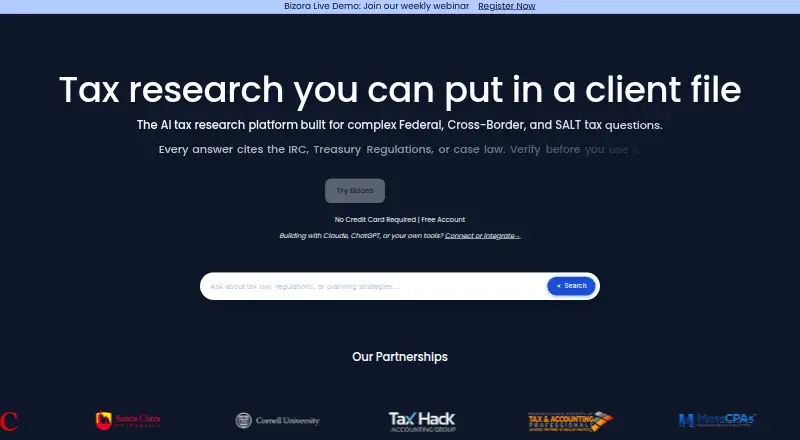
What Bizora AI is
Bizora AI is a tax research assistant that answers complex questions with citations to primary tax authorities. Regular and deep research modes identify the authorities used and explain the reasoning behind answers. Bizora states that its coverage includes U.S. federal tax law, all 50 states, select treaty-partner countries, and OECD and EU VAT frameworks. The Vault works with uploaded client files to summarize documents, extract data, flag differences, and support document-grounded answers. Audit Research covers standards including PCAOB, AICPA, GASB, GAO Yellow Book, FAR, and DFARS. It is available on the web and through API, with a ChatGPT app, Claude connector, and connections to QuickBooks and Xero. Platform subscriptions start at $29.99 per user per month, and a 7-day trial is available; separate prepaid API requests are priced per use. Bizora says customer content is not used to train AI models and describes encryption in transit and at rest. It also says it is working toward SOC 2 security audit readiness.
Who it suits
Bizora lists tax firms, audit and assurance teams, private equity and venture capital firms, in-house tax teams, and software platforms as intended users. It may suit teams that need authority-cited tax research alongside client-document analysis.
What it does well
- Research answers cite primary tax authorities.
- Coverage includes federal law and all 50 states.
- Vault can extract data and flag document differences.
- Connects directly to QuickBooks and Xero.
- Customer content is not used to train AI models.
What to know first
- Select treaty-country coverage expands based on user needs.
- Essential limits several research and document actions daily.
- SOC 2 readiness is still in progress.
Limits
Essential allows 2 deep research, web-search, fast-search, document-upload, and memo or email writer questions per day. It includes unlimited normal AI Assistant questions and Vault access. Pro and Pinnacle list unlimited access to their respective research and document tools.
Plans
| Plan | Billed and limits | Price |
|---|---|---|
| Fast Tax Research API | per request; prepaid credits · one straightforward research question · no monthly minimum · no contract | $0.24, paid once |
| Audit Research API | per request; prepaid credits · PCAOB, AICPA, FASB, GASB, GAO, FAR and related standards · no monthly minimum · no contract | $0.65, paid once |
| Pinnacle | per user, per month · unlimited tax and document research · Audit Research · GAAP/IFRS/GASB/FASB coverage · GAAP-to-IFRS comparison · disclosure checklists · priority SLA · dedicated support · beta access · training | $119.99 a month |
| Deep Tax Research API | per request; prepaid credits · multi-step research across sub-questions · no monthly minimum · no contract | $1.50, paid once |
| Essential | per user, per month · unlimited normal AI Assistant questions · 2 deep research/day · 2 web-search/day · 2 fast-search/day · 2 document uploads/day · 2 memo/email questions/day · unlimited Vault | $29.99 a month |
| Pro | per user, per month · unlimited normal, deep, web-search, fast-search, document, memo/email questions · unlimited Vault | $69.99 a month |
As bizora.ai lists them, read 14 Oct 2026. The maker's own page has the final word.
Getting started
- Open the Bizora website.
- Choose a web platform plan or a prepaid API option.
- Use the 7-day trial for the platform, if appropriate.
- Access the product on the web or through its API.
- Connect QuickBooks or Xero, or use the ChatGPT app or Claude connector, if needed.
Bizora AI is a web-based tax research assistant with document analysis, audit research, and API access. It is best suited to tax and audit teams that need answers tied to authorities and client materials. Its main trade-off is that Essential sharply limits several daily tasks, while international coverage is selective.
Overview
Bizora combines tax research, audit standards research, and client-document workflows, with API options for software teams that want to integrate research into their own applications. Its answers cite primary tax authorities and explain the reasoning behind them, which gives professionals a basis to review rather than a bare response. The product is most compelling for U.S.-centered work; buyers with broader cross-border needs should account for its limited treaty-country coverage.
Key features
Regular and deep research modes show the authorities used and the rationale behind answers. Deep research is designed for questions that require multiple steps, while fast research supports more straightforward lookups. A case law database and current law updates further support ongoing research work. These tools are useful when answers need to be checked against underlying authorities, though the value depends on whether a team’s jurisdictions and research needs fit Bizora’s coverage.
The Vault analyzes uploaded client files, summarizes documents, extracts data, flags differences, and supports document-grounded answers. That makes it useful for teams moving between source documents and tax questions. Essential includes Vault access but caps uploads at two per day; teams processing documents regularly may need Pro or Pinnacle.
Coverage includes U.S. federal tax law, all 50 states, select treaty-partner countries, and OECD and EU VAT frameworks. Treaty coverage expands monthly in response to user needs, but it is not comprehensive global coverage. Audit Research covers standards including PCAOB, AICPA, GASB, GAO Yellow Book, FAR, and DFARS, making the product relevant to audit and assurance teams as well as tax specialists.
Bizora offers a ChatGPT app, a Claude connector, and an OpenAI-compatible API. It also connects directly to QuickBooks and Xero to bring financial data into the platform. The security measures it describes include TLS encryption in transit and AES 256 or equivalent at rest; it says customer content is not used to train AI models and imposes the same restriction on third-party AI providers processing that content. Bizora is working toward SOC 2 security audit readiness, so organizations requiring completed SOC 2 status should weigh that distinction.
Pricing
Essential costs $29.99 a month, billed per user, per month, and includes unlimited normal AI Assistant questions and Vault access. It caps deep research, web-search, fast-search, document uploads, and memo or email writer questions at two per day each. This is the lowest-cost platform plan and may suit occasional use, but the quotas can be restrictive for daily research or document-heavy work.
Pro costs $69.99 a month, billed per user, per month. It removes the stated caps for normal and deep research, web and fast search, audit research, document uploads, memo and email writer questions, and Vault access. It is the more suitable choice for regular professional workloads where Essential’s daily ceilings would interrupt work.
Pinnacle costs $119.99 a month, billed per user, per month. It includes unlimited normal, deep, web, fast, audit, and document research, plus Vault access, priority SLA response, a dedicated support channel, and team training. It is aimed at teams that value a defined support channel and training as well as uncapped usage; those services are the clearest reason to pay more than Pro.
API usage is purchased separately from platform subscriptions, with prepaid credits and no monthly minimum or contract. Fast Tax Research API costs $0.24 per request for one straightforward research question; Audit Research API costs $0.65 per request; and Deep Tax Research API costs $1.50 per request for multi-step research synthesized into one answer. These options suit teams embedding specific research requests without taking a platform subscription, but API credits do not replace platform plans.
A 7-day trial is offered. Support is available to all users by email or Slack; Pinnacle adds a dedicated support channel and priority SLA response.
Platforms
Bizora is available on the web and through an API. Its ChatGPT app and Claude connector offer additional ways to access research capabilities, while QuickBooks and Xero connections bring accounting data into the platform.
Who it's for
Tax firms and in-house tax teams are the natural fit when they need cited research, current law updates, and answers grounded in client documents. Audit and assurance teams can use its standards research, while private equity and venture capital firms may find it relevant for tax work. Software platforms have a separate API route for adding research capabilities to their own applications.
It is a weaker fit for teams that need extensive coverage beyond the United States and stated frameworks, or for users whose workload makes Essential’s two-per-day limits impractical but whose budget does not stretch to Pro.
Pros and cons
- Pros: Research answers cite primary authorities and expose their reasoning, supporting review of complex tax questions.
- Pros: The Vault combines document summaries, data extraction, difference flagging, and document-grounded answers in the research workflow.
- Pros: Pro and Pinnacle remove the stated daily usage caps, and the API has prepaid, per-request options without a monthly commitment.
- Cons: Essential limits several research and document tasks to two per day, which can be a poor match for sustained professional use.
- Cons: Treaty-country coverage is selective rather than a guarantee of broad international reach.
- Cons: Bizora is still working toward SOC 2 readiness, which may matter to organizations with formal compliance requirements.
Alternatives
For a broader selection of products in the category, browse Tax Research Software.
FinRace AI is a freemium option with a free plan and support across mobile, desktop, and web platforms; consider it if platform breadth and a free starting point matter more than Bizora’s stated tax-research and audit capabilities.
Instead offers a free platform with unlimited users, entities, e-file and print file, plus multi-entity support and collaborators; choose it when those workflows are the priority.
TaxPlead has a free plan with daily AI tokens and limited research tasks, alongside basic GST and Income Tax research; it may suit readers seeking a free entry point for those tax areas.
LEXinform is another tax-information option, including a DATEV Basis-Angebot Zusatzmodul LEXinform comfort plan at €14.80 a month for DATEV Basis-Angebot users.
Croner-i Tax is an alternative tax product with package options available on request.
Taxsutra is another paid, web-based tax product.
Bloomberg Tax offers paid web products spanning areas such as tax research, workpapers, fixed assets, and tax planning; consider it when those product areas match your needs.
Tax Analysts Research offers customized subscriptions tailored to organization type and materials needed, making it an option for buyers seeking a tailored package.
Verdict
Choose Bizora AI if your team needs citation-backed tax research tied to client documents, audit standards, or accounting data, and especially if Pro’s uncapped usage or its API fits your workload. Essential is a reasonable starting point for light use, but its two-per-day limits are a real constraint; look elsewhere if broad international coverage or completed SOC 2 status is essential.
Verdict
Bizora brings tax research, document analysis, and audit standards into a web and API offering. Review the daily limits on Essential and the stated coverage boundaries when choosing a plan.
Questions
How much does Bizora cost?
The Essential plan is $29.99 per user per month, Pro is $69.99 per user per month, and Pinnacle is $119.99 per user per month. Separate prepaid API options cost $0.24 per fast tax research request, $0.65 per audit research request, and $1.50 per deep tax research request.
Is there a free plan or trial?
No. Bizora has no free plan; it offers a 7-day free trial of its platform subscriptions, with no credit card required.
Which platforms does Bizora support?
Bizora is available on the web and through an API. It also offers a ChatGPT app and a Claude connector.
What does Bizora integrate with?
Bizora says it connects directly to QuickBooks and Xero. It also offers an OpenAI-compatible API, a ChatGPT app, and a Claude connector.
Who makes Bizora, and where is it based?
Bizora is headquartered in Irvine, California, United States.
Does Bizora train AI models on customer content?
Bizora says it does not use customer content to train AI models and requires third-party AI providers processing customer data on its behalf not to use it for training.
Facts from Bizora AI's own pages
- Accounting integrations
- Direct integrations are offered for QuickBooks Online and Xero to import financial data. · bizora.ai, 14 Oct 2026
- AI data use
- Bizora says it does not use customer content to train AI models and requires third-party AI providers processing customer data on its behalf not to use it for model training. · bizora.ai, 8 Oct 2026
- AI training data
- Bizora says it does not use customer prompts, responses, documents or accounting data to train AI models. · bizora.ai, 14 Oct 2026
- API
- The developer API is a REST interface designed to be OpenAI-compatible, with streaming, research and document-analysis capabilities. · bizora.ai, 14 Oct 2026
- Audit Research
- Audit Research routes questions to standards including FASB, PCAOB, GASB, AICPA and GAO Yellow Book guidance. · bizora.ai, 14 Oct 2026
- Canvas
- Canvas turns research into structured tax memos and client emails while retaining source links. · bizora.ai, 14 Oct 2026
- Company headquarters
- Crunchbase places Bizora AI in Irvine, California, United States. · crunchbase.com, 14 Oct 2026
- Company legal name
- Crunchbase lists the legal name as Bizora Inc. · crunchbase.com, 14 Oct 2026
- Company size
- LinkedIn lists Bizora at 2–10 employees. · linkedin.com, 14 Oct 2026
- Compliance status
- Bizora says it is actively working toward SOC 2 security audit readiness. · bizora.ai, 8 Oct 2026
- Coverage
- Bizora states it covers U.S. federal tax law, all 50 states, select treaty-partner countries, and OECD and EU VAT frameworks. · bizora.ai, 8 Oct 2026
- Data deletion
- Customers can delete stored documents; residual encrypted backup copies may remain until the backup retention period ends. · bizora.ai, 14 Oct 2026
- Deep research
- Deep mode decomposes complex questions, consults multiple authorities, and produces a reasoned synthesis. · bizora.ai, 14 Oct 2026
- Document formats
- The product accepts Word, PDF, Excel, CSV, JPG and PNG files. · bizora.ai, 14 Oct 2026
- Document workspace
- The Vault can analyze uploaded client files, summarize documents, extract data, flag differences, and support document-grounded answers. · bizora.ai, 8 Oct 2026
- Founded
- LinkedIn lists the company as founded in 2024. · linkedin.com, 14 Oct 2026
- Funding
- Crunchbase records one pre-seed round and names LvlUp Ventures as the investor, while withholding the amount. · crunchbase.com, 14 Oct 2026
- Headquarters
- Irvine, California, United States · bizora.ai, 28 Sept 2026
- Installation
- The official Claude connector setup requires no downloads or local installation. · bizora.ai, 14 Oct 2026
- Integrations
- Bizora offers a ChatGPT app, a Claude connector, and an OpenAI-compatible API for integrating research capabilities into other applications. · bizora.ai, 8 Oct 2026
- Intended users
- Bizora lists tax firms, audit and assurance teams, private equity and venture capital firms, in-house tax teams, and software platforms among its target users. · bizora.ai, 8 Oct 2026
- Limit: not a return-preparation tool
- An independent directory describes Bizora as research software rather than a product that prepares tax returns. · curatesuite.com, 14 Oct 2026
- Limit: no tax preparation integration
- Bizora's comparison guide says it does not integrate with UltraTax CS, Lacerte, Drake or CCH Axcess tax-preparation software. · bizora.ai, 14 Oct 2026
- MCP and assistants
- Bizora can be connected through the ChatGPT App Directory, Claude Connector Directory and supported MCP integrations. · bizora.ai, 14 Oct 2026
Where Bizora AI stands on Freedom251
- Tax Research Software#5 of 31