Freedom251 › Minecraft Moderation Plugins

BanManager
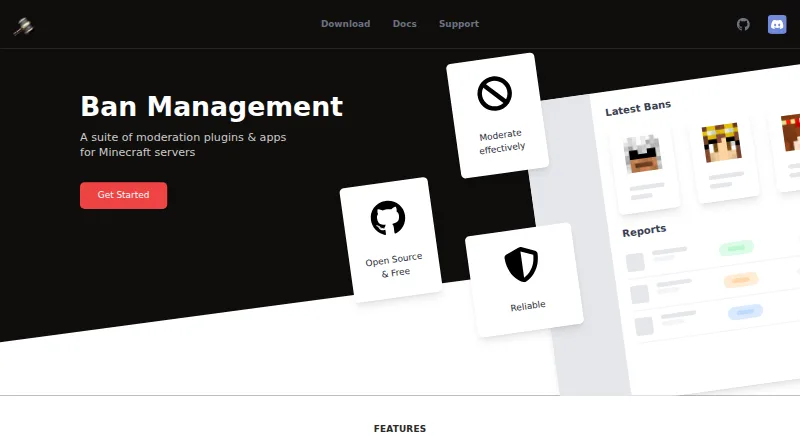
What BanManager is
BanManager is a free, open-source suite of moderation plugins and apps for Minecraft servers. Staff can issue bans, IP blocks and mutes, block profane names, and moderate chat, including by shadow muting. Players can submit behavior reports while staff are offline; staff can later review and resolve them. Configurable warning thresholds can trigger increasingly severe commands. Staff can add notes and inspect player records, including unbans and the staff member who issued them. Downloads are listed for Bukkit variants such as CraftBukkit, Spigot and Paper, as well as BungeeCord, Fabric, Sponge and Velocity. Data can be stored locally in H2 or remotely in MySQL or MariaDB. An optional self-hosted WebUI adds appeals, reports, role-based permissions and a dashboard for one or more servers. That interface requires BanManager-WebEnhancer and MySQL 5+ or MariaDB 10+; it does not support the default H2 database. Its setup page is initially unauthenticated, so the documentation recommends a setup token before internet exposure. A developer API lets plugins access punishment data and receive change events.
Who it suits
BanManager suits Minecraft server staff who need player moderation, reports, warnings and staff records. The self-hosted WebUI may suit teams managing appeals and reports across one or more servers.
What it does well
- Supports bans, IP blocks, mutes and name filtering.
- Players can report behavior while staff are offline.
- Warning thresholds can trigger commands with increasing severity.
- Supports local H2 and remote MySQL or MariaDB.
- Developer API exposes punishment data and change events.
What to know first
- The WebUI requires BanManager-WebEnhancer.
- The WebUI needs MySQL 5+ or MariaDB 10+.
- The WebUI does not support default H2 storage.
- The WebUI setup page is initially unauthenticated.
Limits
BanManager is free. The WebUI requires BanManager-WebEnhancer and MySQL 5+ or MariaDB 10+; the default H2 database is unsupported. Cross-server punishment checks run every 30 seconds for local punishments and every two minutes for global punishments by default, and more frequent checks increase database use.
Getting started
- Visit the BanManager website.
- Choose the download for your server platform: Bukkit, BungeeCord, Fabric, Sponge, or Velocity.
- Choose local H2 storage or remote MySQL or MariaDB storage.
- For the WebUI, configure BanManager-WebEnhancer and MySQL 5+ or MariaDB 10+.
- Set a SETUP_TOKEN before exposing the WebUI installer to the internet.
Overview
BanManager is a free, open-source moderation suite for Minecraft server teams that need more than a basic ban command. Its range of punishment, reporting, and staff-record tools makes it a strong fit for active communities; the optional WebUI adds useful staff workflows but requires a separate database and careful setup.
Server operators can use local H2 storage or connect to MySQL or MariaDB, including to share moderation data. That gives smaller setups a simpler storage option, while teams planning to use the WebUI need to account for its database requirement from the outset.
Explore the Minecraft Moderation Plugins category for other tools in this space.
Key features
Punishments and chat moderation
Moderators can issue bans, block IP addresses, mute players, and prevent profane names. BanManager can also mute chat spammers, including through shadow muting. This breadth gives staff several ways to respond to disruptive behavior without limiting moderation to permanent or public sanctions.
Reports, warnings, and staff records
Players can submit reports while staff are offline, so incidents need not be handled in real time. Staff can later track and resolve those reports. Warnings can trigger configured commands after a chosen count, with increasingly severe responses; that gives teams a way to make escalation consistent, provided they decide in advance what each threshold should do.
Staff can add notes and inspect a player's record, including unbans and who issued them. That history is useful when multiple moderators share responsibility and need context before acting.
WebUI and integrations
The self-hosted WebUI brings appeals, reports, role-based permissions, and a dashboard for one or more servers into a browser interface. It is the clearest reason to choose BanManager over a plugin-only setup, but it is not a plug-and-play extra: it requires BanManager-WebEnhancer and MySQL 5+ or MariaDB 10+, and does not support the default H2 database.
The browser installer is initially unauthenticated, so operators should set a SETUP_TOKEN before making it reachable from the internet. The WebUI uses a 64-character hexadecimal ENCRYPTION_KEY to encrypt stored BanManager database passwords. The developer API also lets other plugins read and change punishment data and receive punishment-change events, which can help custom integrations.
Server coverage and synchronization
Downloads cover Bukkit servers including CraftBukkit, Spigot, and Paper, as well as BungeeCord, Fabric, Sponge, and Velocity. Local punishments are checked every 30 seconds and global punishments every two minutes by default; shortening those intervals increases database use. Teams should weigh faster cross-server updates against the extra database load.
Pricing
BanManager is free and open source, with no paid plan or free trial. That keeps the core moderation tools accessible without a subscription, though teams that want the WebUI still need to provide the required database and configure the installation themselves.
Platforms
BanManager is available for Linux, web, and self-hosted environments, with an API for integrations. Its server downloads span Bukkit (CraftBukkit, Spigot, and Paper), BungeeCord, Fabric, Sponge, and Velocity. The WebUI is self-hosted rather than a hosted service.
Who it's for
BanManager suits Minecraft communities that want a broad moderation toolkit, especially teams handling reports and staff decisions across multiple servers. The local H2 option can suit an operator who only needs the server-side tools; teams needing the WebUI should be comfortable managing MySQL or MariaDB and securing the setup. It is a weaker fit for anyone seeking a managed staff panel or unwilling to take responsibility for database and installation security.
Pros and cons
Pros
- Broad moderation coverage: punishments, chat muting, reports, warnings, and staff notes address distinct parts of day-to-day server moderation.
- Flexible data setup: local H2 keeps the core option open, while MySQL or MariaDB supports shared data and the WebUI.
- Useful staff context: player records include unbans and the staff member responsible, helping moderators understand prior decisions.
- Wide server-platform reach: downloads cover several server and proxy ecosystems, including Bukkit, Fabric, Sponge, and Velocity.
Cons
- The WebUI adds infrastructure work: it needs BanManager-WebEnhancer and MySQL 5+ or MariaDB 10+, ruling out H2 for that use.
- Internet exposure needs care: the installer starts unauthenticated, so operators must set a setup token before exposing it.
- Faster synchronization costs more database activity: teams tuning update intervals must balance responsiveness against database use.
Alternatives
Choose ModGUI if you want a free, MIT-licensed option for Paper 1.21.11 or newer and do not need BanManager's stated server-platform breadth. LibertyBans is another free, self-hosted choice for teams comfortable with Java 17 and its supported Minecraft server platforms.
Nimbus AntiCheat is a free, self-hosted option focused on anti-cheat, with Paper 1.21.8, Java 21, PacketEvents, and Java-edition player requirements. Consider Staff+ for a free MIT-licensed option covering Paper, Purpur, or Folia 1.20–1.21+ and Velocity 3.3.0+.
PunishBAN is another free, self-hosted alternative. ReducedX-Anti Cheat is a free, self-hosted option. PunishmentsSystem is a free alternative. ChatSentinel is a free option for self-hosted use.
Verdict
Choose BanManager if your Minecraft team wants a free, open-source system spanning punishments, reports, warnings, and staff records across a broad range of server platforms. Its strongest case is the combination of those workflows with an optional multi-server WebUI; look elsewhere if you need a managed panel or cannot take on the WebUI's database and security setup.
Verdict
BanManager covers common Minecraft moderation workflows, with a separate self-hosted WebUI for appeals and staff permissions. Teams considering that interface should account for its database requirements and secure its setup before internet exposure.
Questions
How much does BanManager cost?
BanManager is free.
Is BanManager open source?
Yes. The maker describes it as open source and welcomes contributions.
Which server platforms are supported?
Downloads are listed for Bukkit (CraftBukkit, Spigot, and Paper), BungeeCord, Fabric, Sponge, and Velocity.
What database can I use?
BanManager supports local H2 storage and remote MySQL or MariaDB storage. The WebUI requires MySQL 5+ or MariaDB 10+ and does not support the default H2 database.
What does the WebUI add?
The self-hosted WebUI adds appeals, reports, role-based permissions, and a dashboard for one or more servers.
Where can I get support?
The maker directs users to Discord, GitHub discussions, and the FAQ for help and feature requests.
Facts from BanManager's own pages
- Chat moderation
- It can mute players who spam chat, including through shadow muting. · banmanagement.com, 29 Sept 2026
- Credential protection
- The WebUI uses a 64-character hex ENCRYPTION_KEY to encrypt stored BanManager database passwords. · banmanagement.com, 28 Sept 2026
- Cross-server sync
- The FAQ says local punishments are checked every 30 seconds and global punishments every two minutes by default; more frequent checks increase database use. · banmanagement.com, 28 Sept 2026
- Customization
- Messages can be customized with color codes and JSON messages. · banmanagement.com, 29 Sept 2026
- Database options
- BanManager supports local H2 storage and remote MySQL or MariaDB storage. · banmanagement.com, 28 Sept 2026
- Data storage
- BanManager supports local H2 storage and remote MySQL or MariaDB storage for sharing data or using the WebUI. · banmanagement.com, 29 Sept 2026
- Developer API
- The developer API lets other plugins read and modify punishment data and provides events for punishment changes. · banmanagement.com, 29 Sept 2026
- Maker
- The site credits James Mortemore and displays a 2012–2026 copyright; it does not state a headquarters or founding year. · banmanagement.com, 29 Sept 2026
- Open source
- The maker describes BanManager as open source and welcomes contributions. · banmanagement.com, 28 Sept 2026
- Price
- The maker describes BanManager as open source and free. · banmanagement.com, 29 Sept 2026
- Product
- BanManager is a suite of moderation plugins and apps for Minecraft servers. · banmanagement.com, 29 Sept 2026
- Punishments
- It supports player and IP bans and prevents profane names from joining servers. · banmanagement.com, 29 Sept 2026
- Purpose
- BanManager is a suite of moderation plugins and apps for Minecraft servers. · banmanagement.com, 28 Sept 2026
- Reports
- Players can report behavior while staff are offline, and staff can track and resolve reports later. · banmanagement.com, 28 Sept 2026
- Reports and warnings
- Players can report behavior while staff are offline, and warnings can trigger increasingly severe commands after a configured threshold. · banmanagement.com, 29 Sept 2026
- Security configuration
- The WebUI documentation says the browser installer is unauthenticated by default and recommends setting SETUP_TOKEN on internet-reachable hosts. · banmanagement.com, 28 Sept 2026
- Security setup
- The WebUI Docker guide says its setup page is initially open and recommends setting a SETUP_TOKEN before exposing an install to the internet. · banmanagement.com, 29 Sept 2026
- Server platforms
- Downloads are listed for Bukkit (CraftBukkit, Spigot, Paper), BungeeCord, Fabric, Sponge, and Velocity. · banmanagement.com, 29 Sept 2026
- Staff records
- Staff can add notes and view a player's record, including unbans and who issued them. · banmanagement.com, 29 Sept 2026
- Support
- The maker directs users to its Discord, GitHub discussions, and FAQ for support and feature requests. · banmanagement.com, 29 Sept 2026
- Supported server platforms
- Downloads are listed for Bukkit (CraftBukkit, Spigot, Paper), BungeeCord, Fabric, Sponge, and Velocity. · banmanagement.com, 28 Sept 2026
- Warnings
- The warning system can automatically issue commands after a configured number of warnings, with increasing severity. · banmanagement.com, 28 Sept 2026
- Web dashboard
- The self-hosted WebUI supports appeals, reports, role-based permissions, and a dashboard for one or more servers. · banmanagement.com, 29 Sept 2026
- Web interface
- The self-hosted WebUI adds appeals, reports, role-based permissions, and a dashboard for one or more servers. · banmanagement.com, 28 Sept 2026
Where BanManager stands on Freedom251
- Minecraft Moderation Plugins#1 of 19