Freedom251 › Application Lifecycle & Release Management
Azure Orkestra
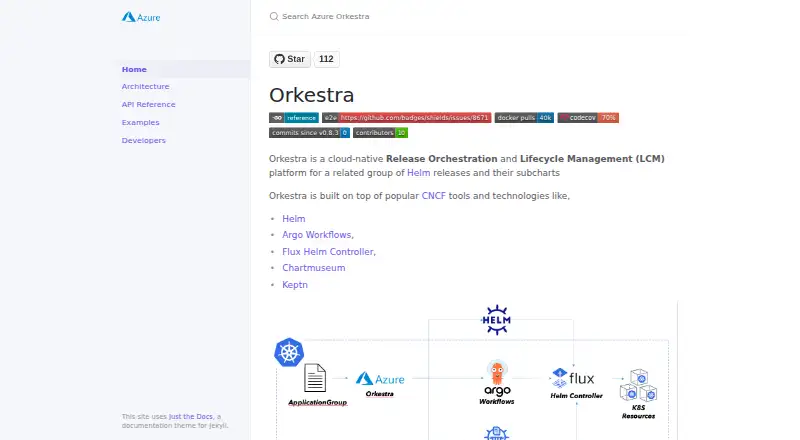
What Azure Orkestra is
Azure Orkestra is a free, open-source, self-hosted platform for coordinating related Helm releases and their subcharts on Kubernetes. It uses Argo Workflows to create dependency-based, DAG workflows that define conditions between releases. Its ApplicationGroup custom resource groups releases and subcharts into one orchestrated deployment, while layer management handles Kubernetes addon layers and their dependencies. During in-service upgrades, Orkestra can fail fast so affected components are isolated, then restore the last successful specification when an upgrade fails. A Keptn executor can check releases against service-level objectives and indicators before deployment or updates. Application definitions can be declarative and version controlled, and deployments can use systems such as FluxCD or ArgoCD. Installation requires Kubernetes, kubectl, Helm, and the Argo CLI; documented cluster examples include AKS, GKE, EKS, Kind, and Minikube. One documented use case is coordinating interdependent 5G network functions and foundational services.
Who it suits
It suits teams managing dependent Helm releases, Kubernetes layers, and automated upgrade workflows. It is also relevant to organizations using GitOps delivery or evaluating releases against SLOs and SLIs.
What it does well
- Free and open source
- Coordinates Helm release dependencies
- Supports rollback after upgrade failures
- Works with FluxCD and ArgoCD
- Evaluates releases against SLOs and SLIs
What to know first
- Requires a Kubernetes cluster
- Requires kubectl, Helm, and Argo CLI
- Self-hosted deployment
- Documented benign monitoring issue on repeated submissions
Limits
Orkestra is self-hosted and requires a Kubernetes cluster, kubectl, Helm, and the Argo CLI. The documentation notes a benign “monitoring failed” issue when an ApplicationGroup is submitted multiple times.
Getting started
- Open the Azure Orkestra website
- Prepare a Kubernetes cluster such as AKS, GKE, EKS, Kind, or Minikube
- Install kubectl, Helm, and the Argo CLI
- Install Orkestra on the cluster
- Define releases and subcharts with an ApplicationGroup
- Connect declarative definitions to FluxCD or ArgoCD if desired
Verdict
Azure Orkestra focuses on dependency-aware Helm orchestration across Kubernetes releases and layers. Its rollback handling, GitOps compatibility, and release evaluation are useful for complex deployments, but installation requires several Kubernetes tools.
Questions
Is Azure Orkestra free?
Yes. It is listed as free and open source.
Where does Azure Orkestra run?
It runs self-hosted on Kubernetes.
Which deployment tools does it integrate with?
The project lists Helm, Argo Workflows, Flux Helm Controller, ChartMuseum, Keptn, FluxCD, Argo CD, and Kubernetes.
Can it roll back failed upgrades?
During an in-service upgrade failure, it can roll back to the last successful specification.
What is required to install it?
You need a Kubernetes cluster, kubectl, Helm, and the Argo CLI.
Facts from Azure Orkestra's own pages
- ApplicationGroup
- Its ApplicationGroup custom resource groups releases and subcharts into an orchestrated deployment workflow. · azure.github.io, 9 Oct 2026
- Community support
- The project points users to GitHub issues and pull requests and an Azure Orkestra Slack community. · azure.github.io, 10 Oct 2026
- Deployment requirements
- Installation requires a Kubernetes cluster, kubectl, Helm, and the Argo CLI; the documentation lists AKS, GKE, EKS, Kind, and Minikube as cluster examples. · azure.github.io, 9 Oct 2026
- Failure recovery
- On failures during in-service upgrades, it can roll back to the last successful spec. · azure.github.io, 10 Oct 2026
- GitOps and CD
- It uses declarative Kubernetes custom resources and supports Kubernetes-compatible deployment frameworks such as FluxCD and ArgoCD. · azure.github.io, 10 Oct 2026
- Integrations
- The project lists Helm, Argo Workflows, Flux Helm Controller, ChartMuseum, and Keptn among its underlying tools. · azure.github.io, 9 Oct 2026
- Keptn evaluation
- Its Keptn executor can evaluate releases against SLOs and SLIs before deployment or update. · azure.github.io, 9 Oct 2026
- Known issue
- The documentation notes a benign “monitoring failed” issue when an ApplicationGroup is submitted multiple times. · azure.github.io, 9 Oct 2026
- Layer management
- It can deploy and manage layers on Kubernetes, with dependencies between layers. · azure.github.io, 10 Oct 2026
- Layers
- It can deploy and manage Kubernetes layers made up of addons, with dependencies between layers. · azure.github.io, 9 Oct 2026
- Purpose
- Orkestra is a cloud-native release orchestration and lifecycle management platform for related Helm releases and their subcharts. · azure.github.io, 10 Oct 2026
- Release evaluation
- Its Keptn executor can evaluate releases against SLOs and SLIs before deployment or update. · azure.github.io, 10 Oct 2026
- Requirements
- Installation requires a Kubernetes cluster, kubectl, Helm, and the Argo CLI; documented cluster options include AKS, GKE, EKS, Kind, and Minikube. · github.com, 10 Oct 2026
- Security reporting
- The security policy asks users not to report vulnerabilities through public GitHub issues and directs them to MSRC or [email protected]. · github.com, 10 Oct 2026
- Technology integrations
- The project lists Helm, Argo Workflows, Flux Helm Controller, ChartMuseum, and Keptn among the tools it is built on. · azure.github.io, 10 Oct 2026
- Upgrade handling
- During in-service upgrades, it aims to fail fast and limit failures to immediately impacted components. · azure.github.io, 10 Oct 2026
- Use case
- The project describes coordinating 5G network functions whose deployment depends on foundational services such as a service mesh, OPA, or Cert Manager. · azure.github.io, 10 Oct 2026
- Workflow engine
- It uses Argo Workflows to build DAG-based workflows that coordinate Helm releases and their dependencies. · azure.github.io, 10 Oct 2026
- Workflow orchestration
- It uses Argo Workflows to build DAG-based workflows that define dependencies and conditions between Helm releases. · azure.github.io, 9 Oct 2026
Where Azure Orkestra stands on Freedom251
- Application Lifecycle & Release Management#9 of 21
- IT Release Management Software#28 of 42
- Release Orchestration Software#20 of 29