Freedom251 › Podcast Show Notes Software
AutoShow
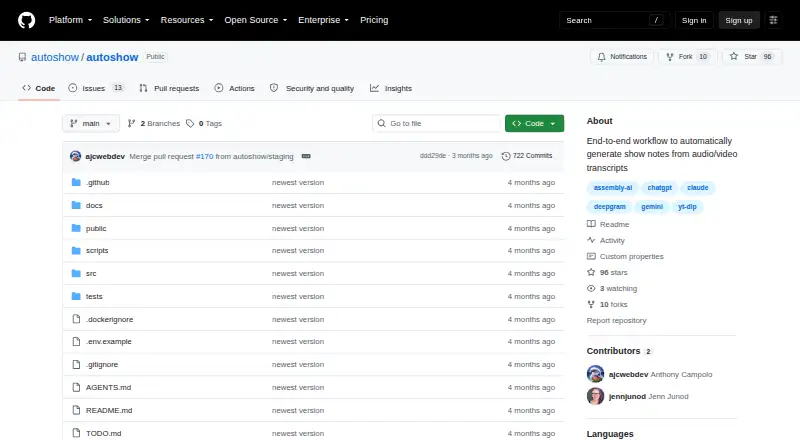
What AutoShow is
AutoShow is a free, open-source application for processing audio and video through transcription, summarization, speech, image, and music generation. It can extract audio from YouTube videos and streaming platforms, or accept direct file uploads. Transcription options include Groq Whisper, DeepInfra, YouTube Captions, and HappyScribe, with automatic speaker diarization. OpenAI GPT, Claude, and Google Gemini models can create episode descriptions, summaries, and chapters. For generated media, AutoShow offers text-to-speech with OpenAI or ElevenLabs voices, AI-generated cover images, and background music generation with ElevenLabs.
AutoShow provides a web interface, an API, and a self-hosted deployment option. Docker deployment is supported, and the local web interface uses localhost:4321 by default. Its API covers health checks, jobs, models, processing, file uploads, and media processing. Production features include source URL validation against a public-network SSRF guard and USD cost estimates before jobs are created. The project also describes structured production JSON logs with request IDs and severity levels, with optional forwarding to an HTTP log drain. Optional configuration checks cover Resend email and Google Drive; Google Drive OAuth client setup is manual. The project is MIT-licensed, and its package metadata names Anthony Campolo as author.
Who it suits
AutoShow suits people who want to turn audio or video into transcripts, summaries, chapters, or generated media, and who can use its web, API, or self-hosted deployment options. It may also fit teams that need documented production URL checks, cost estimates, and structured logs.
What it does well
- Free and open source under the MIT license.
- Accepts direct uploads and extracts audio from YouTube and streaming platforms.
- Offers transcription with automatic speaker diarization.
- Generates summaries, episode descriptions, and chapters.
- Supports Docker deployment and a local web interface.
What to know first
- Google Drive OAuth client setup is manual.
- Docker Compose requires email, provider-key, and S3 settings in the root .env file.
Getting started
- Open the AutoShow project website on GitHub.
- Choose the web interface, API, or self-hosted deployment route.
- For Docker deployment, add the required email, provider-key, and S3 settings to the repository-root .env file.
- Serve the local web interface and open localhost:4321.
- Configure model providers and any optional Resend email or Google Drive checks; set up Google Drive OAuth manually.
Verdict
Choose AutoShow if you need an open-source audio and video workflow that combines transcription, summaries, and generated media. Its self-hosted and API options suit configurable deployments; Google Drive OAuth setup requires manual configuration.
Questions
Is AutoShow free?
Yes. AutoShow is free and open source under the MIT license.
Which platforms does AutoShow support?
It is available as a web interface, API, and self-hosted project. Docker deployment is supported.
Can AutoShow transcribe audio automatically?
Yes. Listed transcription options include Groq Whisper, DeepInfra, YouTube Captions, and HappyScribe, with automatic speaker diarization.
What can AutoShow generate?
It can generate episode descriptions, summaries, chapters, text-to-speech, cover images, and background music.
Who is named as AutoShow's author?
The package metadata identifies Anthony Campolo as the project author.
Facts from AutoShow's own pages
- API
- The project documents an HTTP API with its local base URL at http://localhost:4321/api and says to use the deployment domain in production. · github.com, 8 Oct 2026
- Configuration
- The configuration guide documents optional Resend email and Google Drive setup checks. · github.com, 8 Oct 2026
- Costs
- The README links to documentation covering provider cost estimates and runtime totals. · github.com, 8 Oct 2026
- Deployment
- The README documents Docker deployment and a web interface available at the local URL printed by the CLI, defaulting to localhost:4321. · github.com, 8 Oct 2026
- Docker requirements
- The Docker guide says the repository-root .env file must include required email, provider-key, and S3 settings for the documented Compose commands. · github.com, 8 Oct 2026
- Generated media
- The README describes converting summaries to speech with OpenAI or ElevenLabs voices, creating cover images from AI prompts, and generating background music with ElevenLabs. · github.com, 8 Oct 2026
- Google Drive setup
- The guide says Google Drive OAuth client setup remains manual because the web client flow is not reliably covered by gcloud. · github.com, 8 Oct 2026
- Inputs
- It can extract audio from YouTube videos, streaming platforms, and direct file uploads. · github.com, 8 Oct 2026
- Integrations
- The model configuration documentation lists integrations including OpenAI, Anthropic, Google Gemini, Groq, ElevenLabs, AssemblyAI, Deepgram, HappyScribe, Mistral, Runway, and YouTube Captions. · github.com, 4 Oct 2026
- License
- The package metadata identifies the project author as Anthony Campolo and its license as MIT. · github.com, 4 Oct 2026
- Logging
- The README lists structured production JSON logs with request IDs and severity levels, plus optional HTTP log drain forwarding. · github.com, 4 Oct 2026
- Maker
- The repository is hosted under the GitHub organization autoshow; the pages reviewed do not state the maker's headquarters or founding year. · github.com, 8 Oct 2026
- Proxy configuration
- The configuration guide documents an option to trust forwarded proxy IP headers and a shared token required before those headers are trusted. · github.com, 8 Oct 2026
- Purpose
- AutoShow is a full-stack application for processing video and audio with AI transcription, summarization, text-to-speech, image generation, and music generation. · github.com, 8 Oct 2026
- Security
- The model configuration documentation says production model execution uses source URL validation against a public-network SSRF guard and USD cost estimation before job creation. · github.com, 4 Oct 2026
- Summarization
- OpenAI GPT, Claude, and Google Gemini models can generate episode descriptions, summaries, and chapters. · github.com, 8 Oct 2026
- Transcription
- Listed transcription options include Groq Whisper, DeepInfra, YouTube Captions, and HappyScribe, with automatic speaker diarization. · github.com, 8 Oct 2026
Where AutoShow stands on Freedom251
- Podcast Show Notes Software#21 of 22